I’m having issues. I’m trying to find the will of my fourth-great-grandfather, Heinrich “Henry” Ritchey who died in Bedford County, Pennsylvania in 1849. The only trouble is I can’t seem to find his will. I’ve looked through the probate records and the only Henry Ritchey was a different Henry Ritchey who died in 1856 (I was hopeful when I requested his will that it was MY Henry Ritchey who just took a long time for his estate to be settled, but alas, it was a different Henry).
So I then began trying to find records in the Orphan’s Court – but I’ve been unsuccessful there as well, looking at the index of the records on FamilySearch and also being led from the FamilySearch Wiki to the Bedford County Historical Society’s index and they don’t have a Henry Ritchey listed either.
So where is Henry?
I’m sure you wonder why is it so important that I find the will of Henry Ritchey? Easy, I have no documentation that states who the parents of my third-great-grandfather, George Ritchey are. I’m rather hopeful that I will find a will and it will state who his children are. I could only be so lucky for him to name everyone (which I’ll admit if he died intestate I had better chances of finding everyone).
So I’m at a loss. My guess is to look in surrounding counties, despite his living in Hopewell, Bedford, Pennsylvania – I suppose he may not have died there after all. Getting down to the nitty-gritty of researching can be hard and frustrating – but sadly, in the end, I know it will be worth it.
A screenshot of my profile of Henry Ritchey and his wife, Catherine Strickler. The children listed are who I have pieced together so far – other sites have more listed – but for some reason I am more limited but still realize I have no true blue documentation of those I have.
I’ve searched Newspapers.com and NewspaperArchive.com (PA edition through my Genealogical Society of Pennsylvania subscription) with no luck. If I didn’t have a date of death I’d swear Henry is hanging with Andrew and Suzanna. (Insert laughing emoji here).
If you have any suggestions for me as I try to gather more pre-1850 information on my 3rd-great-grandfather, George Ritchey to tie him together with who I think is my 4th-great-grandfather, Henry Ritchey – by all means I am open to suggestions. I will continue to do the FAN Club and look up information on others who I believe are Henry’s children (the youngest child that I have for Henry and his wife Catherine was John Ritchey and he died in 1913 so there is a death certificate for him, and though it’s secondary information, Henry and Catherine are noted as his parents… so that’s something). Deep breaths and baby steps. I’ll get there.
Each year in the back of my mind I try to have some sort of goal for the next year. Any goals I had for this past calendar year I know I fell short as I feel as if I didn’t spend any time really working on my own family tree, but I do hope to change that in the coming year.
So here are my goals for 2024.
5) Make Some Headway with my Family Tree
This past year I have met a distant cousin because of this blog and our goal is to try to find out more about our shared 6th-great-grandfather, Philip Morgart. We know he is the father to Peter, but who are his other children? Who are his parents? We want to know!
And let us not forget Andrew Blair and Suzanna Akers – they are always in my thoughts and maybe this will be the year that I chip away at that brick wall (I can only hope).
4) Clean Up my Software
I am not always as good about entering my supporting information into my Legacy Family Tree software so I’m going to try to do better about filling in the missing pieces of information for all the many people in my family tree. Some may say why? But I work so hard to have an accurate tree, and if I don’t have the sources connected to my ancestors, then it could look like I’ve just plopped information into my program and not truly done the research.
3) Create a Locality Guide for Bedford County, Pennsylvania
With so many of my ancestors being in the vicinity of Bedford County, Pennsylvania, I’m going to work on creating a locality guide for this area of the world. For all I know one could already exist out there – if it does I really haven’t seen one, so this would be a helpful tool for me in my continued research.
2) Finish my NGS “Family Foundations” Course
I’ve done the first 2 sessions of the “Family Foundations” course offered by the National Genealogical Society. You have 6 months to go through a variety of modules that educate you in all types of topics related to doing your family tree. FamilySearch, Newspapers, Cemeteries, Vital Records, Research Plans, these are just some of the topics you learn about in the first 2 sessions. I still have part 3 to take covering Probate Records, DNA, Religious Records, and more! I really have learned a great deal taking these courses. They do have a cost (reduced for members) but it’s been well worth it.
1) Do a Better Job of Posting Here
I miss making discoveries that I can share here. Not only do I enjoy sharing what I find – but I have discovered a handful of cousins this way (not realizing when I began this that many people use a blog to do just that, not me – I just wanted what I learn to be out there and possibly help others). So I am going to once again focus on my family history and try to go back to introducing not only stories about my family but new techniques and websites as I did in the past because quite frankly, it helped me to learn, too!
Here is wishing you all a wonderful and Happy New Year! May you achieve all of your own goals this upcoming year!
For the final month of 2023 the prompt is “New Horizons”. The first person who popped into my head is a relative who is not a direct ancestor for myself, but someone I’ve been curious about learning more about. Her name is Rachel Snell Morgart, she is the younger sister of my 2nd-great-grandfather, George Washington Morgart. She was born in Providence, Bedford County, Pennsylvania and made her way to North Dakota to teach.
Beginnings
Rachel Snell Morgart was born 24 February 1863 to Andrew Jackson Morgart and Rebecca Margaret O’Neal in Providence, Bedford County, Pennsylvania. She was named after her father’s older sister, Rachel Morgart, who married William Snell. Rachel was the 8th of 10 children to her parents, her siblings including Katherine Amanda, George Washington, Mary Elizabeth, Rebecca Jane, Arabelle, James Henry, Sarah Ellen, William Baltzer, and Ida Florence.
When Rachel was just 7 years old, her father died 19 August 1870.
This obituary is from the 24 August 1870 edition of the Bedford County Press and Everett Press. Found using Newspaper.com
Education
Not much is written about Rachel in the newspapers to find out what her life was like after her father died. I did find an article from 13 September 1881 stating that she scored a 91 3-5 attending the Prof Bachtel English and Classical Institute.
From the 13 September 1881 edition of the Everett Press found on Newspapers.com
I then decided to find out what kind of school this Institute was, and so I found this, and it may have been a similar article in the newspaper that convinced Rachel to attend.
Found in the 28 June 1881 edition of the Everett Press on Newspapers.com
The other puzzle is how Rachel ended up undergoing instruction in Bedford County, Pennsylvania and ending up in North Dakota as the next document I can find her in is the 1885 Dakota Territory Census where she is listed as a teacher. In the 11 April 1883 the Everett Press lists how they had received a copy of the North Dakota version of the Daily Minnesota Tribune to review. I tried to see if this was a part of Newspapers.com or even Genealogybank.com but I did not find the newspaper listed. I was curious to see if there was any sort of advertisement for teachers.
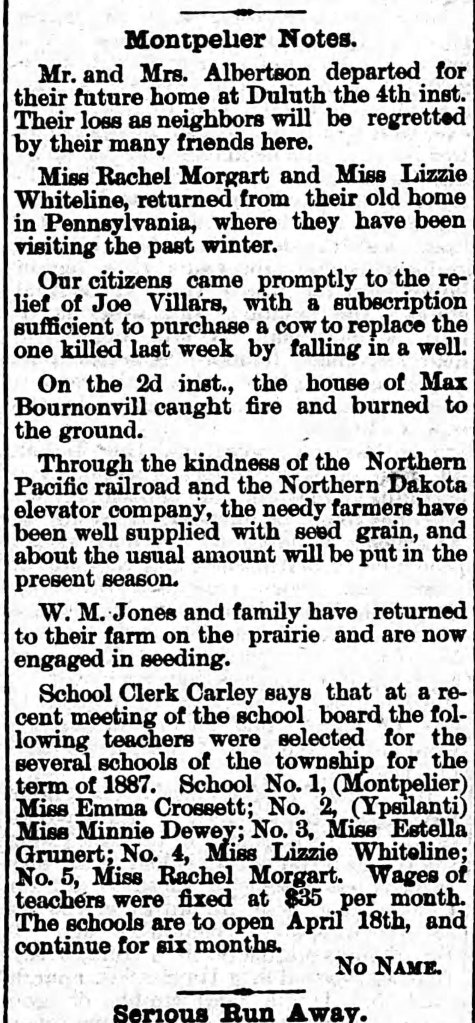
By continuing to use newspapers I was able to discover that Rachel taught at the Ypsilanti and Montpelier schools in what was originally the Dakota Territory as North Dakota did not become a state until 1889. I found her with the following timeline:
1885 – Listed on the Dakota Territory 1885 Census
1886 – Teaching at Ypsilanti
1887 – Teaching at Montpelier School #5
1888 – Teaching at Montpelier School #2 (she had 15 students)
In the Dakota Territory school began in late April and went for 6 months. In some winters Rachel attended the Valley City Normal School for additional instruction, in the winter of 1887 she returned to Pennsylvania and visited with her family.
Using an inflation website, $35 a month in 1887 is equivalent to almost $1,100 in 2022. This article was run in the Jamestown Weekly Alert in the 14 April 1887 edition found in Newspapers.com
Marriage & Family
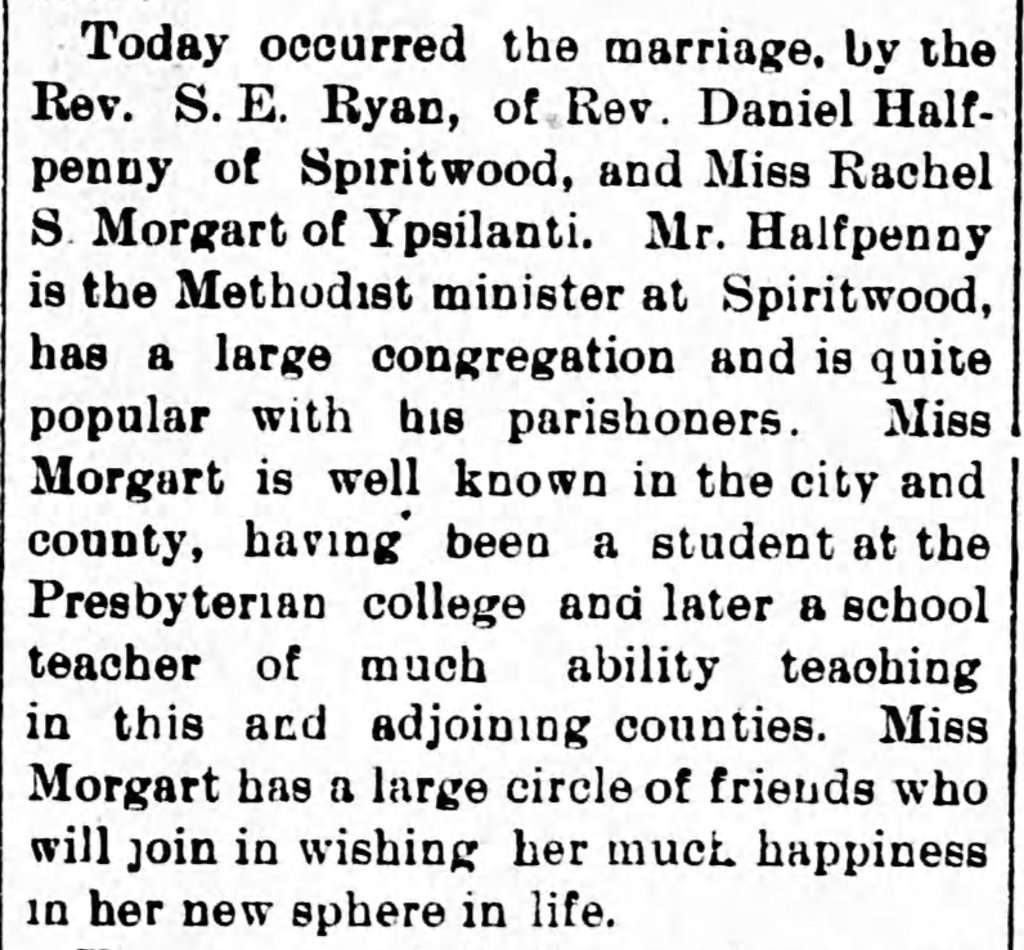
On 31 July 1895 Rachel Snell Morgart married Daniel Halfpenny.
Found on Newspapers.com in the 1 August 1895 edition of the Jamestown Weekly Alert
After getting married children came, daughters to be exact, 4 of them over the course of 10 years. First was Dorothy Evangeline who was born 8 June 1896, then Ruth Morgart born 1 April 1901, and finally twins born on 7 May 1906 Margaret Rebecca and Mary Kathryn.
All 4 girls took on teaching as their vocation at some point in their lives. Ruth Morgart and Mary Kathryn lived their entire lives in the North Dakota area, (Mary Kathryn actually lived her final years in Montana). Dorothy Evangeline and Margaret Rebecca both ended up moving to the San Diego area.
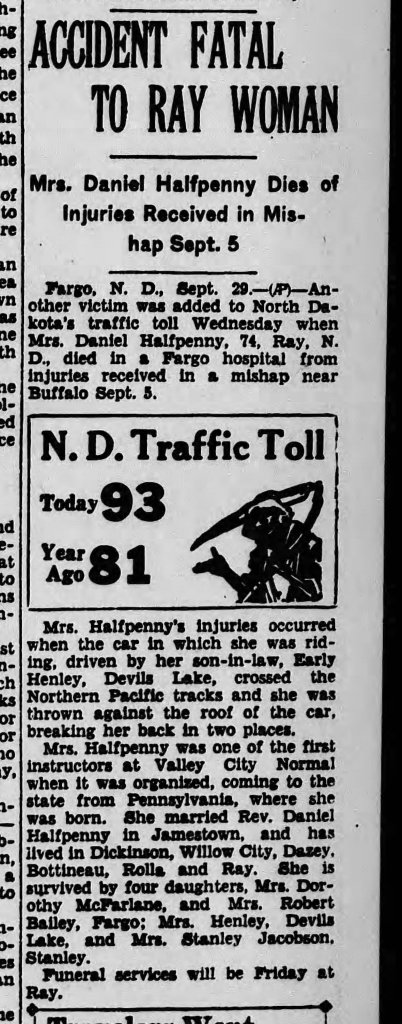
Reverend Daniel Halfpenny died on 21 January 1928 at the age of 75. Within 10 years on 29 September 1937 his bride would die from injuries she sustained in a car accident earlier in the month when her back broke in two places.
Found in the 29 September 1937 edition of the The Bismarck Tribune on Newspapers.com
Ever since I discovered a couple of years ago from a distant cousin who descended from Rachel Snell Morgart of her journey, she has intrigued me. I wish I had more information in regard to her move to North Dakota, it amazes me that no newspaper was impressed with her moving across the country. I tried to see if she had any siblings that may have gone that way and maybe she tagged along, but that is not the case. Her brother, William Baltzer, does end up settling in Idaho, but was living in West Virginia in the 1880’s when Rachel moved to North Dakota. Such gumption she had to do such a thing. And it was a decade before she married, simply amazing!
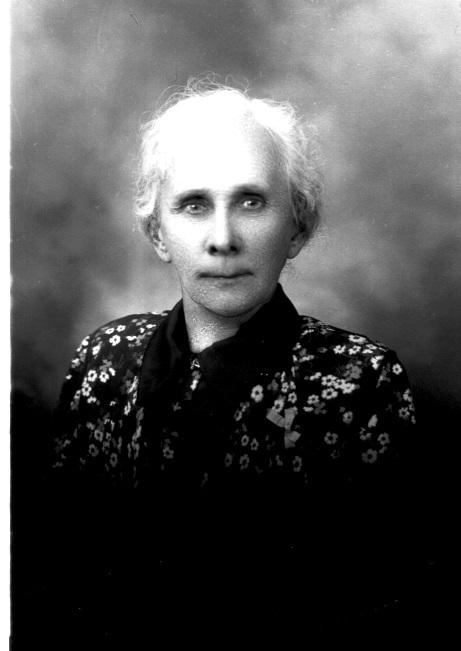
This photo of Rachel Snell Morgart can be found on FamilySearch and was uploaded by TeriGraham.
Did you have any sort of “pioneers” in your family tree? If you do I’d love to know where they went, and if they didn’t go anywhere, maybe they did something that made them a pioneer. Share your ancestor in the comments.
If I’ve learned anything from the countless classes, webinars, and presentations I have attended/watched over the last six years is that you need to branch out to get the full story about your ancestors. Branching out includes researching your collateral relatives and even researching the town(s) where your family lived.
Collateral Relatives
In case you are not aware of what a “collateral relative” is, it is your aunt, uncle and cousins, however distant they may be. It may seem strange to investigate these non-direct relatives, but sometimes you can learn things about your direct relative as researching their sons and daughters can find missing pieces of your own genealogical puzzle.
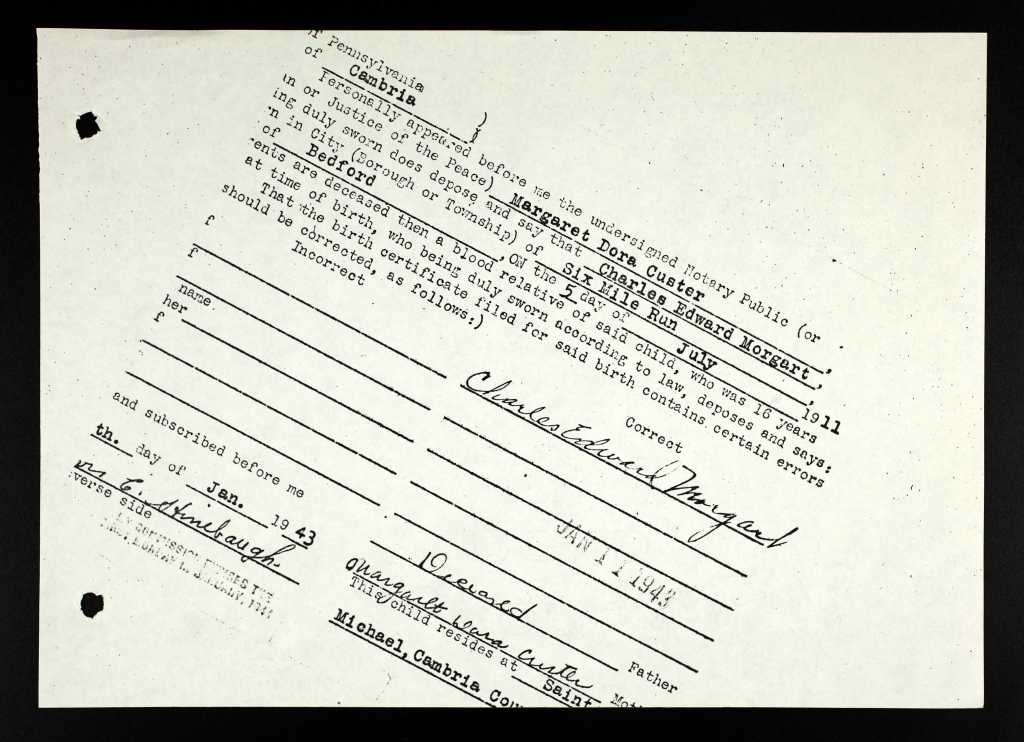
As I was looking up information on my Grandma Blair’s older brother, Charles Edward Morgart, referred to by my Grandma as “Eddie”, I came across both his birth certificate and a delayed birth certificate that they went and applied for on 11 January 1943. I don’t even have to look the date up, as I thought it was funny that they went and got this delayed birth certificate the same day my Grandma gave birth to my dad in Indiana. But that isn’t the only interesting thing I found out, when signing her name to the delayed birth certificate, my great-grandmother, Margaret “Maggie” Wise signed her full name, Margaret Dora Custer (she was married to her second husband, Earl Custer, at the time). Until this document I was unaware of what the “D” stood for.
Revised or delayed birth certificate for Charles Edward Morgart found on Ancestry.com
Another reason searching for information on your collateral family members is a smart thing to do, sometimes names are spelled incorrectly, and people don’t always show up in search results. By getting as many documents as possible for your extended family you may find missing relatives intermingled with others. For example, parents and grandparents can be found living with their children or grandchildren.
Cities and Towns
You can indirectly learn information about your ancestors by researching the cities and towns they lived in. If they were farmers, you can get an idea about what type of farm your relative had by researching the area where they lived, which comes in handy for someone like me whose relatives live in a state where the agricultural index for the census has been destroyed.
Sometimes you may be lucky enough that your family was important enough to be written about in a book about the history of the town. I was lucky enough to have the Morgart Tavern listed in a photographic book about Bedford County. My elation when I recognized names when I came across the book, simply trying to find out more about Bedford County, I wanted to jump up and down for joy. It’s a shame one has to be quiet in a library. (I thought I had taken photos of the book to share with others, but apparently I didn’t – presently hanging my head in shame).
Branching out in your genealogical research is essential to finding everything you need to know in your family tree. I always research all siblings and children of my relatives. I don’t always research parents of spouses of extended people because sometimes you have to stop, but there are times when I still do, like siblings married siblings so sometimes when you can’t find where a person is the answer may be with the other set of associated parents (I have done this with George Washington Blair, son of Andrew Blair and Susannah Akers, as he is married to his younger brother, Samuel Alexander’s wife’s sister).
Have you found out any interesting facts about your direct line ancestors by researching collateral relatives or where they lived? I would love for you to share in the comments.
This week’s theme for 52 Ancestors in 52 Weeks is “In the City”. I’ll admit this one was hard, because most of the relatives I have focused my research on were born and died in Pennsylvania, in one of the following counties: Bedford, Blair, Cambria, Fulton, Huntingdon, or Somerset. Granted on my mom’s side they either came from England and settled in Ohio or they were born in Massachusetts and moved to Potter County, Pennsylvania. But finding someone who was born in a small town and moved to a big city was not anything my ancestors did.
But then I remembered my 5th-great-grandfather, Ebenezer Oakman, who was born in Lynn, Essex, Massachusetts and moved to Philadelphia, Pennsylvania.
Lynn, Essex, Massachusetts
With land purchased from the Indians, Lynn, was founded in 1629, specializing in the manufacture of leather shoes, eventually becoming the ladies shoe center of the world, even getting Congress to place a protective tariff on the shoes.
In 1850 Lynn officially became a city and they had another claim to fame as the General Electric Company was born in 1892 by the merging of Edison Electric and Thomson-Houston Electric.
Today, Lynn is the 9th largest city in the state of Massachusetts and is close to 4 miles north of Boston located on the Atlantic Ocean.
Ebenezer Oakman
Ebenezer Oakman was born 8 August 1775 in Lynn, Essex, Massachusetts when it was still a part of British Colonial America, to Isaac Oakman and Elizabeth Lathe. He married Hannah Stocker on 13 October 1796 and they went on to have six children: Rebeca, Hannah, Elizabeth, Ebenezer Phillip, Sally, and Squires, all born between 1797 and 1805 (this was found using a document I found at AmericanAncestors).
In 1802 Ebenezer began a shoe factory in East Saugus with large expansions in 1807 and 1810, where he then had the largest shoe factory in the area. He would make the shoes in Massachusetts and then take them to be sold in Philadelphia, however in 1818 he moved the entire business to Philly.
One of the reasons for the move was that Ebenezer’s wife, Hannah, died on 27 March 1812. He then met and married Anna Bruce Ansley in approximately 1814 where they then had seven children between 1815 and 1832: Joseph, Robert, Agnes, Jane, Isaac, John, and William.
It appears around 1850 Ebenezer and Anna separated and he moved to and died in Lynn, Essex, Massachusetts at the age of 78 on 6 September 1854 (she moved to Illinois with Isaac).
My Lineage
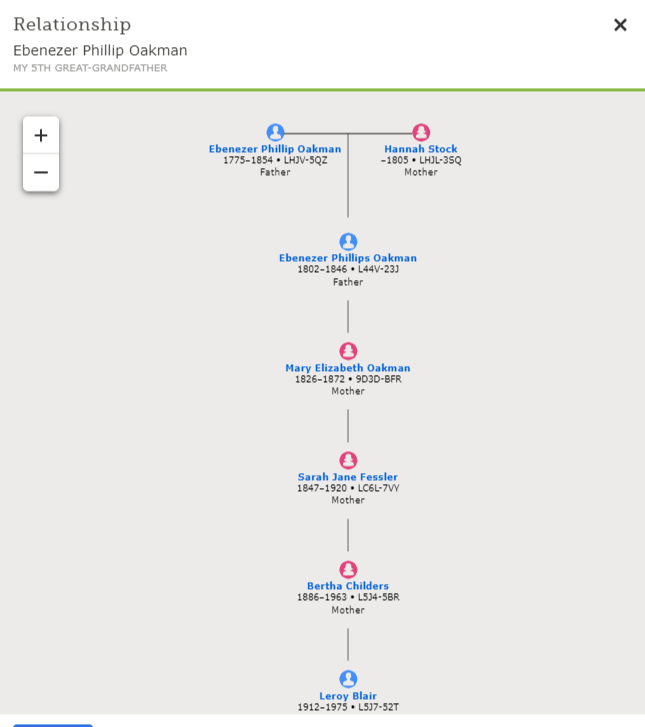
I am related to Ebenezer Oakman through his oldest son, Ebenezer, through his daughter, Mary Elizabeth who was born in Philadelphia to his wife, Mary Catherine White. Mary married George Henry Fesler and their oldest daughter is my 2nd-great-grandmother, Sara Jane Fesler. She married Randall Childers and had Bertha Childers, who married the younger Andrew Jackson Blair and their son Leroy was my grandfather.
Here is the direct relationship from my grandfather, Leroy Blair, to my 5th-great-grandfather, Ebenezer Oakman using FamilySearch
As a girl who was quite fond of trendy shoes back in my college days (well, we can just sum it up as the 1990’s in general) I was really excited when I learned of my ancestors owning a leather shoe store. I’ve not yet uncovered what happened with the shoe store (one of the online blurbs I read stated they traded the store for land in Bedford County but at this time I have nothing to back this up), but I would love to know if maybe this company turned into a brand that I myself wore.
Free is the prompt for this weeks 52 Ancestors in 52 Weeks, and who better than to write about than my 5th-great-grandfather, Solomon Sparks, who fought in both the Revolutionary War and the War of 1812.
Solomon Sparks was born 13 June 1758 to Joseph Sparks and the former Mary McDaniel in Frederick, Maryland. Overall he was the fifth of at least nine children, and the third boy. (As a side note, Solomon’s younger sister Sarah is also my 5th-great-grandmother, making Joseph and Mary my 6th-great-grandparents two times over).
Solomon’s family moved from Maryland to Bedford County, Pennsylvania in 1778 and in 1782 Solomon joined the militia as a private, mustering out when the war was over in 1783. He was a part of Captain Boyd’s Company of Rangers, their job was “to scout the forests and guard the settlements against surprise attacks from hostile Indians” (Taken from the History of Bedford, Fulton, & Somerset Counties).
Upon the war ending Solomon returned to Frederick, Maryland to live for a short time. This is where Rachel Weimer also lived, and they very well could have known each other or met at this point in time. They married in Pennsylvania in 1786 and had 11 children, settling in Providence Township in Bedford County, where he became a successful farmer.
When the War of 1812 began Captain Solomon Sparks and his Regiment of Rifleman “marched through the wilderness to the Canadian frontier and there performed efficient service” (Taken from the History of Bedford, Fulton & Somerset Counties).
Solomon passed away on 8 April 1838 but I wonder if he had been ill for a while. His will is dated 10 January 1821 with the beginning wording as “being for time very unwell but sound in mind, memory and understanding” (will was found in records not yet transcribed on FamilySearch). He gave $200 to each of his daughters, and money and homes to each of his sons. His wife, Rachel, was Executrix and his oldest son, Abraham, Executor.
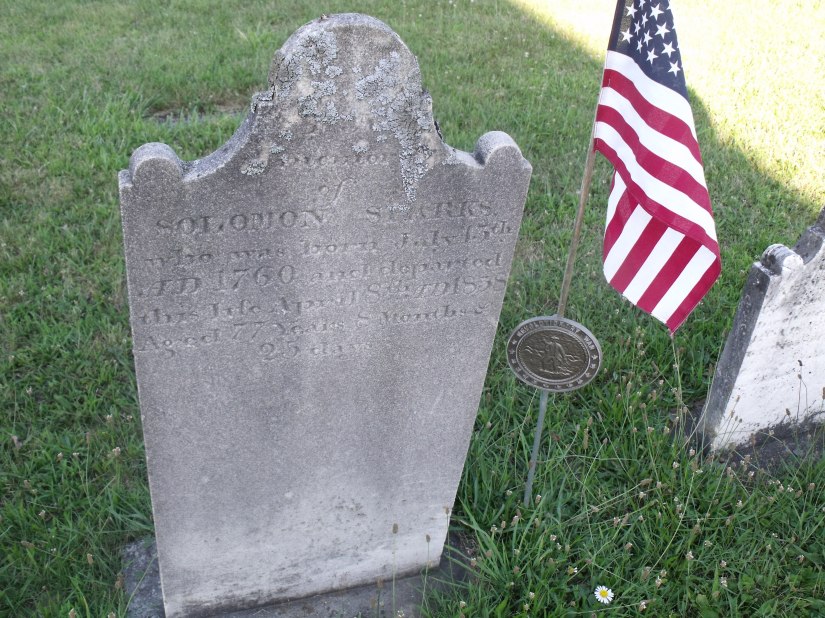
Grave of Solomon Sparks, he is buried at the Providence Union Church in Everett, Bedford, Pennsylvania
This week’s topic for 52 Ancestor’s in 52 Week’s is the Same Name. Do you have ancestors with the same name? You know the ones, they drive you crazy because they are all back to back to back and you aren’t sure which ancestor they are talking about because they are father and son and they overlap.
I have the same name. Andrew Jackson. Andrew Jackson is a name that turns up on both my paternal and maternal sides of my dad’s side of the family. On my Blair side I my great-grandfather and great-great-grandfather are both Andrew Jackson Blair’s with my great-great-great-grandfather being Andrew (he may be an Andrew Jackson as well but I’ve not had any confirmed documentation stating such). Then on my grandma’s side I have a great-great-great-grandfather named Andrew Jackson Morgart.
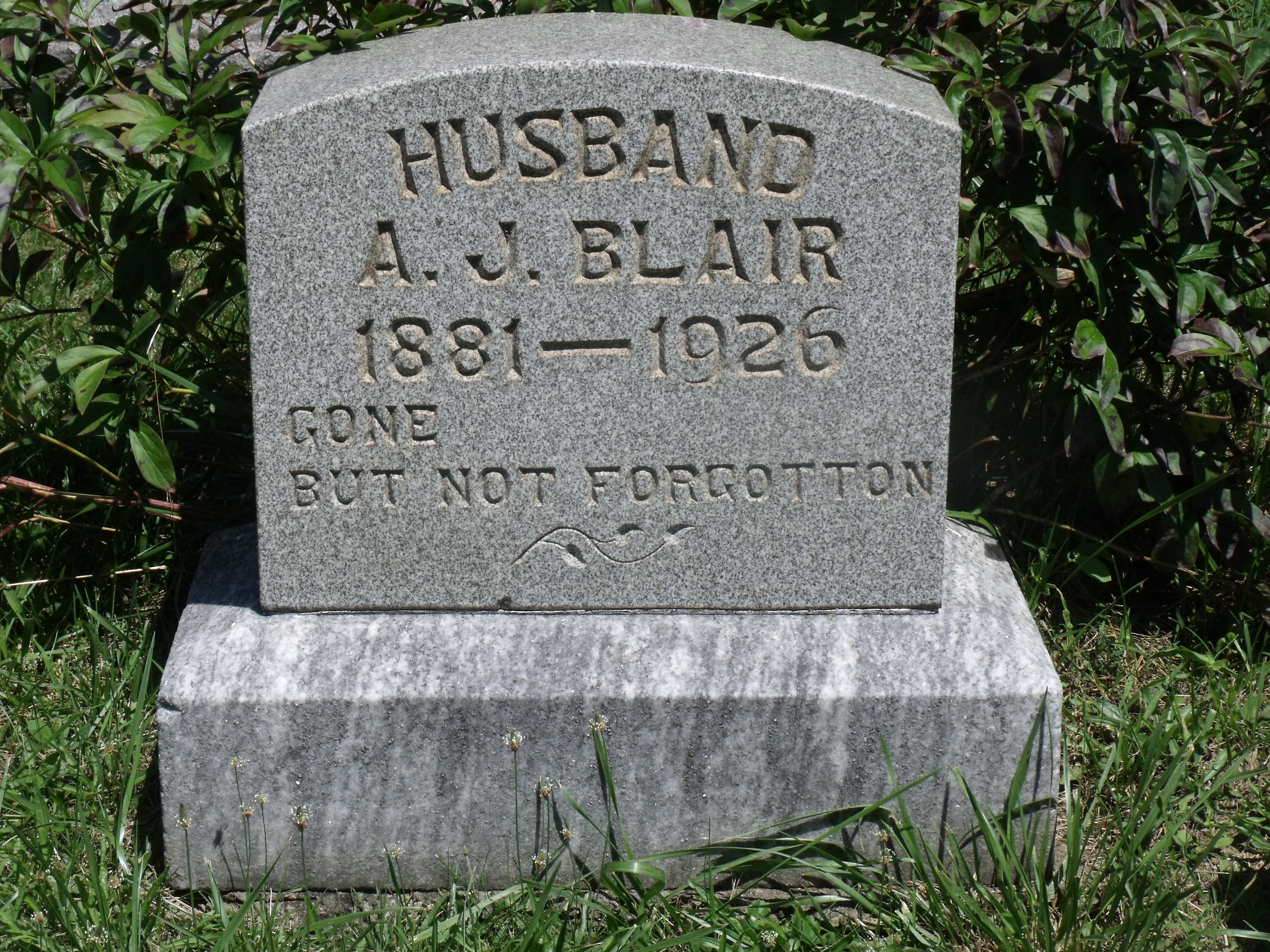
Andrew Jackson Blair (1881-1926)
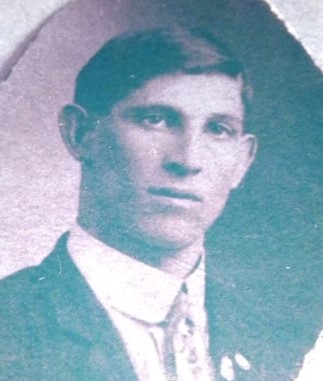
The first Andrew Jackson Blair I will discuss was my great-grandfather. No one alive today ever knew him as he died before any of his grandchildren were born. Andrew was a miner and died when rock began falling within one of the mines and it crushed his chest. His brother-in-law, Abraham Childers, was injured when the ligaments in his leg were torn.
Above is the only photo known to have been taken of my great-grandfather. The story is that it was taken as a group shot of his Sunday School class and they managed to snip him out of the group shot so we have it. When I was sent this photo a few months ago I was so happy, I love seeing what my relatives looked like.
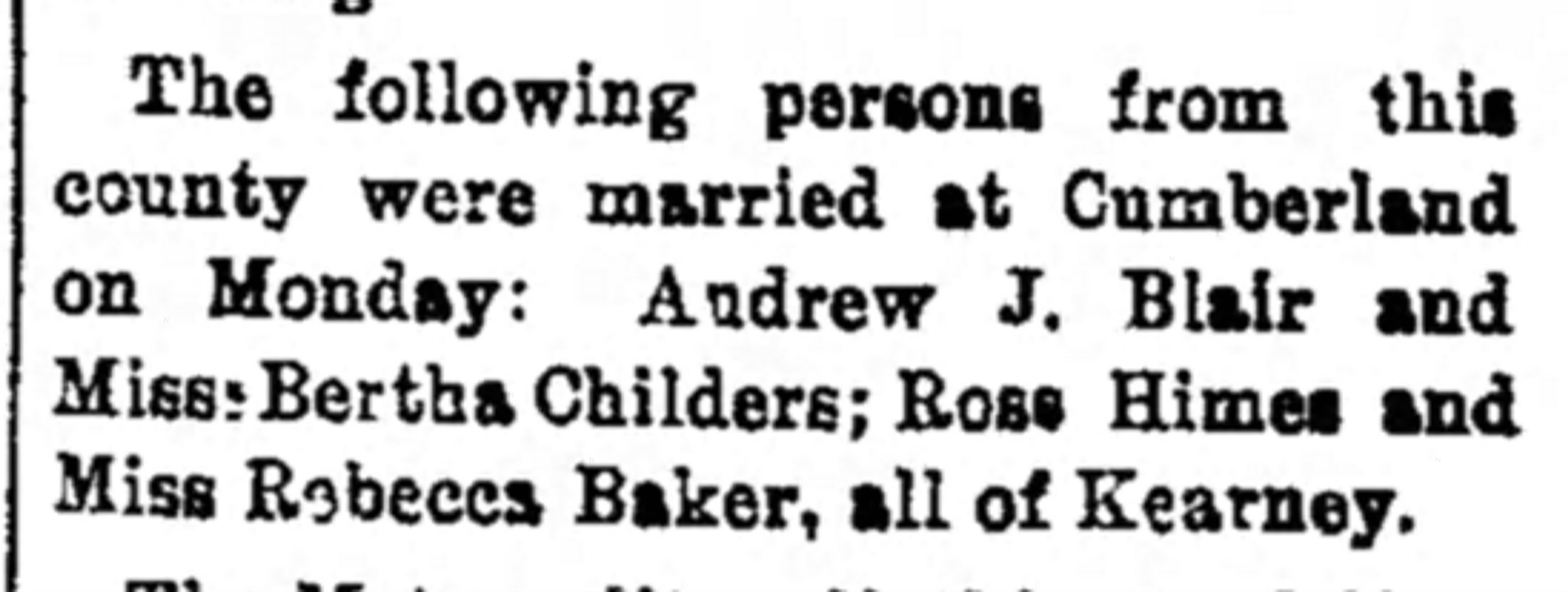
I have never found any marriage record yet of when my great-grandparents wed. But using Newspapers.com I have been able to piece together their marriage date of March 19, 1906.
Bedford Gazette, Friday, March 23, 1906
Andrew, or AJ as I have seen him regarded as often, was buried in South Fork Cemetery.
Andrew Jackson Blair (1851-1899)
I don’t know a whole lot about my great-great-grandfather. He was born in March 1851 in Cambria County, Pennsylvania and passed away of a Paralytic Stroke on June 20, 1899 in Bedford County, PA. On the 1870 Census he was still living at home and was a woodchopper but in the 1880 census he had married the former Susan Jane Foster and had 3 children, all girls, and was a miner. In the 1880’s he and his wife would have 3-boys and 2-girls to add to the mix, bringing their total children to 9.
Andrew is actually buried in Duvall Cemetery, which is on the land of his wife’s great-grandfather, Basil Foster. I didn’t see his grave when I visited last year, but I also was unaware of his being buried there until my final day in Pennsylvania when I discovered his death record at the Bedford County Courthouse.
Andrew Blair (@1812 – After 1880)
Andrew Blair is my 3rd-great-grandfather and also one of my biggest brick walls (the other is his wife, Susannah (Suzanna) Akers and his son, George Washington Blair). Though he isn’t an Andrew Jackson, he is the Andrew that at least began it all (or so I think). I can honestly say I’ve not gotten any further than just the 1850, 1860, 1870 and 1880 censuses for my great-great-great-grandparents. His occupation is just a laborer, and he rented his home so there is no land ownership. In 1850 he lived in Conemaugh Township, Cambria County, then in 1860 he lived in Huston Township in Blair County, and in 1870 and 1880 he lived in Bedford County, first in Broad Top Township and then in Coaldale.
Along with a vague occupation, I have no definitive birth or death date for this elusive man. One day I will find out more about my ancestor – it will just take time and plenty of patience.
Andrew Jackson Morgart (1824 – 1870)
On my grandmother’s side of the family is my 3rd-great-grandfather, Andrew Jackson Morgart. This Andrew Jackson was a farmer who lived in West Providence in Bedford County, Pennsylvania. On June 4, 1847 he married his wife, the former Rebecca O’Neal whom he had 10 children with, I’m an offspring of his oldest son, George Washington Morgart.
Photo of Andrew Jackson Morgart by Teri Graham that was uploaded onto FamilySearch.org
He died August 19, 1870. According to his obituary he must have been sick for a spell as death was not unexpected, but at the same time he was only 46-years-old. Wow, that’s the same age I am, but he was actually younger as I’ll be 47 next week.
To Sum It Up
To my knowledge, these are all the Andrew Jackson’s in my family. Now, Andrew Jackson Morgart did have a grandson named Charles Jackson but that’s another story for another time.
I guess the most fascinating part of having all these Andrew Jackson’s in my family is that in college I took a class entitled Jefferson to Jackson where it focused on the history of the United States while Thomas Jefferson, James Madison, James Monroe, John Quincy Adams and Andrew Jackson where president. During this time period Andrew Jackson was such a hero, saving our new country from the British in the War of 1812 which led to his presidency. But I so disliked Andrew Jackson, still dislike him to this day. It would just figure that I have all these relatives named after him.
Though a part of me would love for my Andrew Blair to be an Andrew Jackson Blair too – as he was born in 1812 (maybe sooner) it could possibly make it a family name and not in honor of the famous war hero.
But I am going to have to break down that brick wall first.
Are you like me, constantly looking at maps to see exactly where your family once roamed? I’m always using the below map on the FamilySearch Wiki to solve brick walls, wondering where my next further back batch of relatives would come from or lived in relation to others.
Just about all the relatives on my paternal side are found within the counties in the South-Western/Central portion of Pennsylvania. These counties would be Somerset, Bedford, Fulton, Cambria, Blair and Huntingdon counties. But not all of these counties have always existed, at one point I believe most of the region was Bedford County (which is why I chose Bedford to visit in July 2019).
Maps can be very helpful for locating where your ancestor’s records are kept. Records tend to stay with the county of when they were created. So if your family’s land is in what is now Blair County – since it was formed from Bedford County and Huntingdon County – if the records you seek are prior to 1846 – you will need to look in either Bedford or Huntingdon Counties.
An article on GenealogyBank.com by Gena Philibert-Ortega states, “Maps help you follow migration patterns, learn more about the place your ancestor lived, determine the location of cities that no longer exist, show changes in county boundaries, and verify land your ancestor owned.”
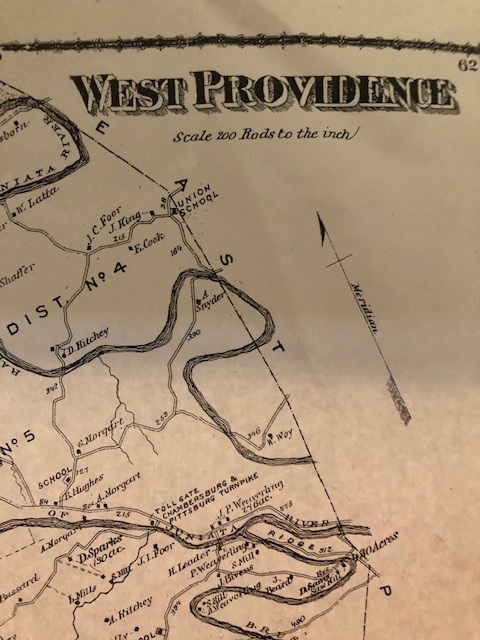
You may be lucky enough to find a map that even shows where your ancestors lived without your even plotting it. Below is a map that I photocopied out of the “County Atlas of Bedford Pennsylvania” and it shows the land where both my 2x-Great-Grandfather lived (G. Morgart) and my 3x-Great-Grandfather lived (A. Morgart). It turns out B. Hughes is a distant relative as well, and he married my 2x-Great-Grandmother when George Morgart passed away. I’m most likely related to the Ritchey’s as my aforementioned 2x-Great-Grandmother was Mary Ann Ritchey, and she had 2 brothers with the first name beginning with D.
Gazetteers
According to Wikipedia, a gazetteer is “a geographical dictionary or directory used in conjunction with a map or atlas. It typically contains information concerning the geographical makeup, social statistics and physical features of a country, region, or continent”.
These books are essential as they normally list the names of places that may not even exist in an area anymore, which can be very important for finding information on your family. Gazetteers can also provide the history of an area, including photographs.
David Rumsey Map Collection
A great website to find historical maps is the David Rumsey Historical Map Collection. The collection began about 30 years ago and includes over 150,000 maps spanning between the 16th through 21st centuries from across the world. The digitizations began in 1996 and include over 95,000 pieces. The real pieces are housed in the David Rumsey Map Center in Stanford library.
Mapping Software
If you find yourself trying to purchase a ton of books to find the maps you need, you can always turn to mapping software for computers. These programs work by you typing in your location and then you can scroll through the years watching the boundaries change before your eyes, giving you the exact county within your state (if in the United States) of where your ancestor lived at a specific point in time. This makes it convenient so you know where to look for the records you seek (remember, records stay with the county).
Examples of these programs are AniMap, Family Atlas, or you can go the free route and use Google Earth. One of the nice features of using Google Earth is that it is programmed with some of the David Rumsey maps that you can overlay where your ancestors lived at various points in history, so you can walk where they walked, so to speak (please note you’ll have to download the software for your computer for the Rumsey maps to work, but don’t worry, it’s still free!).
Just Google It
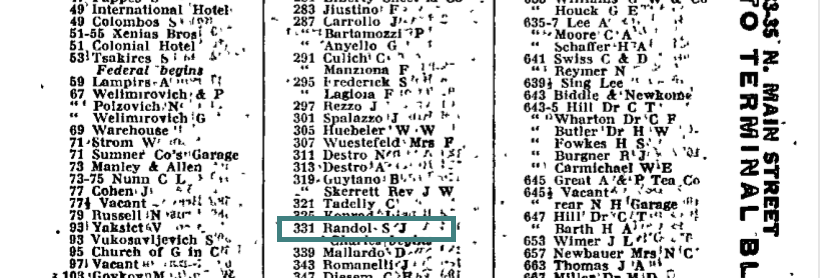
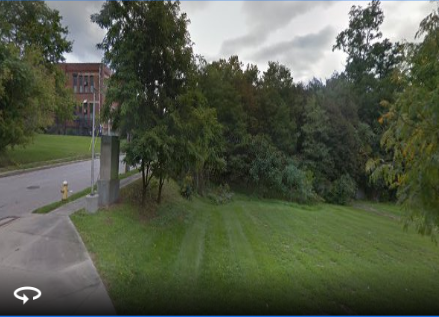
One of the other functions I used for my more recent ancestors is simply putting the address of where my ancestors lived that I have found using City Directories in Google so I can see the homes where my family members once lived. More often than not the house is still standing (I will often refer to the real estate tax site for my county as well just to confirm when the house was built). By seeing what the house looks like in advance I am able to drive by and find it more easily.
My mother’s side of the family settled where I live around 1916 and a majority of her side of the family is still here. Because of where they originally made their home each day when I drive to work I pass where my great-great-grandmother and her husband had their store. And I found it using the City Directory to obtain the address and putting the address into Google.
1924 Akron City Directory
Google Image searched on 28 Jan 2020
In a Nutshell
Maps offer us so much information. They are visual so it can open up an entirely new world to your research. You can see how far apart relatives live. If you’re tackling a brick wall and you see someone far away from any other place they’ve lived it might have you question “Is this person mine?” as the migration patterns can become quite apparent once you begin plotting addresses.
I’ve always referred to maps in my search for my family history, but I am at the point I’m really going to start plotting out where they lived just to get a better idea of where their proximity to others so I can wrap my head around things.
If you have used maps please feel free to share your tips and what you use to visually track your relatives and get a feel for where they lived.
Are you in the same boat as me and really get befuddled on how to use PERSI? In case you are unaware of what PERSI is, it is the PERiodical Source Index (PERSI for short). Ever since I took my first class at my local library about genealogy I have heard nothing but wonderful things about PERSI. Trouble is – I can never seem to have any success with it myself. So today’s goal is to learn what PERSI is, and how to use it.
What is PERSI?
So I know I already told you it is the PERiodical Source Index but what is it really? Organized by the Allen County Public Library Genealogy Center (ACPLGA) and Find My Past, PERSI connects you with thousands of articles for genealogy and local history. Though initially just an index relaying articles and their locations to users, the ACPLGA and Find My Past are working to digitize the articles to give family historians instant gratification.
How to Use PERSI
I’ve always understood what PERSI is, my trouble has been actually using it. So here are some tips I’ve accumulated in my search.
How to Find PERSI
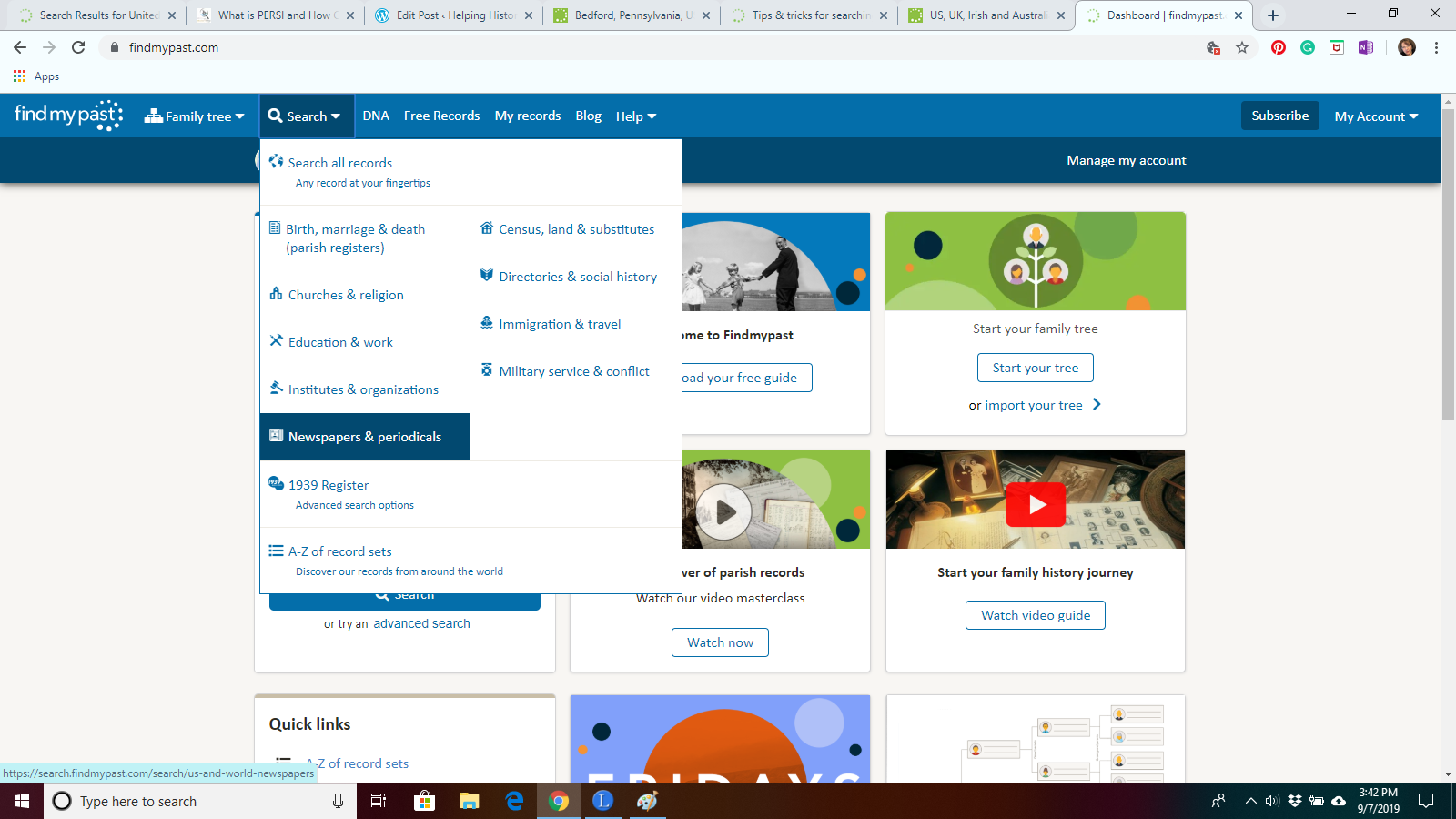
PERSI can be found by going to Find My Past, then using the toolbar at the top of the screen select “Search” and then when the pull-down menu appears select “Newspapers and Periodicals”.
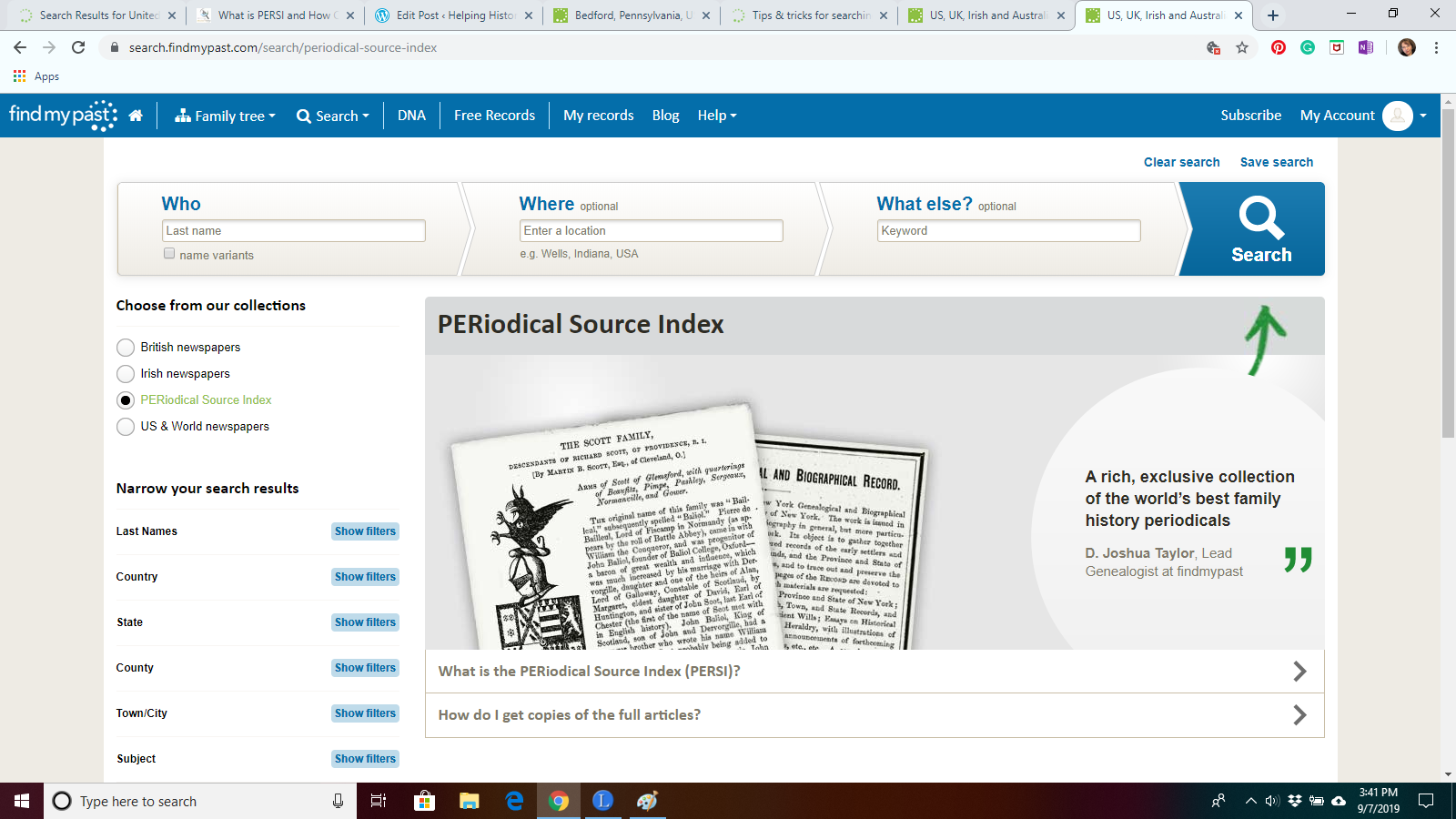
On the left-hand side of the screen near the top you will see a heading “Choose from Our Collections”, fill in the dot next to “PERiodical Source Index” and you’ll be ready to go!
PERSI is Subject Based
It does not search the text of articles, it searches the terms or keywords assigned to articles by the people who created PERSI. For example, you may come across an article that is all about your family, but if the person who indexed the article just assigned it “Bedford County” (where your people may have lived) searching for your family name will give you 0 hits. For best results you are better off to use the “Where” or “What Else” options on the search bar.
Lots of Filters
PERSI provides you with nine different filters to help narrow the number of results you receive. These filters include: last names, country, state, county, town/city, subject, keyword, and database title. These are located down the left-hand side of the screen.
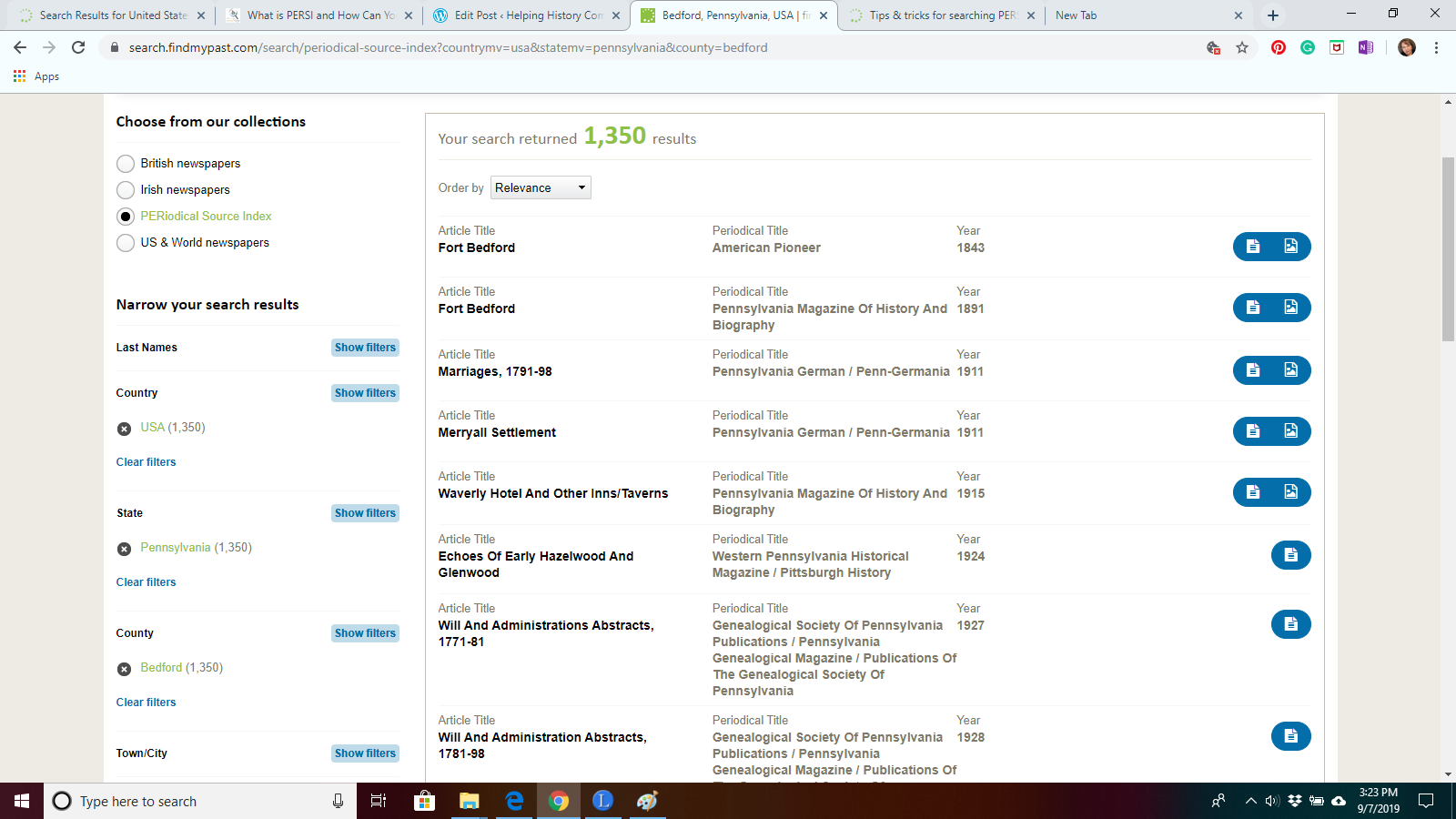
Since the world knows I have family in Bedford County, Pennsylvania, I went ahead and did a search on Bedford. By just putting Bedford County, Pa in the “Where” box (see above), I ended up getting 4,359 hits. This included places in England, Massachusetts, etc., which was amazing as I had Pennsylvania as part of my where.
By filling in the country, state, and county fillers along the left-hand side of the screen, I lessened my hits to 1,350. Here is a screenshot:
Please Note
If you click on an article, it is not going to take you to the page you are seeking. You will most likely have to read/skim through a book/paper/article to find the information you are seeking. Try to be optimistic, this may be a good thing as you may find more information than you bargained for which is a big YAY!
Remember, not all articles/books/papers have been digitized so some books you may have to do an interlibrary loan to see. I know earlier today I found an article from the Bedford County Historical Society that was done on my 5x Great Grandfather, Peter Morgart, in their newsletter. I am attempting to see if they have past newsletters online, or if I need to pay for a copy of that 1994 newsletter. I’ll keep you posted, it’s presently a Saturday and they are closed.
Lastly, you are able to search PERSI for free but to view records you do need a subscription to Find My Past. I know I don’t always have a subscription for all the different sites for genealogy but I know my local library (at least my Main Library) has the library edition of Find My Past for free where you can view the documents that are digitized. If you find an item that isn’t digitized, you would already be at the library and maybe you can set up an inter-library loan.
I’ll probably update this in the future. I presently have a simple subscription to Find My Past from when I joined my state genealogical society. It goes bye-bye in December so I am going to try to focus some of my research endeavors on here so I can utilize it before it’s gone (I say simple as I have learned many documents I need to view for my English ancestors are a higher subscription than the free one I received for signing up with my state society).
Just another valuable tool to maybe help you get the final piece of a puzzle for your ancestors. Good luck searching!
Have you ever gone on a research trip for your family history? Next week I am going on my first trip. I am so excited. I knew my children wouldn’t be so my dad has been nice enough to care for them and the dog while my husband and I head to Bedford County, Pennsylvania (about 4 hours from our home) so I can do a cemetery search and hopefully find original land and probate records from my relatives who passed away over a hundred years ago.
Having never gone on a trip like this before, I am sure there are lots of mistakes that I am making, so I decided to watch a very informative webinar by Family Tree Webinars that was given by Nicka Smith entitled “Get Set, GO! Planning and Executing a Successful Research Trip”. I was amazed at how many things I hadn’t really thought of doing, so that’s when I started getting my ducks in a row.
I then turned to the book I purchased about a month ago, “Organize Your Genealogy: Strategies and Solutions for Every Researcher” by Drew Smith (after listening to the Genealogy Guys Podcast I realized how knowledgeable he is, AND he sat next to me at the Meet and Greet at the Ohio Genealogical Society Conference in early May). In his book, Drew has an entire chapter dedicated to getting organized for a research trip.
Stay Focused
Both Nicka and Drew have various details in common: stay focused on what you are going there to research, have a plan, call ahead – make sure the places you are going to research are open the day that you are planning on going, AND find out if what you want to research is on site for you to look through, space can be limited for historical documents and it’s entirely possible that the land records from 1873 are off-property but if you call a few days in advance, they could have them waiting there for you when you plan on being there.
“Focus” was the word. Bright, shiny objects are always a threat when you are researching but can especially happen when you are on a research trip. This is where apps like Evernote or OneNote can come in handy – note your find, mark down the book you found your information in and either come back to it if you found everything you were looking for – or look for it on another trip.
I know I am presently still figuring out all that I need to look at. I have so many empty holes for specific people at various points in my tree that I am a bit overwhelmed at what exactly I am going to be looking for. Besides visiting the Bedford County Courthouse (which is my second visit) it has been highly recommended to me to visit the Bedford County Historical Society. I have a feeling that I may end up finding a bunch of information at the Historical Society, but I am not 100% certain what all they have (I keep getting snippets of information in my Facebook Group that they have a lot. The Historical Society also acts as the Genealogical Society as well).
Questions to Ask
What hours are they open (you can’t always go by what their website states)?
Am I able to take photos of what I find with my phone?
If I can’t, how much does it cost to make copies?
Is everything I may want to research available, or are there items I need to request in advance?
You want to be as prepared as you can possibly be for your trip, as you don’t want to have driven a long way and be disappointed.
Another tip that I read in a Genealogy Gems blog by Lisa Louise Cooke is to be patient. Things may not go as smoothly as you envisioned in your head (things seldom do) but if you keep a good mindset and roll with the punches, it will allow you to have a wonderful trip.
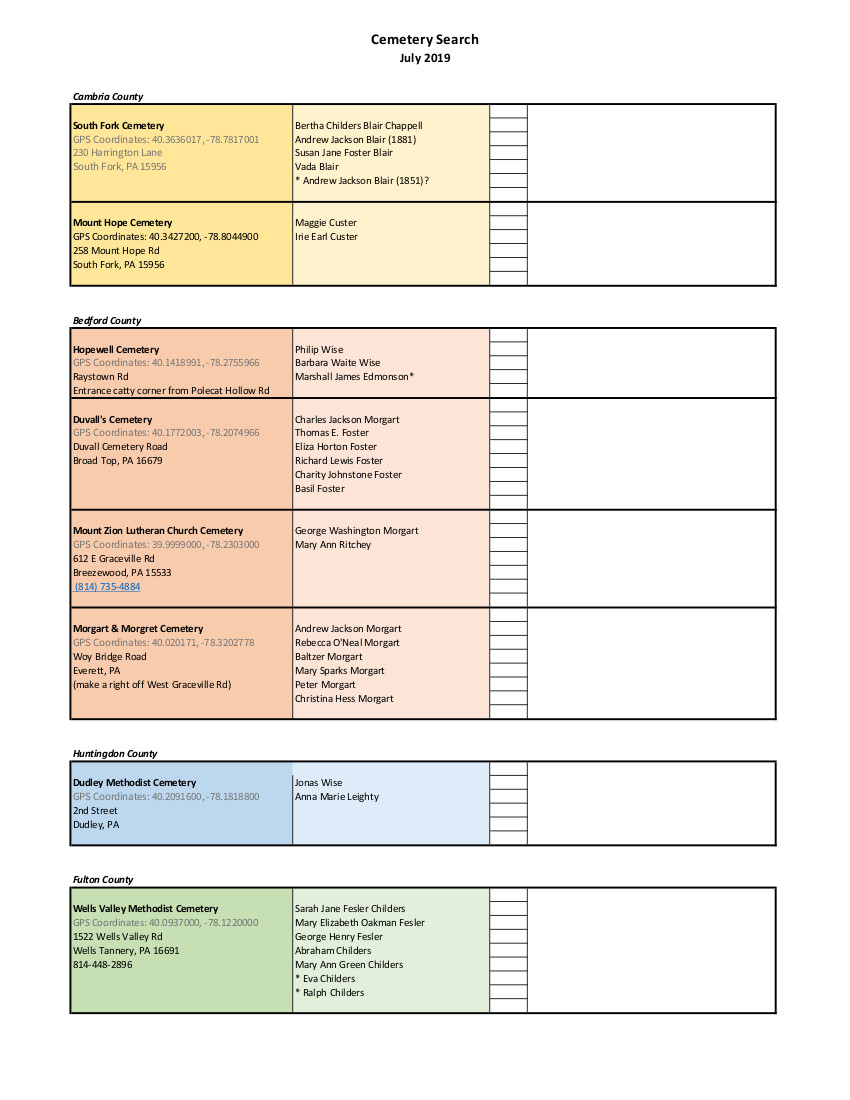
Below is a very simplistic page I created (reminiscent of one in the webinar by Nicka Smith) as a way to keep me focused on my cemetery search that is going to take place on Monday. I’ve listed the cemeteries, who is buried there, and then I can come up with a few others who I am not sure where they are buried (for example, my great-great-grandmother Susan Jane Foster is buried at South Fork Cemetery, but I’m uncertain if her husband is buried there too. He died before death certificates were mandatory (in 1899) so I don’t have a slip of paper telling me where he is buried (yet – can you say that’s part of why I’m visiting the Bedford County Historical Society) but I’m hoping that maybe I will find him buried with her (or possibly with his children as Susan Jane didn’t pass until 1943). The purpose is to keep myself focused and I think this will do the job (like the little checkboxes?). The blank space to the right is for notes.
Most of those I have listed are direct line relatives. I’m sure if I see others I’ll photograph them. Those with an asterisk have special importance to me, so they are the exception to the direct line rule (I have essentially 3 days, I’m trying to acquire as much as I can but distant aunts, uncles, and cousins can wait).
I’ll update you on my progress next week. My husband thought I’d be able to visit everything in just a few days. I have relatives from Bedford, Fulton, Somerset, Cambria and Huntingdon counties in Pennsylvania, unless I am the world’s fastest and most efficient researcher, I don’t see conquering 4 counties in 2 days, not with both sides on my paternal side of my family to seek information on.
Do you have any tips or suggestions – I feel like in all I’ve read and watched I’m missing something critical to share with you. I’m sure I’ll think of it as soon as I hit “send”. I’d love to hear about anyone’s experience on their own visits to their families homeland. I am super excited to see mine and I’m meeting with a distant cousin and will get copies of photos of family members I’ve not seen.









 Helping History Come Alive