Genealogy, Maternal Side, My Family Tree, Paternal Side

Giving Your Ancestors a Life

A big difference between my husband and myself is how we relate to our families.  He has just started, so maybe I shouldn’t judge him so harshly, but he views his ancestors as names on a screen.

Names on a screen!

Then there is me, I sit there and though they may initially be names on my tree (I will confess my aunts, uncles and distant cousins I do refer to as filler people until I get to know them a little better), I enjoy finding out what I can on them, where they lived, how long, did they marry.  I especially try to find out as much as I can on the little ones.  You know, the ones who pass away before they ever have a birthday, I fear they may be the easiest for time to forget.

The more I research my ancestors, whether it be government documents, city directories, or newspaper articles, I enjoy getting a sense of who they are.

Harold Fairhurst – My Grandfather

Within the last few weeks Newspapers.com was free for a few days and I so enjoyed learning new things about my relatives.  One article that ran in the Akron Beacon Journal on September 17, 1964, referred to when my grandfather, an area golf pro, hit a hole in one.  It was interesting as when I had found it my Aunt Debbie had relayed how he had hit one and won a years supply of Pepsi. He had only hit a hole in one once, so this had to be the time.

The_Akron_Beacon_Journal_Thu__Sep_17__1964_

When I threw my grandfather’s name to find articles about him I was floored when I saw how many hits I received.  My mother had always told me he was a golf pro, but I never realized he held course records in my hometown and was a semi-serious contender.

Alberta Lou – My Grandmother

I found out some interesting bowling information on my mom’s mother too!  I knew my grandmother was on a bowling league but I never knew she was on a league of women bowlers where you had to bowl a 600 series.  My uncle (her son) he gave me the information after I found and shared the following article with him.  It was posted once again in the Akron Beacon Journal on March 14, 1971.

The_Akron_Beacon_Journal_Sun__Mar_14__1971_

Orienta Gustin Warner – My Great-Great-Great-Grandmother

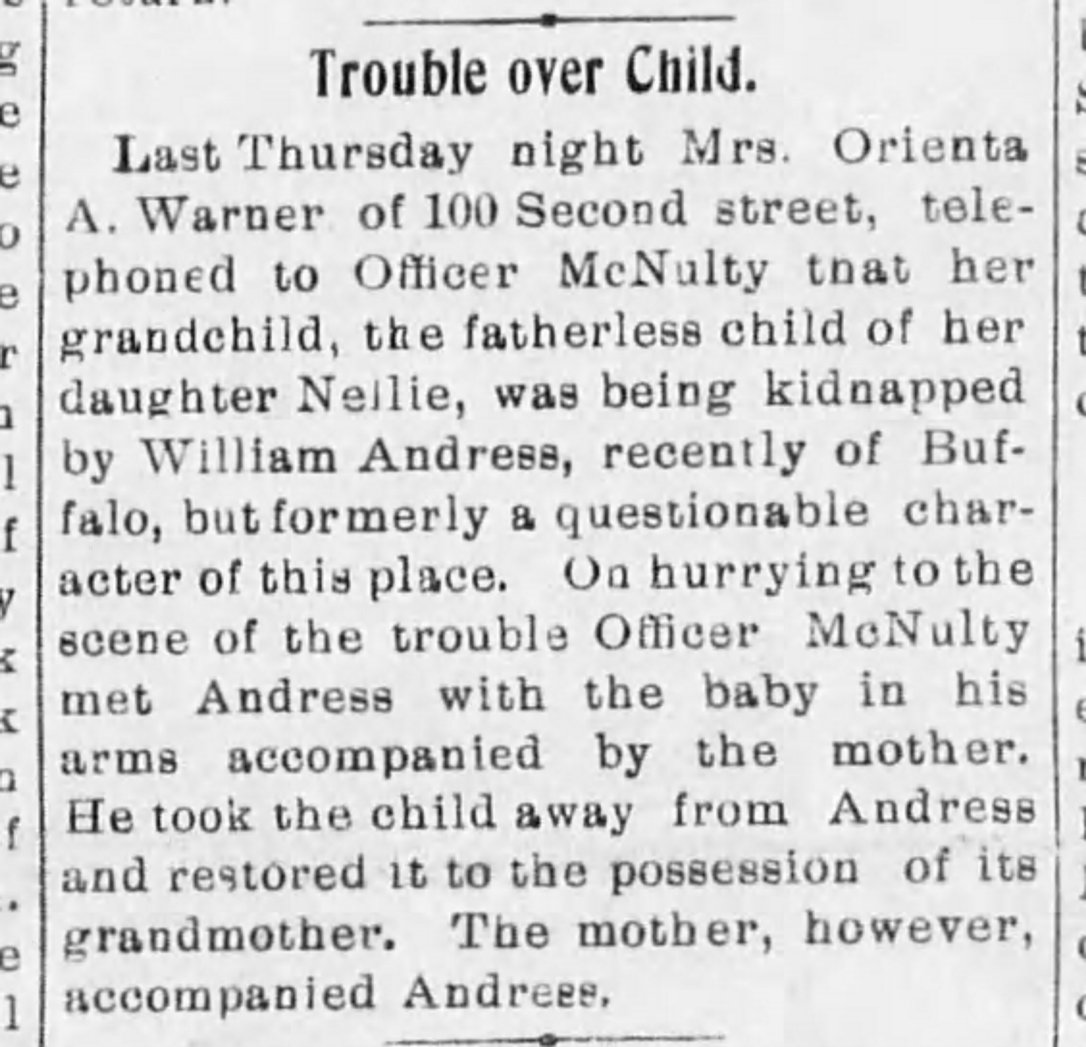
I learned some juicy information about my relatives too.  Again, visiting my mother’s side of the family, this time it was my great-great-great-grandmother, Orienta Gustin Warner who is mentioned in the following article from the Potter Enterprise that ran on February 11, 1904, along with her daughter, Jeanette Warner (Nettie) my second great-great-aunt.

The_Potter_Enterprise_Thu__Feb_11__1904_

Real-life stories of your ancestors help to put them into perspective far more than just dates and names on a computer screen.  The aforementioned Orienta Gustin Warner lived here in Akron, Ohio for the last 6 years or her life.  She passed away at 644 Carpenter Street and I’ve driven past the house, which is less than 5 minutes from my own home.

I’ve used Google to see what all the houses look like (most are still standing, some have been torn down). Once I figure out locations for homes in other areas I plan on doing the same.  This is when technology is at it’s best.

Samuel & Mazie Randol

By using the city directories, I saw how my great-great-grandmother let her daughters move in with her when their marriages failed, I saw her and her husband, Samuel, finding a new house to live in while her daughters stayed in their old one with their new husband, and I saw the pattern repeat. So to me, this shows me Mazie was truly a good person, going out of her way for her girls.  And taking them back in when they needed help and support (and yes, after a while I got a little judgy as I think Mazie and Samuel might have had 2 years alone before he passed away in 1938).

Speaking of Samuel, my father gave me a box of mementos that belonged to my mother’s side of the family. He had no need for them after my mom passed last year, so about 2 months ago he handed the photos off to me.  Inside the box was the book from the funeral home from when Samuel Randol passed away.  He was a trucker when he died in Decatur, Illinois.  He apparently became ill, went to the hospital, and died within a short period of time.  I’ve not ordered up his death certificate yet, I may have difficulty as he is not a blood relative and I think Illinois laws may be a bit more strict than they are here in Ohio. Anyhow, never had I seen so many names in a book of those who visited the funeral home as those who paid their respects to Samuel.  I was dumbfounded.  To me, it’s further proof that he and Mazie were good people.

Ralph Reed

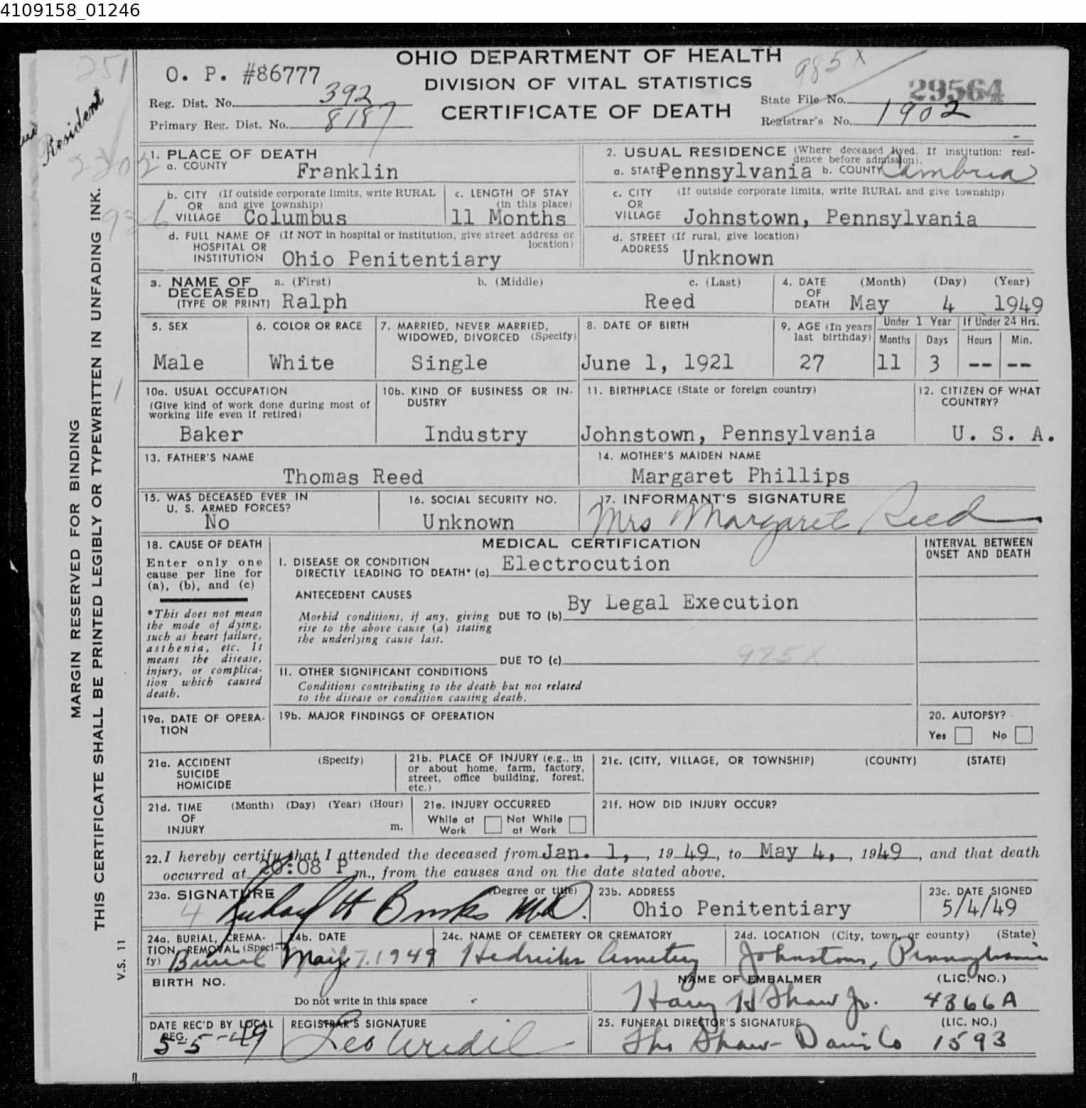
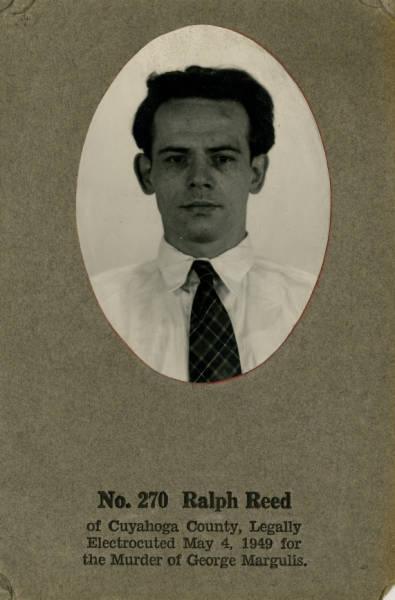
To be fair I’ll throw in the black sheep of my dad’s side of the family.  In the early months of my going to the library and using Ancestry Library Edition to search about my family, I came across the following death certificate for my second cousin twice removed.  His name is Ralph Reed.

RalphReedDeathCertificate

Notice his cause of death?  Electrocution by Legal Execution.  I used a link using my library’s resources which has an academic version of Newspaper Archive on their website.  It’s nice as I was able to use it for free from home using my library card number.

Turns out Ralph and his friends decided to rob a company payroll office one day when companies still paid with cash.  Problem was they beat the cash there, decided to rob the office workers and Ralph shot the one worker in the back (yes, the headlines were man murdered for $60).  They drove off in their getaway car but nearby some telephone repairmen were fixing a wire and watched exactly where they drove off too.  Ralph was sentenced to death while the others had life in prison.  I don’t think the punishment held for all of them though, as I believe at least 2 may have been released (I’ve not thoroughly researched them yet, I will need to take a day to travel to the Ohio History Center in Columbus to find out more details. In 1948 the accused were tried, sentenced and put to death all within a years time.  On May 4, 1949 Ralph was electrocuted. Below is his photo (courtesy of the Ohio Pentitentiary in Columbus, Ohio).

RalphReed-PrisonPhoto

Resources to Use

Maps, probate records, newspaper articles, city directories, all these useful sources can help provide background information on your ancestors.  Even if you can’t find stories directly about them, you can see where they lived using old maps, you can find out what the weather was like reading articles about the area, and if they fought in wars, even if it wasn’t their personal account, reading the diaries of others fighting in the same war can give you insight as to what they went through.

So take the time to search through newspapers, you can get a subscription to such sites as the aforementioned Newspapers.com, GenealogyBank.com or visit the free Library of Congress website ChroniclingAmerica.org to see if you can find some information (trust me, sometimes they just pop right out, other times you have to go through lots of names to find what you are looking for).

Check out your library to see if they give you access to resources such as Newspaper Archive that I mentioned previously.  Sometimes you can get access to library editions of other searching tools such as MyHeritage or Fold3 as well.

Government Records

Government records work too – the census gives you where your ancestor is at a specific point in time, probate records can illustrate how their life was at the end and who their relatives are/were, if they are males registrations for wars come in handy as it lets you know next of kin, eye color, height, any interesting marks (such as scars, birthmarks, etc), all of this can give you a better indication of who your ancestors were.

So now I’ve given you more reasons to analyze those documents you’ve found to find out the story behind the story of your ancestors.  It’s worth going the extra mile because they become far more memorable when you have a story to tell than if they are just a name on the screen.

Have you found out anything interesting about your family?  Share with me in the comments below.

Genealogy

Make Sure You Look at Everything on the Census!

For two years I’ve had a brick wall in my great-great aunt Margaret Blair who was born in October 1879.  She is on the 1880 census as this is how I know she lived.  She has been one of my biggest mysteries.  By the time the 1900 census comes around, Margaret would have been 20 so I never knew if she had passed away in childhood or just gotten married with her license just eluding me.

Frustrated I reached out to two different Facebook groups last Friday where I received great advice and suggestions from so many supportive family historians.  One very helpful commenter suggested that I examine the 1900 and 1910 census because they both state how many total children a woman had and how many were still alive.

You know that emoji where it looks like a woman smacking herself on the forehead?  It’s my favorite emoji, and my most used.  That was me after reading the recommendation. OVER TWO YEARS and the answer was in front of me the entire time.

I remembered seeing that column on the census way back when I first found the censuses for many family members.

So make sure you know what your census has to offer.  Over the years the US government has asked different questions of its population on the census forms.

1790 Census

The first census of the United States was pretty basic.  It was all about free white males 16 and older, free white males under 16, free white females of all ages were lumped together, then other free persons, and then slaves. Only the heads of household were listed, along with the state and county.

1800 Census

The second census of the United States expanded on the first one, where it became a little more precise with the age groups of the free white males and free white females, then it was all other free persons, and then slaves.

1810 Census

The third census of the United States was not really that creative and was pretty much the same as in 1800.

1820 Census

The fourth census of the United States still had the same breakdown of free white males and free white females, but this particular year they were interested about foreigners who were not yet naturalized, who was earning a living in agriculture, commerce or manufacturing, then it went into more detail about the ages of slaves, and the ages of free colored persons.

1830 Census

The fifth census of the United States was more of the same, but along with the age increments of all segments of the population, the government also wanted to know who was deaf, dumb (as in couldn’t speak), blind (these were also spread out below age 14, between 14 and 25, and above 25 for both whites and blacks), and they still wanted to know who was an unnaturalized foreigner.

1840 Census

The sixth census of the United States was similar to the 1830 census, but it was also curious about who were pensioners of the Revolutionary War, occupations expanded from just three categories to mining, agriculture, manufacturing, navigation of the ocean, navigation of lakes and rivers, or worked as a professional engineer. There were also questions referencing education/college.

1850 Census

The seventh census of the United States, also the first census most people like as it lists the name of everyone living in a house, age, sex, color, value of real estate, profession, place of birth, married, if they attended school, if they could read or write, and whether deaf, dumb, blind, insane, idiotic, pauper or convict.

1860 Census

The eighth census of the United States was very similar to the 1850 census but along with the value of the real estate, it also asked the value of one’s personal estate.

1870 Census

The ninth census of the United States inquired a lot of the basic information of 1860, but was curious about whether your parents were foreign-born and if so, where?  Also asked if you were born or married within the past year, what month? If you had attended school within the past year?  And if you were a male citizen 21 years or older, and if you were 21 and older and if your right to vote is denied due to crimes or rebellion.

1880 Census

The tenth census of the United States began asking questions such as what street you lived on, your relation to the head of the household, single, married, widow, your profession, if you had been unemployed in the past year, if you were sick or disabled, blind, deaf, dumb, insane, if you had attended school, and where you born, and where your parents were born.

1900 Census

The twelfth census of the United States was the first of two with how many children a woman bore and how many survived as of the census, it also asked what year you immigrated to the US, and how long you have lived here, and if you were naturalized.  It asked for a profession, if you attended school, knew English and if you owned or rented your home, if it was a farm or a house, and the farm schedule.

1910 Census

The thirteenth census of the United States delved a little deeper into one’s profession, only cared to know if you were deaf or blind, and also asked if you were an Army or Navy member during the Civil War.

1920 Census

The fourteenth census of the United States delved a little deeper into the ethnicity of people, as it asked where you from but also your mother tongue for both fathers and mothers as well as oneself.

1930 Census

The fifteenth census of the United States was similar to the previous ones, but it also asked what your age on your last birthday was, how old you were when you married, whether you were a veteran, did you work?

1940 Census

The sixteenth census of the United States along with all the information of the previous census’ wanted to know what your highest level/grade of school,  if the individual worked for the WPA, what your occupation was and the industry you worked for, and how much money you made.

Margaret

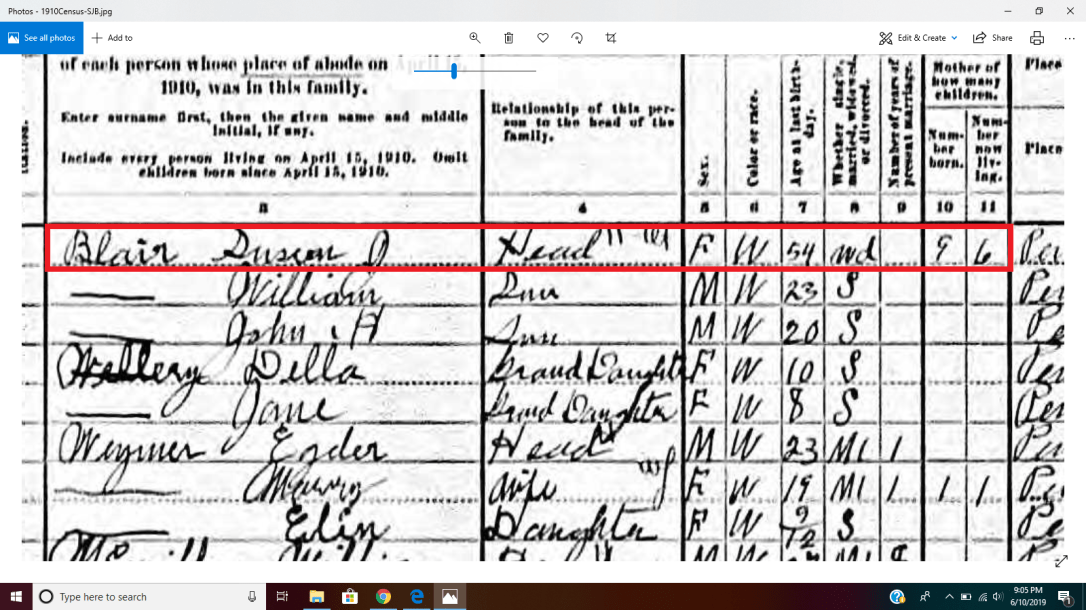
I had seen the line items on the 1900 and 1910 census about the number of children born and the number of children who were still surviving at the point in time.  Here is the 1910 Census for my great-great-grandmother, Susan Jane Foster (Blair). Both the 1900 and the 1910 Census state the same numbers, but on the 1910 census she is at the top of a sheet.

1910 Census

Susan had 9 total children and 6 survived.  I can account for her 6 living children: Phoebe Jane Blair, Loretto Jane Blair, Andrew Jackson Blair, Minnie Blair, William Blair, and John Blair.  She had 3 that died, Margaret was one of them.

This had me sad.  I really hoped she ran off and got married and I just hadn’t tracked her marriage information yet.  In a months time, I’m going to head to Pennsylvania and visit some relatives, cemeteries and the Bedford County courthouse, where I hope I am able to find out what happened to poor Margaret.  I have two others to find as well.

The Moral of the Story

Pay attention to the details that your census offers, because even though they give you names and approximate birth dates for your ancestors, they can solve your brick walls too.

So many of us use computer programs where we upload the document into our system, and yes we look at enumeration districts and who else is listed when we share our document with all who are on it for citations but do we really KNOW what it’s telling us?

So your homework is to go print off clean copies of the census, and transcribe what you see onto the clean sheet of paper for your relatives, so you can know them better, and tell their stories in a whole new way.


Genealogy

The Most Important Thing I Learned at My Conference

Last week I attended the Ohio Genealogical Society Conference in Mason, Ohio and there was one topic that was repeated no matter what the subject of the class was… FamilySearch, Ohio Archives, Finding Females, Newspapers, British Roots, Bright Shiny Objects… and that was you should always have a research plan.

Why Should You Follow a Research Plan?

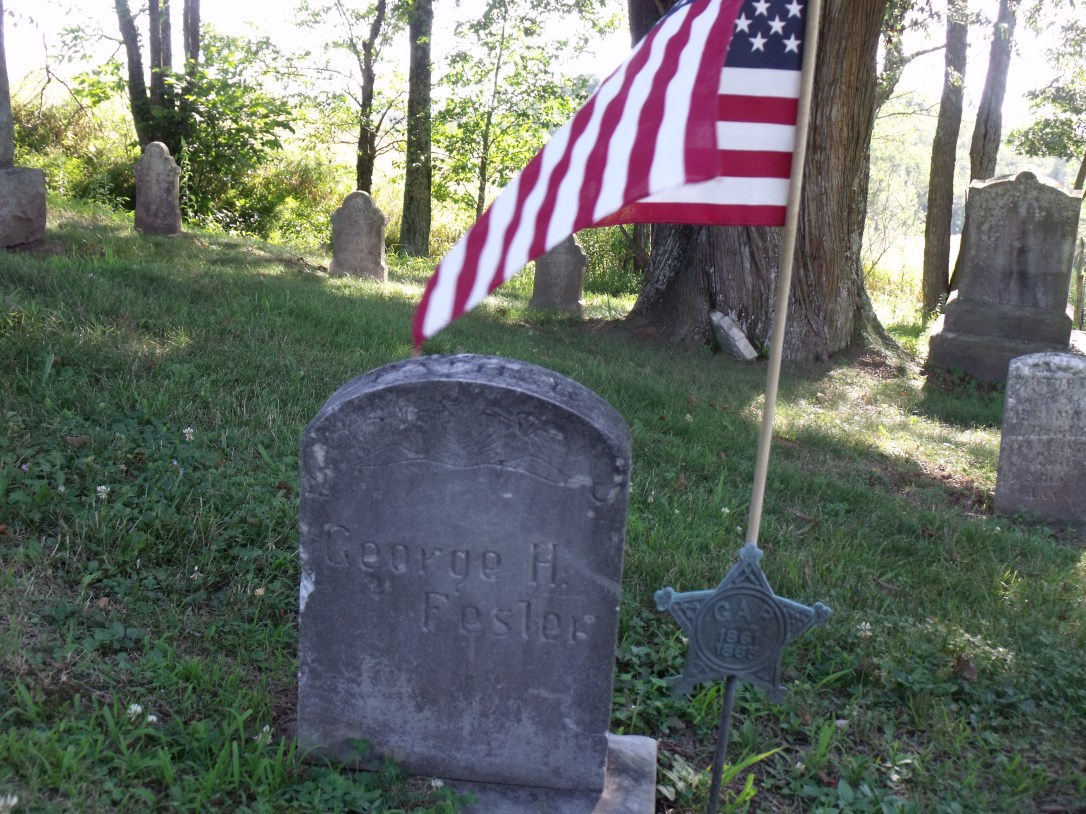
I’ll confess, the closest I come to having a plan when it comes to my own genealogical journey is beginning each day with an “I think I’ll work on my great-great-great-grandfather, George Henry Fesler” today and I proceed to enter into my program all the information I have and search for the documents that I don’t.

But having a research plan can keep you focused.  It can help you from getting distracted by the beforementioned bright shiny objects (I’m sure you have come into contact with those – a document that you find or information on another ancestor that you stumble upon that you just HAVE to follow up on RIGHT NOW).

The Steps of a Research Plan

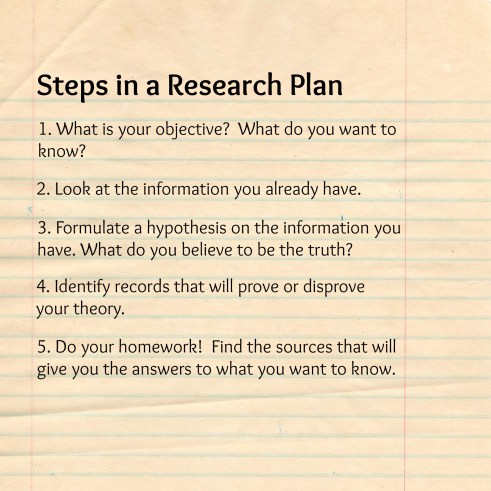
Steps in a Research Plan

Depending on the website you seek your information from, recommended research plans seem to fall between 5 and 7 steps. Most that were gone over in my classes seemed to go with 5-steps.

1. What is Your Objective?

It’s always best to know what it is you want to know before you sit down and begin randomly searching for information.  Even I when I just decide “I’m going to work on researching my Great-Great-Great-Grandfather George Henry Fesler”, I have identified who I want to research.  I’m in the process of still adding many family members to the software that I use, or sometimes I have the basic information down (to fill in a fan chart or such) but I need to add documents, events, and sources.

2. What Information Do You Already Have?

It’s always best to double check the information that you have already acquired for a person because you may already have the answer that you seek.  And by finding out what information you have, narrows down the information you still need to seek.  Sometimes it’s helpful to even look at other close relatives such as father’s because you may be missing a census in one file but have it in another (assuming you file by the head of household).

Going back to my example of George Henry Fesler, I had a number of files that I had downloaded, and when I was adding them to my software I often don’t have the information for the citations handy and will either re-find the document on FamilySearch or Ancestry.com for this.  Here on my personal family tree on Ancestry.com I saw where I had attached George’s death certificate, but I never downloaded the file. Lucky for me my husband had a 14-day free trial of Ancestry that hadn’t been used and I was able to instantly download the death certificate (don’t worry, if this was not a possibility I would have gone to the library and used the free Ancestry Library Edition).

3. Create a Hypothesis on What You Believe to be True?

Hypothesis is such a big word.  It makes me think of tenth grade when I had to write a term paper for my Expository Writing Class.  I’m sure I learned about it in science too, but the term paper really seems to strike a chord.

According to Wikipedia, a hypothesis is “a proposed explanation for phenomenon”. Basically, it’s the information you think you will find.

For example, I think George Henry Fesler, my great-great-great grandfather, died in Wells Tannery, Pennsylvania.

Until I re-discovered his death certificate attached to my tree on Ancestry.com, I wasn’t 100% certain where George passed.

4. What Records Will Prove Your Hypothesis?

To prove or disprove your hypothesis you will need to find records that will either support or discredit what you believe.  These are often government documents such as census records, death certificates, pension files, or published records such as city directories, or an obituary in the paper.

What records will I need to prove that George Henry Fesler died in Wells Tannery, Pennsylvania?  I know that his death certificate will be helpful, possibly his grave, census records could assist with letting me know precise locations of where he lived every ten years before his death. Where he is buried helps, but a person can die anywhere (my great-great-grandmother’s 2nd husband died on a trip visiting family in Illinois and he lived in Akron, Ohio), often they live in the vicinity of where they are buried or reside.

5. Do Your Research!

Now you find those documents I mentioned above that you don’t have.  I was lucky enough to discover my great-great-great-grandfather’s death certificate was somewhat in my possession.  George actually lived in Wells Township in Fulton County, Pennsylvania pretty much his entire life.  He is buried at Wells Valley Methodist Cemetery in Wells Tannery.  He was born in Bedford County, but all the census’ from 1850-1910 have him living in Wells Township.

A Way to Stay Focused

Researching with a plan is going to be my new motto.  It’s one thing to attend maybe one or two classes where it was mentioned – but I attended 6 classes each day at the Ohio Genealogical Society Conference (and I went to 6 classes each day – despite recommendations to possibly sit out a time to mingle with others – there was too much to learn) and I would say at least 3 classes each day began with how important research plans are.

Research plans help you stay focused.  Sure you’re going to come across bright shiny objects but as Lisa Louise Cooke stated – “embrace them, save them for later” and keep your focus on your task at hand.  You can always spend time another day just following up on those unexpected gems.

So the next time you decide to sit down for a spell of working on your family history, trying creating a research plan and let me know if you find it to be helpful or a hindrance.

Happy Hunting!


Genealogy

I’m At My First Genealogy Conference!

You know when you hit a fork in the road and realize you are all in with your genealogy journey when you go to your first genealogy conference. That is where I am at present, sitting in my hotel room, typing away after my second fun-filled day going to classes.

What Have I Learned?

I have learned things from using new software (Adobe Spark), utilizing FamilySearch in tracing my British roots, how to embrace bright shiny objects, how to prepare oneself for research trips, DNA, and lastly, overseas colonial research (which is pre-1776).

Who Have I Seen?

It’s a bit intimidating at times as I walk around the hallways of the Great Wolf Lodge and see such names as Blaine Bettinger, Lisa Louise Cooke, Thomas MacEntee, The Genealogy Guys, Lisa Alzo (I have listened to so many of her webinars on Legacy Family Tree Webinars I wish one of her lectures didn’t always fall within one I really need… goosebumps!).

Have You Ever Thought of Going?

If so, then go!  I’ll confess it makes for a long day but you don’t have to go all in as I did, which was 3-full days.  (They had workshops on Wednesday but nothing screamed – come to this workshop! I did attend a meet and greet with many of the bigger names in attendance and it was extremely informative).

You can register for 1, 2 or 3 days here at the Ohio Genealogical Society’s Conference.  Next years is scheduled already and will be taking place up in Sandusky.

Exhibitors

Do you know how many books I’ve bought?  My husband was really surprised that they had so many books on genealogy.

I laughed.

But so many great books about research.  If only they had Pennsylvania books about Bedford or Potter county – SOLD!

But it’s not just books, it’s photo scanning, and historical societies (representing Ohio counties and ones from neighboring states).  Fun stuff like mouse pads, and archival pens and a cool clicky eraser (yes, a throwback from when I was in high school or possibly a freshman in college), t-shirts, jewelry, DNA, the list goes on.

Conclusion

I’m sure I’ll go into more detail in the next week or so, and missing my family aside, I’m so happy that I came to the OGS Conference.  It made me see how many people are out there that are just like me… lovers of genealogy and so incredibly interested in finding their people.

It has been an incredibly fun 3 days, with 1 more to go.  I have learned so much and can’t wait to up my game in my research process (which it’s so apparent what I’m doing wrong – I lack focus!).

Until next time.


Genealogy

The United States Census

One of the most powerful tools for any genealogist is census records. I still seek these out and I love all the juicy details they provide: where my ancestor lived at a specific moment in time, who was living with them, and of course an idea of their age. They are “the building blocks of your research” as noted by the National Archives.

Census

Why The Census is Done

According to www.census.gov, “the framers of the Constitution of the United States chose population to be the basis for sharing political power, not wealth or land”. So counting people every 10 years is important, it helps determine the representatives for each state and territory in the House of Representatives, “federal funds, grants, and support to states, counties, and communities” is based on “population totals and breakdowns by sex, age, race, and other factors”. Businesses also use census information when deciding to “build factories, offices and stores” which helps in job creation.

Other information the census shows us, according to www.phys.org is how the U.S. has changed. It illustrates where populations have increased and decreased. For example, in the 1990 census, the highest growth was in the south and western states.

The 1790-1840 Years

When working with census records you tend to begin with 1940 and work backward. Life is fine and dandy until you hit 1840 and suddenly going every 10 years and seeing familiar names stops as it becomes 1-name (the head of household), and a bunch of hash marks in columns associated with their sex, age, and sadly, color.

These early census records do provide age approximations, economic, military, immigration and naturalization information (depending on the year) that can help point you in the direction of other supporting material to help in your family history journey.

1890 Census

The 1890 population census is no more due to a fire in the Commerce Department in January 1921. The 1890 Veteran’s Census for Surviving Soldiers, Sailors and Marines, and Widows survived the fire and can be used for a relative who qualifies.

The 72 Year Rule

There is a 72-year waiting period before the release of a census after the information is collected. This is for the privacy of the people within the documents.

State Census

Did you know some states had their own census done, often on the fives?  This is such a great help as it assists in tracking your family members even more closely, finding children who may have had technical names so you have a better chance of getting it correct, or ones that may have passed away young and so they show up on an official document.

I was originally going to list all the states that have done a census, but it’s apparently easier to list those who have not: Connecticut, Idaho, Kentucky, Montana, New Hampshire, Ohio, Pennsylvania, Vermont, and West Virginia.

I’ve just begun to peek at other countries census records so we’ll leave foreign census for another day (if my foreign is your home, my apologies, but feel free to enlighten us in the comments below).

I have enjoyed learning about my ancestors and all the other branches by viewing names on the United States Federal and even State census. Sometimes (no, all the time) the lack of the 1890 census bugs the dickens out of me. I have a great-great-aunt, Margaret Blair, who is on the 1880 census.  It states she was born October 1879, but by the 1900 census, she would be 20. Trouble is I don’t know if poor Margaret got married (my hope) or died as I’ve not found any marriage records for her (when I peek at other user trees on Ancestry, it appears no one else has been successful either).  One day I’ll find you, Margaret, I promise.

Though I’d still like to think if our ancestors knew how wonderful these records were going to be for those of us wanting to know them, more attention to detail would have been had by all – informant, census taker, the works!


Genealogy, Maternal Side, My Family Tree

A Wonderful Surprise

A week or so ago I decided my living room had had enough and I needed to move the last of my stuff up into the attic where I planned on storing my genealogy research. Once there I decided to go through one of the boxes I’d found a few weeks before because I was surprised to find my sisters and my school photos.

But as I looked at the photos of my sister and me as we each wore the same dress in different grades with even the same barrette in our hair, it was what was underneath that made me even happier.

It all goes back to when I began doing my genealogy a couple of years ago, one of my first initial puzzles was my great-great-grandmother Mazie Lorenia Warner.  I had such a difficult time finding her in the census and things because you would be surprised how messed up the name Mazie can be in “official” documents.  Magie in one, which is at least close, Daysa in another, because that makes sense.  As I found more and more out about her the more I began creating a personality for her, as she seems like a wonderful and caring woman, especially in regard to her children.  She was always letting her children move back home when relationships didn’t work out or finding a new home for herself to let her children have the existing home to help them get started on their own.  I discovered this trend as I saved City Directory after City Directory.

The one thing all the documents didn’t provide was what Mazie looked like.

But then going through this box of photos I stumbled across pictures that must have belonged to my great grandmother.  I found a photo of Mazie and I was so incredibly happy. I literally had tears of joy, immediately calling my husband because I was so thrilled.

MazieWarnerSig

Next up is making sure I find the right products to store such treasures.  Along with the photo of Mazie was one of her mother, Orienta Gustine Warner (this had me thinking as my grandmother had it titled “Great Grandmother Warner” – it made me think Mazie because I am so used to associating maiden names with my female ancestors, and then I realized who she really meant).

OrientaGustineWarnerSig

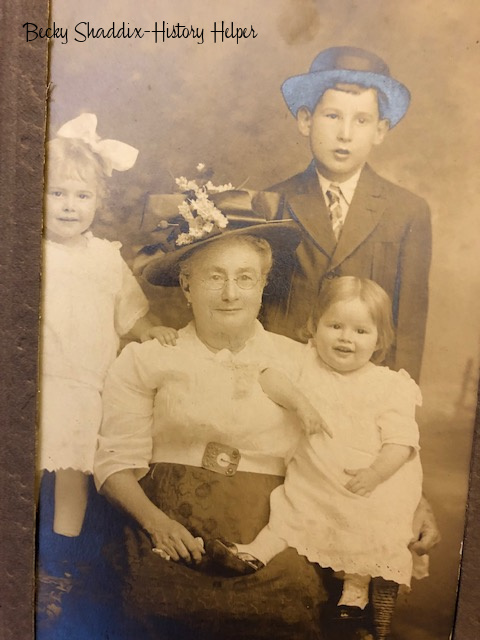
Now I’m curious as to what other great finds are awaiting me in my boxes of photos. The ones in the header of my blog here are my relatives – the baby is my great-grandfather who was born in 1873 while the group shot is my 2 paternal great grandmothers, my beloved Grandma Blair, and my grandfather, affectionately called Pappy (he passed when I was 2).  Those 2 photos I found in a box of pictures from my Grandma Blair, and I know her niece may have an adult photo of my her dad (the baby).

I hope you are lucky enough to have such wonderful finds in your own family history quest. If you have been fortunate please share in the comments below.

Genealogy

My Trip to the Health Department

Last week I finally did something I’d wanted to do for a few months: I made a genealogical appointment at my county health department.

Have you heard of a genealogical appointment?  I hadn’t either until I was trying to find out if there was a way I could get death certificates cheaper than purchasing a certified copy for $22.  That’s fine and dandy if I needed one for legal reasons, but for genealogy, with as many as I needed for my specific county, it was going to cost me well over $400 for these death certificates and that’s money I just don’t have.

That’s where a genealogy appointment saves you money (at least where I live in Ohio).

Mine was for 9:30am last Thursday morning.  I was so excited and extremely prepared (but still forgot a few people).  I arrived and they set me up at a computer where I put in the names of my deceased ancestors and from 1964 and on (this took 5 people automatically off my list).  I wrote down their name, their date of death, and their file code/certificate number and the ladies who work there then print them out on plain white paper where they are stamped with the words “For Informational Use Only” on them and though I couldn’t keep them, I was allowed to take photos of each death certificate.  (I also did some birth certificates for my mom, her siblings, and my maternal grandparents).

Two of the five death certificates I had on my list I was able to find by searching death certificate by death certificate on FamilySearch. The one for my great-great-grandmother, Mazie Randol, I was thrilled to find as she never came up in any of the searches I’ve done anywhere.  The other, her mother, Orienta Gustine Warner, was found a little easier as I had found her information on the Ohio Death Index.

My last three I have mailed away to purchase through the Ohio History Connections, the state historical society, but my cost is now just $22.58 for all of them ($7 each plus tax). Still a better budgeting tactic when you have so many to find.

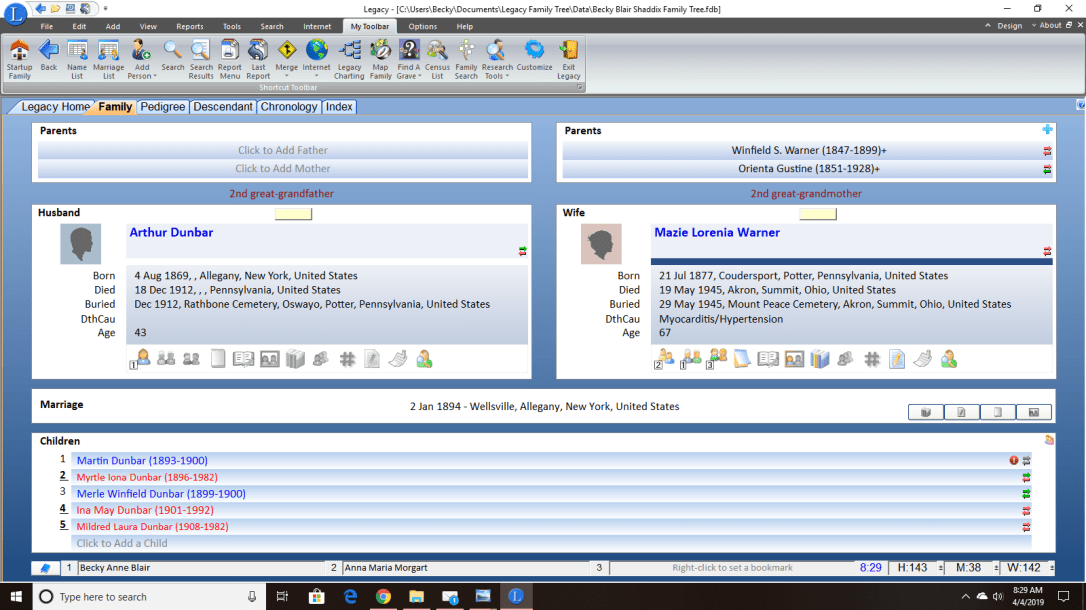
Now the blank spaces for some of my people are filled-in on my software.  It’s amazing what having all the information for a person does for peace of mind.  The individuals seem a little more complete now.  Below is an example:

Legacy-Mazie&Arthur

See how Mazie looks more complete than her first husband, Arthur? (Don’t worry, I’m gathering up names to send in with Arthur’s to get his death certificate from Pennsylvania).

Just wanted to share my money saving tip on the chance you were unaware that you can contact your local health department for this genealogical appointment.  In the state of Ohio where I live, the county health department’s can only print out death certificates for those who died in Summit County (the county where I live).  Both my grandfathers died in other counties so I’ll either have to make a trip there or contact them to see if they could scan it and send it to me or if those may be the ones I pay full price to have.  Time will tell.

It was also nice for health reasons to see what caused their death just to give me a clue as to what I may need to keep an eye on.

I am not sure if every state does death certificates this way, but it was very helpful with putting all the pieces of the puzzle together.


Genealogy

Facebook Groups for Genealogy

Last weekend I learned just how helpful Facebook groups can be for your genealogical journey.

As I was “fleshing” out a branch of my tree (it’s my great-great aunt on my dad’s paternal side) I was hoping I could find more information about her father and in turn his father (as they are my direct line).

While searching on Find a Grave, I stumbled upon a grave listed in Hopewell Cemetery (Hopewell, Bedford County, Pennsylvania) where Phoebe Blair Edmonson is buried (she’s the great-great aunt in question), and the girl’s name was Phoebe Thelma Edmonson. I clicked on her name and it said she was the daughter of my great-great aunt and her husband, James Edmonson. It turns out she was born in 1905 and passed away in 1906.  Immediately I went to Ancestry and found her death certificate stating she died from broncho-pneumonia.

As I clicked on other names I came across a 3-year old boy, Marshall James Edmonson that once again stated he was the son of James and Phoebe Edmonson.

I was lucky with Phoebe Thelma as 1906 is the first year Pennsylvania required birth and death certificates. But Marshall was born in 1896 and passed away in 1899 – was there any record of his death?

I decided to go to a Facebook group I’d joined last Fall to find out.

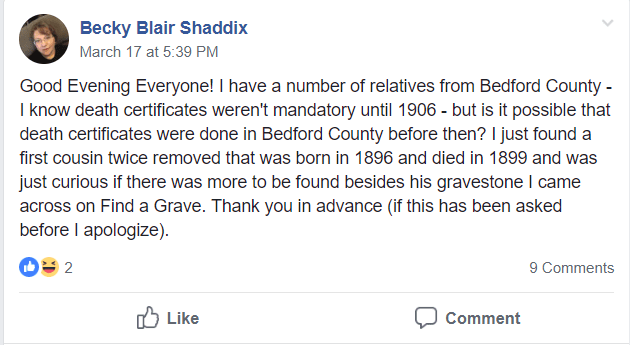
The group is called “Old Bedford County PA Genealogy (Includes Huntingdon, Fulton, & Blair Co)”.  Here was the question I asked:

FB Post 17Mar2019

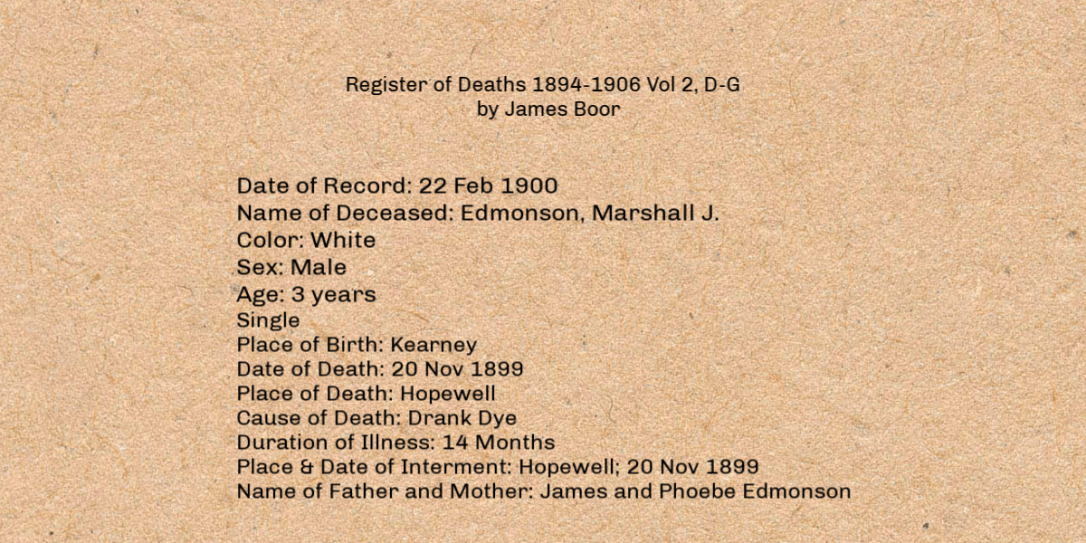
I was super lucky – within an hour I received various suggestions where to look. Someone asked for more information which is when I gave Marshall’s name, birth and death dates, and his parent’s names.  Turns out Marshall was found in a register that the county kept.  It wasn’t mandatory to report the deaths, but Marshall’s was.  The book was called “Register of Deaths 1894-1906 Vol 2, D-G by James Boor” and it had the following information listed:

Marshall

I was so thankful for this man having this book on hand and answering this question.  Within 12 hours of my post, I had received an answer.

I have found that many of the genealogy groups on Facebook have some of the kindest people in it.  They stop what they are doing and go out of their way to help you find what you are looking for and to me, it’s one of the greatest parts of genealogy.

So if you are a member of Facebook, fill in the search box with “genealogy” and see what you can find. I’m sure there is a group for the area of the world your ancestor lived or just an overall group that will help you with your search.

Good luck searching!

Genealogy

Scrapbooking

“Scrapbooking is a method of preserving, presenting, and arranging personal and family history in the form of a book, box or card” – Wikipedia.


For a few years, I was really into scrapbooking. My aunt introduced me to it one weekend when she set up a bunch of tables in her attic and had several friends and family over for a “crop”.

Never having done this before I grabbed the set my mom had ordered me off QVC and headed over with some photos (not really sure why we had these on hand, I am guessing it was something that had crossed our minds – and my mom could not resist a “Today’s Special Value”  to save her soul).

I was hooked after one time. I got up the next morning and went to the store to purchase key tools that I would need and convinced my husband it was going to be a good investment (I still have and use these items). The photos I chose were my honeymoon pictures. I figured a week’s worth of memories from Busch Gardens (Williamsburg), Myrtle Beach, and Savannah would be enough to keep me occupied for an evening,.

I had so much fun creating the pages, bringing those moments to life in a fun, whimsical way – including journaling – that allows my kids to know what was happening the first week of June in 2003 with their crazy parents.

On the next crop, I convinced my mom to go and she did the same as I did, she chose photos from a specific event (I think it was the 30th-anniversary party I threw for her and my dad) and used her set to begin her own creative journey.

My mom ended up taking her scrapbooking to a much higher level than me. She learned new techniques by taking classes from a variety of experts in the field that she discovered online. She also tried her hand at digi-scrapping which is when everything is done on the computer. She loved all sorts of concepts and took different challenges about herself, the past, everything (though her favorite topics were my kids, her only grandchildren).

My mother completed a number of layouts that pertained to genealogy/family history.  A few are posted below but more of her work can be seen on her website at Gramma’s Happy Place (she passed in late May 2018 so I have no idea how long it will stay up).

Scrapbooks have been around for a long time, not so much as their modern renditions,  but often included with photos were mementos that went along with an event – ticket stubs, hair, flowers, booklets, brochures, coins – all sorts of ephemera. These keepsakes are wonderful ways for us to learn more about our ancestors, assuming we are lucky enough to find such treasures.

My goal as I go along on my genealogical journey is to begin scrapbooking again (I’ve been blessed with all my mom’s supplies, I technically shouldn’t have to purchase anything other than glue/adhesive for years).

Do you scrapbook? Share some of your favorite pages below, it’s always a treat to see what people at their creative best.

Genealogy

A Beginner’s Guide to Genealogy: FamilySearch

If I were to begin my genealogy search again I would hope to start exactly how I did 2.5 years ago, by signing up for FamilySearch.

FamilySearch Screen Shot

Why FamilySearch?

First and foremost, it’s free!  When you have no idea how committed you are going to be for a project, free is one of the best words you can hear. And though the one huge all-encompassing tree on FamilySearch can be both pro and con, the millions of records it provides is outstanding.

One Tree: The Positives

When you are new and you put in a name and find it already on the FamilySearch tree, it’s exciting. You attach it and sometimes a whole new world is open up for you.  Even if you are unable to verify all the people right away when you are starting out, it’s EXCITING to see names that could be your relatives.

Another plus of one big tree is that if you’re stuck, it can give you a clue about who to look for in your next tier of ancestors.  We all hit that brick wall in our research, but it’s nice to get a hint of who to look for next.

Other perks of the one big tree include research that isn’t duplicated, and that a person’s research lives on after they pass.

One Tree: The Negatives

I have had my own negative experience with the “one tree”.  Someone put their relative in the middle of my family tree and I was amazed at how upset I became.  Every day when I logged into FamilySearch, there he would be, staring back at me, Andrew Sloan Blair (he really did as someone posted a photo of him that would come up on my homepage).  But Andrew wasn’t my relative, my relative is Andrew Jackson Blair who was born about 2 years before or after him (funny how this part I’ve forgotten), and I seriously doubted that my Great-Great-Grandmother, Susan Jane Foster named two of her sons Andrew in two years time.  So I was nice, I contacted the person who had inserted him onto my branch of the family tree, I even did a little research and told them who his father and mother were so the appropriate changes could be made.  They were thankful and told me it would be corrected.  A year later he was still there, so finally I deleted him from my portion of the big tree and attached him to who I had recommended the previous year.

So in not so many words, sometimes the one big tree is not the most reliable when it comes to information.  For every person who spends a great deal of time getting all their I’s dotted and T’s crossed to make sure they have the facts and nothing but the facts, you have someone who just attaches their person to whomever.

Another drawback is that people can change your correct information and replace it with something incorrect. One way to keep up with this is to put a watch on your people so that whenever anyone makes a change you are notified (there is a little star on each person to implement this feature).

Why I Like FamilySearch

No online software is going to be perfect.  Whether you use FamilySearch, MyHeritage, Ancestry, or FindMyPast (I’m sure there are some I am unaware of at this time), each of them has flaws.

FamilySearch is a non-profit organization sponsored by the Church of Latter Day Saints because they believe that family can be together in the after-life, so completing one’s genealogy is very important to the Mormons (more people to meet with when you pass on), which is why censuses, birth, and death records are posted on FamilySearch for free.

If you’re a beginner and you are just looking for basic information on a specific relative, like your grandparent, go to the search page.  By filling in the blanks with the first and last name, a state, a year (I love how with FamilySearch you can control the years you search between instead of +/- on so many of the others) and you are more than likely to get a hit (assuming the person is deceased, FamilySearch does not provide information for those who are still alive).

FamilySearch Search Screen Shot

Once you get more proficient you can start using the bottom right where it states “Find a Collection” and browse all their published collections.  Many files have not been indexed yet, so you can still find the information that has been digitized, but you have a dig a little more to find what you are looking for.

I have used most of the online genealogy sites at one time or another because I will often go to my library and utilize them for free.  If you are seeking a specific record, go to the FamilySearch Wiki and it will tell you where to find the information – even if the best place is a different site.

FamilySearch Screen Shot of Wiki

FamilySearch Wiki Screen Shot

For beginning your genealogical journey, FamilySearch is a great place to start.  You do have to sign up for a free account but it’s well worth it.  I don’t receive very many emails, and when I do it’s “here’s what’s new” which is nice if something added is what you are researching.

Some files (I don’t think I’ve come across any yet) can’t be opened unless you are at a Family History Center or a satellite location (often your library would be a branch).

The website also has a Help Center that can provide you with free tutorials to aid you in your genealogical adventure.

FamilySearch Help Center Screen Shot

I hope my brief overview of FamilySearch has helped you (I’m sure I could do a specific part of FamilySearch once a week for weeks).  It’s just one of many valuable tools you can use to find your ancestors. Genealogy is such a great and rewarding hobby, and with each discovered ancestor a piece of your own personal puzzle is found.