The theme for 52 Ancestors in 52 Weeks is “tragedy”. I’ll admit I did a search in my genealogy software trying to find a relative who was a logger and died under tragic circumstances (I could not find them) or I contemplated about a distant cousin who died young under horrible circumstances (leaving that for another year?).
But then I decided to be different.
All week long when I began attempting to compose this post the Bee Gees song began going through my head. Why? Well “Tragedy” is the name of the song, it’s also quite catchy, as most songs by the Brothers Gibb are.
But for me the Bee Gees songs have a greater meaning, in the last 20 years of my mom’s life she loved the Bee Gees and would often ride her recumbent bike listening to them, or when taking a walk around the block or at the local gym. She would often comment that their music would allow her to bee bop through the house (she had a specific term for this bee bopping but I shall not say it, because though Cynthia Anne Fairhurst meant it as a HUGE compliment, it may not be seen that way in today’s climate).
The Bee Gees Greatest Hits were one of my mom’s favorite albums, and my sister often has moments that she feels my mom is with her when a Bee Gees song comes on. Sadly, I don’t listen to the correct radio stations to be blessed with this – but that’s okay. I get cardinals in my lilac bush on her birthday which is just as nice.
This week’s theme for 52 Ancestors in 52 Weeks is “In the City”. I’ll admit this one was hard, because most of the relatives I have focused my research on were born and died in Pennsylvania, in one of the following counties: Bedford, Blair, Cambria, Fulton, Huntingdon, or Somerset. Granted on my mom’s side they either came from England and settled in Ohio or they were born in Massachusetts and moved to Potter County, Pennsylvania. But finding someone who was born in a small town and moved to a big city was not anything my ancestors did.
But then I remembered my 5th-great-grandfather, Ebenezer Oakman, who was born in Lynn, Essex, Massachusetts and moved to Philadelphia, Pennsylvania.
Lynn, Essex, Massachusetts
With land purchased from the Indians, Lynn, was founded in 1629, specializing in the manufacture of leather shoes, eventually becoming the ladies shoe center of the world, even getting Congress to place a protective tariff on the shoes.
In 1850 Lynn officially became a city and they had another claim to fame as the General Electric Company was born in 1892 by the merging of Edison Electric and Thomson-Houston Electric.
Today, Lynn is the 9th largest city in the state of Massachusetts and is close to 4 miles north of Boston located on the Atlantic Ocean.
Ebenezer Oakman
Ebenezer Oakman was born 8 August 1775 in Lynn, Essex, Massachusetts when it was still a part of British Colonial America, to Isaac Oakman and Elizabeth Lathe. He married Hannah Stocker on 13 October 1796 and they went on to have six children: Rebeca, Hannah, Elizabeth, Ebenezer Phillip, Sally, and Squires, all born between 1797 and 1805 (this was found using a document I found at AmericanAncestors).
In 1802 Ebenezer began a shoe factory in East Saugus with large expansions in 1807 and 1810, where he then had the largest shoe factory in the area. He would make the shoes in Massachusetts and then take them to be sold in Philadelphia, however in 1818 he moved the entire business to Philly.
One of the reasons for the move was that Ebenezer’s wife, Hannah, died on 27 March 1812. He then met and married Anna Bruce Ansley in approximately 1814 where they then had seven children between 1815 and 1832: Joseph, Robert, Agnes, Jane, Isaac, John, and William.
It appears around 1850 Ebenezer and Anna separated and he moved to and died in Lynn, Essex, Massachusetts at the age of 78 on 6 September 1854 (she moved to Illinois with Isaac).
My Lineage
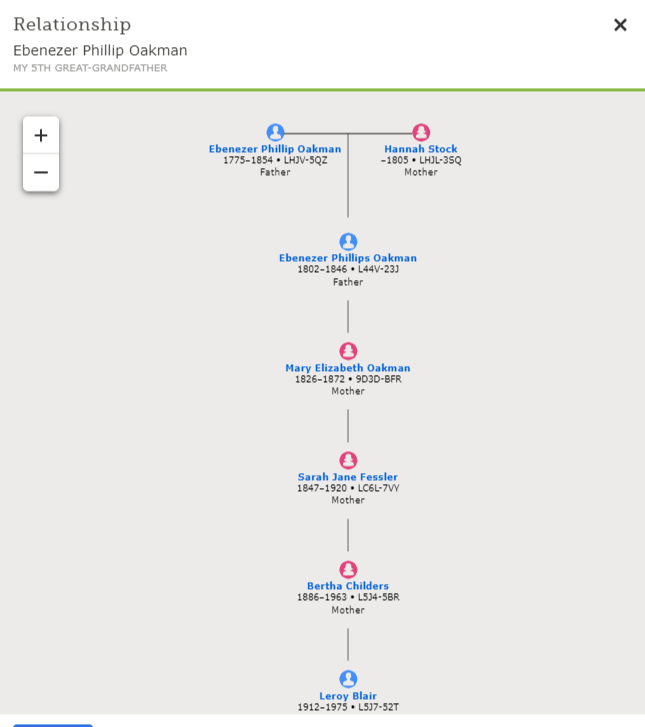
I am related to Ebenezer Oakman through his oldest son, Ebenezer, through his daughter, Mary Elizabeth who was born in Philadelphia to his wife, Mary Catherine White. Mary married George Henry Fesler and their oldest daughter is my 2nd-great-grandmother, Sara Jane Fesler. She married Randall Childers and had Bertha Childers, who married the younger Andrew Jackson Blair and their son Leroy was my grandfather.
Here is the direct relationship from my grandfather, Leroy Blair, to my 5th-great-grandfather, Ebenezer Oakman using FamilySearch
As a girl who was quite fond of trendy shoes back in my college days (well, we can just sum it up as the 1990’s in general) I was really excited when I learned of my ancestors owning a leather shoe store. I’ve not yet uncovered what happened with the shoe store (one of the online blurbs I read stated they traded the store for land in Bedford County but at this time I have nothing to back this up), but I would love to know if maybe this company turned into a brand that I myself wore.
I literally went through a list of my ancestors names to determine my “favorite name”. It was tough but like most everything else, she popped out and despite my looking at other names that caught my eye (one was a first cousin twice removed, Chester Charles Childers because who doesn’t like a good cha-cha-cha) I couldn’t stop thinking of a name I saw before his, and that is Thankful Chapin, my fifth-great-grandmother.
Or is she?
I think she is though many do not have her listed as my fourth-great-grandfather’s mother. He was born in 1809, she died in 1812, seems like he should fall into her realm. But who knows? But here is what I do know about Thankful Chapin Warner.
Who is Thankful Chapin?
Thankful Chapin was born 11 November 1774 in Bernardston, Franklin, Massachusetts to Lt. Joel Chapin (he fought in the French & Indian War and the Revolutionary War) and Sarah Burke, the sixth of seven children born to this couple. Her siblings names are Joel Chapin, Jr., Eddy Burke Chapin, Israel Chapin, Solomon Chapin, Sarah Chapin, and Oliver. Depending on the book you read it claims she had another sister, Gratia, who was also married to Joel, but this book seems to be the only book I can find that lists her.
On 27 April 1799 she married Joel Warner and in their almost 13 years of marriage, they had three children: Sarah Burke Warner born 8 February 1800; Anson Warner born 27 November 1805; and lastly Oliver Charles Warner who was born in 1809. She died on 3 April 1812 and is buried with many other Chapin’s in Old Cemetery, Bernardston, Franklin, Massachusetts.
I have never been able to find a whole lot of information on Thankful, and honestly nothing concrete if she is really Oliver’s mother (though since her younger brother was an Oliver, it really helps to think that she may be).
So over the course of the next few months, as I discuss research logs I plan on using Thankful as my example, to prove that she is the mother of Oliver Charles Warner.
Why Is Thankful a Favorite Name?
I chose Thankful Chapin as my favorite name as it always brings a smile to my face. We all have so much to be thankful for and to have a direct line ancestor named such, and you wonder why her parents, my sixth-great-grandparents, would name their daughter such a name. Did they have a reason to be extra grateful at that time? 1774 had the British Colonial America gearing up for a war with Great Britain, Massachusetts especially. Did they have a good crop that changed their world? So many things go through my mind.
Do you have an ancestor whose name is your favorite? Feel free to share!
This is my 100th post on my blog. I was surprised a few weeks ago when I saw I was at 95 posts and couldn’t believe I was reaching a milestone (or at least it is for tv shows).
The one thing I have not done is add more book reviews and actual history tidbits – I actually named my blog “becky history helper” for a reason – because I wanted to bring history to life. I was fortunate to have fun history teachers that made learning fun and I hope to do the same going forward with my blog.
In the meantime I will re-start posts on the important things you should do when completing your family history (if nothing else as a reminder to me) as well as continuing Amy Johnson Crow’s writing challenge of 52 Ancestors in 52 Weeks.
Thank you for reading and subscribing to my blog and I hope to share more knowledge and make it even more exciting in the future.
This week’s topic for Amy Johnson Crow’s 52 Ancestors in 52 Weeks is Health. It was proving to be a struggle for me as I went through various people, illnesses, and how my mom was a nurse, but since I had discussed her not so long ago I wanted something that was different and not so obvious, and then it hit me – I have so many relatives who were coal miners, I decided to discuss the unhealthy conditions of working in a coal mine.
Coal Miners in My Family
I started making a list of all the men that were coal miners in my family and had not gotten too far on just my dad’s side and I already had over 20. My mom’s side could easily have just as many with her Fairhurst and Boone relatives as they all came over from England in the early 1900’s and settled in Jefferson County, Ohio where they were also miners (my great-grandmother, Phoebe Boone even ran a boarding house for miners).
My coal miners were not just limited to those who were here in the United States like my Blair’s, or the Fairhurst’s and Boone’s who immigrated from England, but my great-great-great-grandfather, James Boone was a coal miner in England. I do know that Isaiah Boone, mentioned later, moved to Utah and mined there and then returned to Ohio.
An Unhealthy Industry
Coal was one of the main resources that ran engines (stationary and locomotive) when the world began going through the Industrial Revolution. Though in the United States coal mining was done in smaller, rural towns, the mines were sometimes owned by railroads, which would obviously make sure the coal got where it needed to go.
Coal mining was not easy work. You were in the darkness all day, hunched over because most of the time the cavities within had low ceilings and you were constantly inhaling coal dust. Many illnesses were caused by lung issues.
Coal Workers Pneumoconiosis
Coal Workers Pneumoconiosis is a lung disease caused by the inhalation of dust and the lungs become inflamed or scarred which eventually made the person have a difficult time breathing. Another common name for this is black lung.
The stages of the disease often began with a cough, which leads to shortness of breath, then chest tightness. There is no cure, only prevention.
Though technology was not available hundreds of years ago, today’s miners can wear a personal dust monitor that measures the dust exposure, knowing at the end of each shift what the amount of dust was.
Another similar ailment is Silicosis.
Lung Cancer
Lung cancer in coal mining is primarily caused by exposure to the diesel exhaust daily for five-plus years. This is focused primarily on miners since the 1940’s and is normally combined with pneumoconiosis.
Chronic Obstructive Pulmonary Disease
Chronic Obstructive Pulmonary Disease (COPD) is a common ailment among many people in today’s world, even outside of being a coal miner (your common habit of smoking is enough to contribute to COPD, my mother and maternal grandmother were both diagnosed). Like pneumoconiosis, COPD cannot be cured. Examples of COPD are bronchitis and emphysema, and along with coal worker pneumoconiosis, it has been classified as an occupational disease.
Skin Conditions
Coal miners suffered various skin ailments along with the lung diseases. Eczema and contact dermatitis were issues that came about since the 1950’s due to chemicals, “communal bathing, prolonged and profuse sweating, friction and dirty clothing” causing bacterial and fungal infections (and was the reason for the most days missed).
Though not deemed harmful, “coal tattoos” also were a sign of the coal miner as the miner would get cut and coal dust would get in it before it healed.
Disasters
Along with suffocation, gas poisoning, another unhealthy part of coal mining are explosions and mine collapse. I know in my own lifetime I’ve witnessed on television in differing areas of the world tragic outcomes where a group of men were trapped underground due to an explosion or a cave-in and it was unknown if the area where the men were trapped had enough air to sustain the 22 miners in China (11 survived), or the 33 miners in Chile (all survived for a period of 69 days), or the 13 miners in West Virginia (only 1 miner survived this explosion).
Explosions in mines are nothing new. I have both direct and collateral ancestors in my tree who died from such mining accidents.
“Mine Explosion Kills Four Men At Wolf Run” – Carroll Journal, 12 December 1935
“Four men lost their lives and 31 had a narrow escape in an explosion early last Thursday night in the Warner Collieries Mine at Wolf Run near Bergholz. Those killed were Isaiah Boone, 50, his half brother, Joseph Boon, 47, and Robert Russell, 25, all of Amsterdam, and Albert James, 50, of Bergholz.”
Isaiah and Joseph Boone were the older and younger brother of my great-grandmother, Phoebe Boone, she was sandwiched between them in chronological order of children of Enoch Boone and Susannah Rigby’s children. Both came to the United States from Leigh, England – Isaiah in 1923 and Joseph in late 1920.
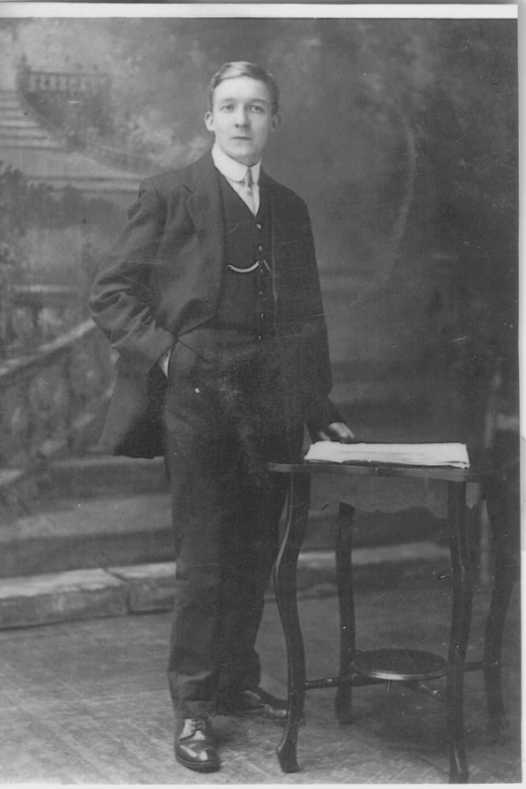
Isaiah Boone, photo permission granted from RWissler Collection
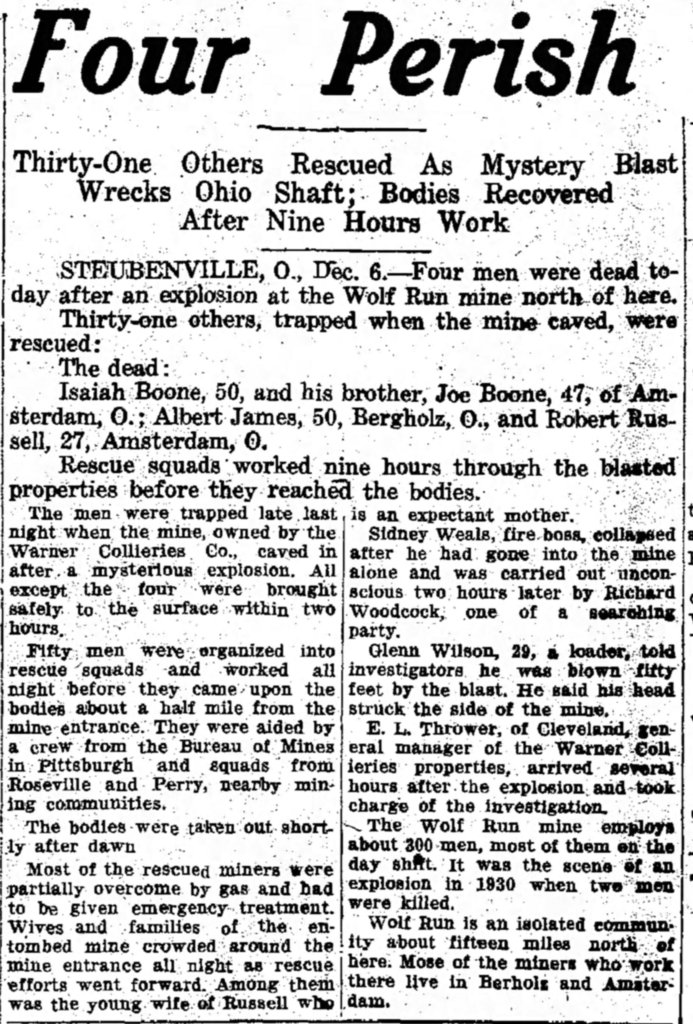
Using Newspapers.com to find articles of the paper, the blast was reported from as far East as Connecticut and as far west as Idaho, and I also found where it was reported in Canada.
Article taken from the 6 Dec 1935 Xenia Daily Gazette found on Newspapers.com
Andrew Jackson Blair
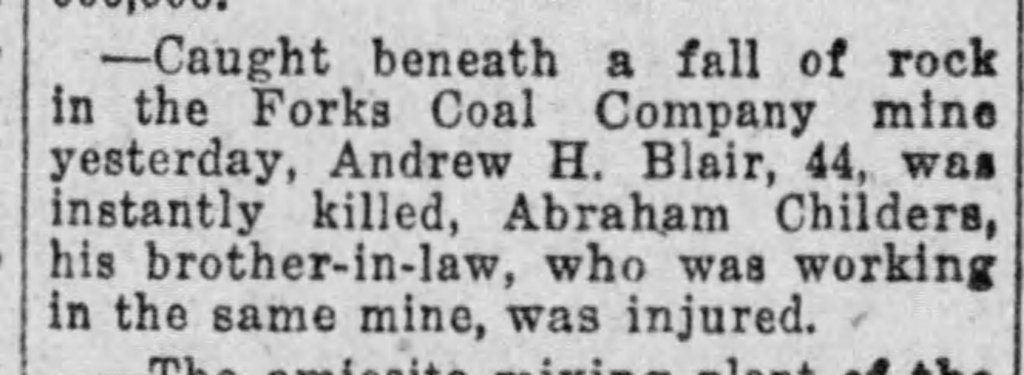
“Blair, Andrew J. aged about 44, of B Court was instantly killed about one o’clock this afternoon when caught beneath a fall of rock while at work in the Forks Coal Mining Company mine. The victim was badly crushed. Mr. Blair’s brother-in-law, Abraham Childers, was injured in the same mine yesterday, having the ligaments torn in his leg”. – Johnstown Tribune, Wednesday, 17 November 1926, Page 26 (This article was found on Find A Grave where it was transcribed for his memorial, I was unable to find the original to include).
My great-grandfather was born in 1881 and on the 1900 census was already working in the coal mines. My dad told me that his dad, Leroy, Andrew’s oldest surviving son, also briefly worked in coal mining but had an accident in the same area his father died and that is when he found a different vocation.
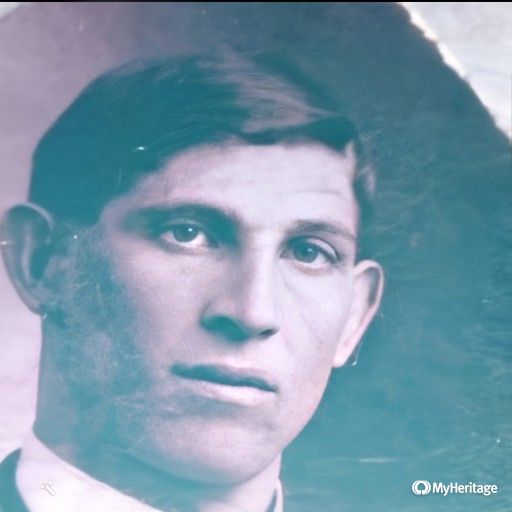
Andrew Jackson Blair, sadly he was cut out of a group photo it is believed to have been from a church. I enhanced it at MyHeritage (hence their watermark in the corner)
I was able to find a newspaper article from Harrisburg, Pennsylvania newspaper, The Evening News, with a snippet of his death:
The Evening News from 17 November 1926 found on Newspapers.com
Other Interesting Facts
Coal mining was an institution unlike any other that I know of. Workers worked for a company who not only paid them in company cash or script, the housing was crude and also owned by the mines, the stores that took the script were owned by the company and priced everything high, but they could, because these stores were the only ones that would take the company cash. You were in a never-ending cycle and it really didn’t give you an “out”.
Young boys began working at the mines by the time they were 12 to 14 years old. They were not allowed to work in the mines but they would stay outside sorting the coal. To work within the mines they had to be 18 years old.
The social systems surrounding the mines were ethnicity based. Those with the highest prestige were the Welsh and English (this would have been where Isaiah and Joseph Boone fit in); then the Irish, Italians, Eastern Europeans and finally those that were from Appalachia. I am not quite sure where my great-grandfathers would have fit in being born in Bedford County, Pennsylvania, they weren’t foreign but also too far north for Appalachia.
It had to take a person of strong mind and spirit to work in the coal mines day in and day out. My other paternal great-grandfather, Charles Jackson Morgart worked in the coal mines the last handful of years before he took his own life. I’ve sat and contemplated his death numerous times trying to wrap my head around why he killed himself but I’m sure it’s a mystery I’ll never know for sure. Was it a bit of depression from working in the dark after being a farmer? I’ll never know.
I am sure there are hundreds of other illnesses that can coincide with working in a coal mine that I haven’t listed, but this is what I found in just a day or two researching for this blog of mine. Coal mining was a dangerous occupation that until I saw how many of my ancestors did this for a living, I never gave much thought too (well, until you hear about a grave situation on the news). I look at it so much differently these past few years, so many risks, both health and otherwise, that these men took to provide for their family.
* I found the information for the above article and provided links throughout leading to Wikipedia, American Lung Association, NCBI, NIOSH, and the Nursing Times
Thank goodness for fashion, otherwise we would never be able to figure out what era our family pictures came from. Fashion is also the theme for this week’s 52 Ancestors in 52 Weeks, and though there is not much for me to say, more or less to show, I am going to showcase my 2 fashionable aunts on my maternal side of the family.
Ina May Dunbar
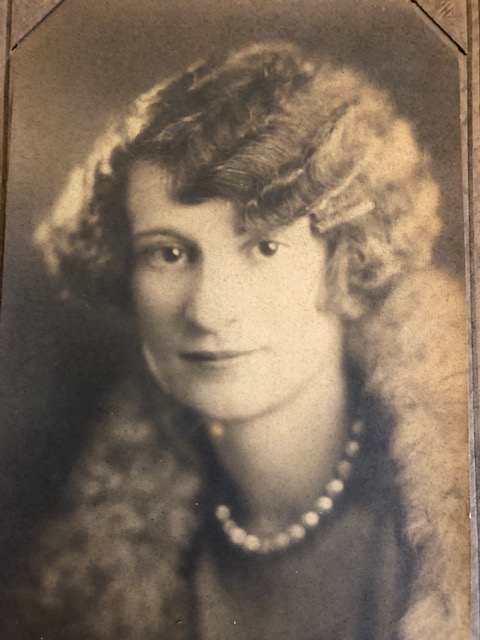
I remember a few weeks ago when I was binge-watching Downton Abbey, when I saw Edith’s ‘do in season 3 as we entered into the 1920’s I smiled at how much her hairstyle reminded me of my Great-Grand-Aunt, Ina May Dunbar, older sister to my Great-Grandmother, Mildred Laura Dunbar.
Ina May Dunbar, circa 1920’s
She is so beautiful and stylish, between the fur top of her coat and the pearls. I always have wondered how they got those beautiful waves in their hair, I’m sure I would utterly fail if I ever tried to attempt it myself.
Terry Mildred Fairhurst
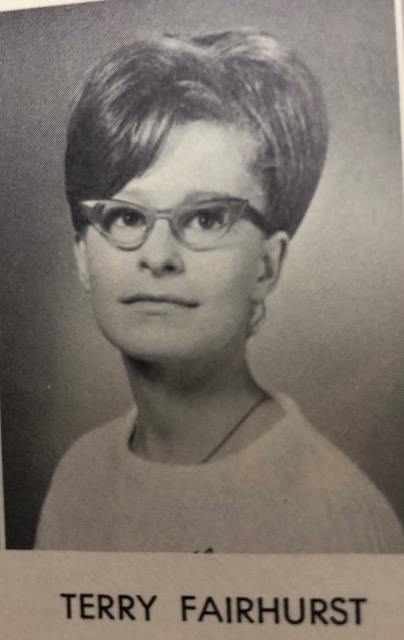
My Aunt Terry was such a wonderful lady. She had a hard life, mostly because she made poor choices, but she always did her best to make lemonade out of lemons. Or at least that is how it seemed to me when I would talk to her. No matter how bad life seemed to get, she was a fighter and found a way to land on her feet (probably because she had family who loved her).
But my Mom always loved how stylish her younger sister was. My Aunt loved to dance and just have a good time. I loved her laugh.
Terry Mildred Fairhurst, 1965
I have so many other photos of beautiful ladies but these are the two I have that just really exemplify the decade of fashion they were taken in. The 1920’s and the 1960’s had such unique style, so much that they are often imitated even today.
Today I am not writing about a direct line ancestor, but a man who seems to have been a very special person. His name is Samuel J. Randol and he was the second husband of my maternal great-great-grandmother, Mazie Lorena Warner.
Samuel Joseph Randol holding Alberta Lou Fleming, early 1930’s (again, no date but my Grandma was born in October 1929)
I will tell the tale of Samuel as he at one point worked for the railroad when they lived in Potter County, Pennsylvania. Then, after moving and settling in Akron, Summit County, Ohio, he worked as a truck driver. He was actually making a delivery to Decatur, Macon County, Illinois, when he became ill and died.
Samuel Joseph Randol
Samuel Joseph Randol was born 5 October 1874 in Independence, Warren County, Indiana to Alonzo Randol and the former Laura Altman. Upon doing my homework for this post I came to the conclusion that Samuel had been married three times. He was divorced from a Rosa Cox (born in 1876 and passed away in 1924), and his second wife, Emily, died of a cerebral hemorrhage a month before he married Mazie (I tried to keep an open mind hoping that Samuel and Emily had only been married a short time, but it was 14 years, but this was over a century ago, they did things different then, right?)
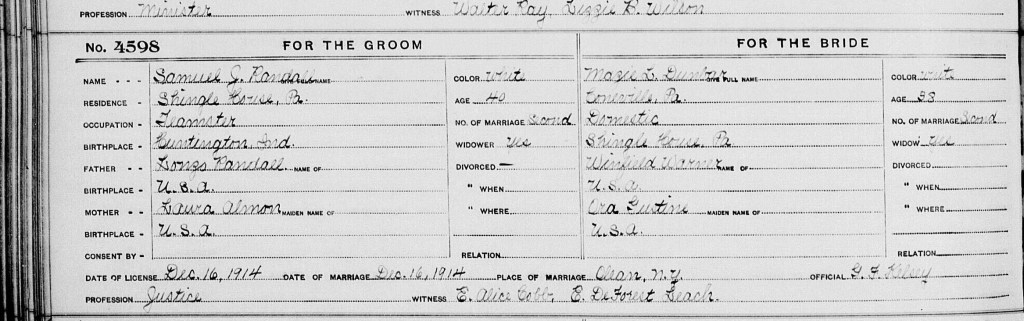
Portion of the page from the New York Marriage License of Samuel Randol & Mazie (Warner) Dunbar – this Record of Marriage was found on FamilySearch
His Occupations
According to the 1900 Federal Census, Samuel was listed as a teamster. For those who do not know what a teamster is, it is a truck driver or a person who drives teams of draft animals.
In the 1910 Federal Census he was listed as working for the railroad. This was not his only stint with the railroad, he was employed with the Pennsylvania Railroad once he settled in Akron from 1917 through about1922. When he initially moved to Akron he worked for the Swinehart Rubber Company, which was not far from where he lived.
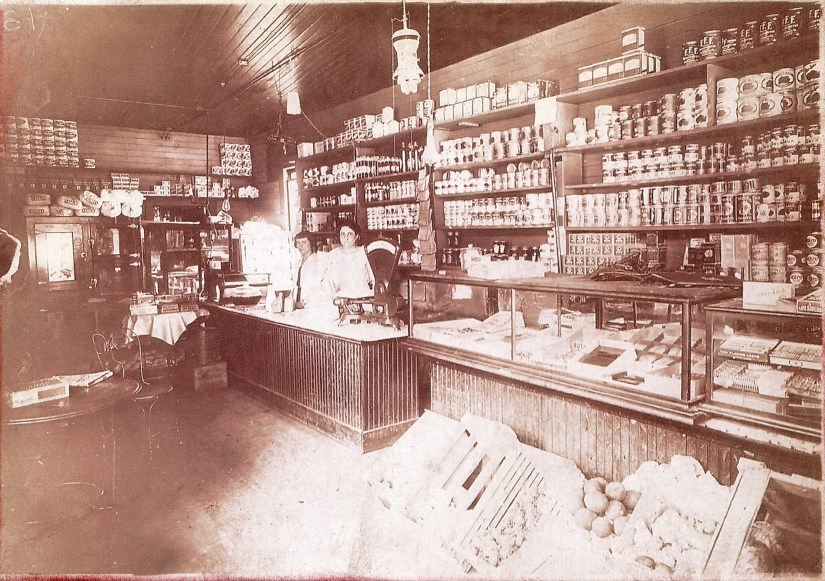
Around 1923 he opened his own grocery store entitled “SJ Randols” located on Howard Street in North Akron. This entrepreneurial endeavor did not last long as he was once again a truck driver by 1925 (I tracked his occupations once he arrived in Akron using the digitized City Directories that are located online by the Akron-Summit County Public Library, from years 1859-1969).
S.J. Randols Grocery Store – this was amongst my great-grandmother’s items, no date, no names. Circa 1923
Life With Mazie
Seeing as his first 3 marriages did not last long, that Samuel was married to my great-great-grandmother for 23 years, it must have been love (or at least I hope it was).
Samuel and Mazie were married in Olean, Cattaraugus County, New York on 16 December 1914. By this point in time my great-great-grandfather, Arthur Dunbar, had been dead for 2 years (he passed away of heart failure, most likely a complication from his having polio).
When Samuel married Mazie he got a full package, her and 3 daughters, who he took on and cared for as his own. Myrtle had already married William Harvey of Elmira, Chemung County, New York, but Mazie was still raising a teenage Ina May Dunbar and my 6-year-old great-grandmother, Mildred Laura Dunbar.
Just before moving to Akron, Samuel and Mazie had a son, Richard LeHoty Randol 8 March 1916. Five months later on 7 August 1916 he died of intestinal intoxication, which is a severe dietary deficiency. It’s so sad when you see dehydration and malnutrition as causes of infant deaths just a century ago as IV’s and formula now do so much.
Richard LeHoty Randol, only child of Samuel & Mazie, 1916
Samuel and Mazie had no more children but had their hands full with Ina and Mildred.
Ina married John Slater, had a daughter, but when the marriage didn’t last it was Samuel and Mazie who took them (Ina and daughter) in. The same could be said for Mildred twice over as she got married, then divorced, got remarried, had a daughter, then another divorce and when she married for the last time they lived with Samuel and Mazie for a couple of years before finding a home (I like to think they were saving up for a down payment?).
Ina did re-marry Ralph Stone in 1928 and I remember attending their 50th Anniversary Party. I was 5 and my Daddy was getting me punch, not realizing it was spiked. All I remember is laughing a lot and saying “Oh Johnny” as I thought my older teenage cousin was really cute (Johnny descends from my Aunt Myrtle, and I have yet to find him in my genealogy search).
Anyhow, I digress. In 1938 Samuel was still a truck driver, often going to Decatur, Macon County, Illinois. He apparently got sick while there, was taken to the hospital and after a week “with a complication of diseases” he died.
The Decatur Daily Review, Monday, October 17, 1938 – found on Newspapers.com
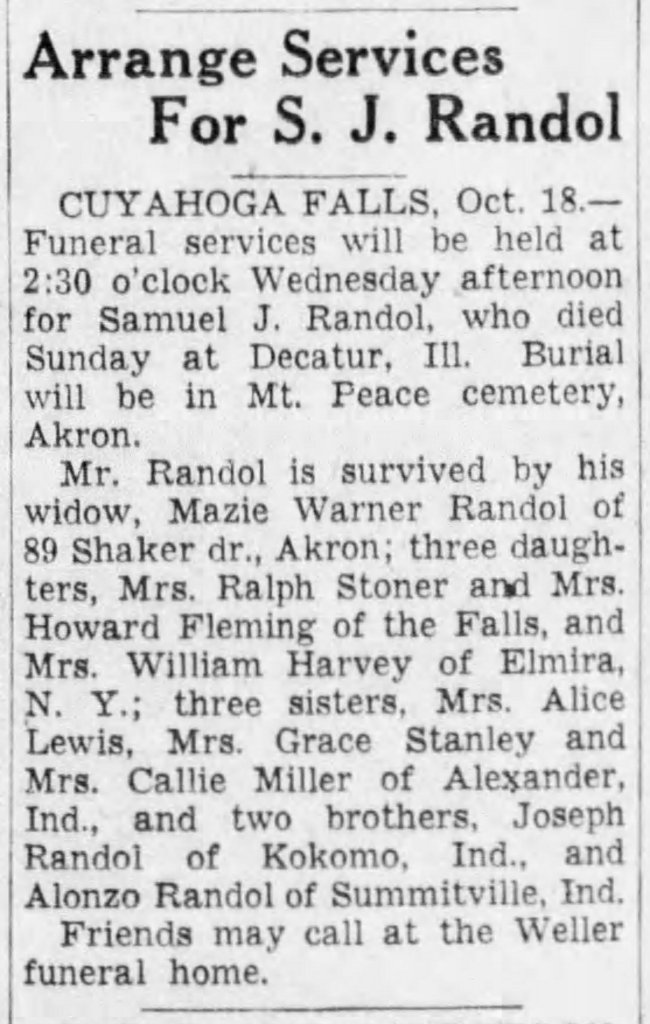
They shipped his body back to Ohio, and his funeral had quite the turnout. Along with the photos and such my dad gave me that were my great-grandmother’s, Samuel’s funeral book is among the items. I was amazed at all the names of all the people, at least 10 full pages, who either attended calling hours or the funeral (or both). Among them, one of his first Ohio friends, Clyde Geer (and most likely my great-great-grandfather). Clyde worked at Swinehart Rubber Company when Samuel did when he first moved to Akron in 1916.
The Akron Beacon Journal, Tuesday, October 18, 1938 – found on Newspapers.com
But working in transportation – be it by train or automobile (maybe even heading up a team of animals???) is how Samuel supported himself and his family. That he changed with the times was quite trendy of him.
Though I never met Samuel (he died about 35 years before I was born), he seemed like a loving man and I couldn’t have asked for a better person to care for Mazie.
Transportation was the theme for week 28 of Amy Johnson Crow’s 52 Ancestors in 52 Weeks family history writing challenge. It’s a fun way to stop and write about your family each week. If you would like to sign up, please do so here.
Free is the prompt for this weeks 52 Ancestors in 52 Weeks, and who better than to write about than my 5th-great-grandfather, Solomon Sparks, who fought in both the Revolutionary War and the War of 1812.
Solomon Sparks was born 13 June 1758 to Joseph Sparks and the former Mary McDaniel in Frederick, Maryland. Overall he was the fifth of at least nine children, and the third boy. (As a side note, Solomon’s younger sister Sarah is also my 5th-great-grandmother, making Joseph and Mary my 6th-great-grandparents two times over).
Solomon’s family moved from Maryland to Bedford County, Pennsylvania in 1778 and in 1782 Solomon joined the militia as a private, mustering out when the war was over in 1783. He was a part of Captain Boyd’s Company of Rangers, their job was “to scout the forests and guard the settlements against surprise attacks from hostile Indians” (Taken from the History of Bedford, Fulton, & Somerset Counties).
Upon the war ending Solomon returned to Frederick, Maryland to live for a short time. This is where Rachel Weimer also lived, and they very well could have known each other or met at this point in time. They married in Pennsylvania in 1786 and had 11 children, settling in Providence Township in Bedford County, where he became a successful farmer.
When the War of 1812 began Captain Solomon Sparks and his Regiment of Rifleman “marched through the wilderness to the Canadian frontier and there performed efficient service” (Taken from the History of Bedford, Fulton & Somerset Counties).
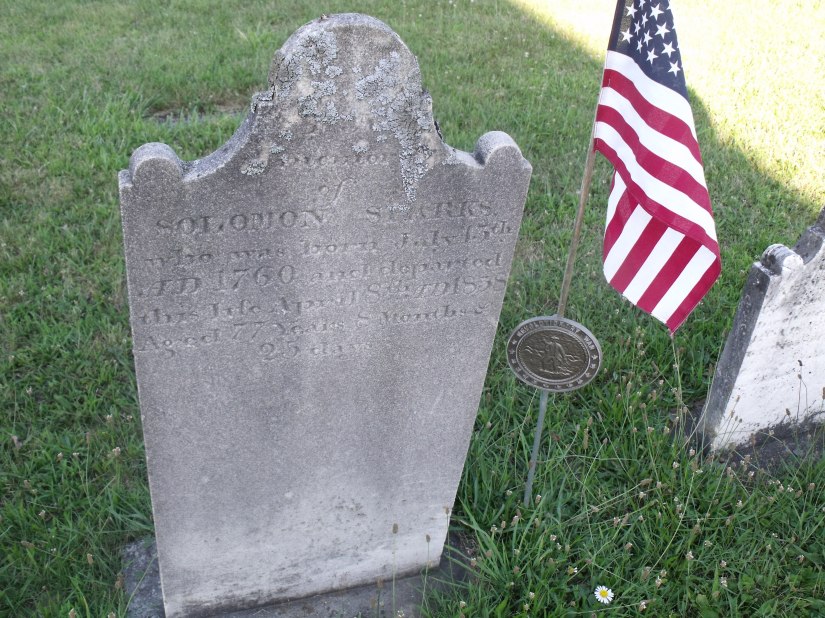
Solomon passed away on 8 April 1838 but I wonder if he had been ill for a while. His will is dated 10 January 1821 with the beginning wording as “being for time very unwell but sound in mind, memory and understanding” (will was found in records not yet transcribed on FamilySearch). He gave $200 to each of his daughters, and money and homes to each of his sons. His wife, Rachel, was Executrix and his oldest son, Abraham, Executor.
Grave of Solomon Sparks, he is buried at the Providence Union Church in Everett, Bedford, Pennsylvania
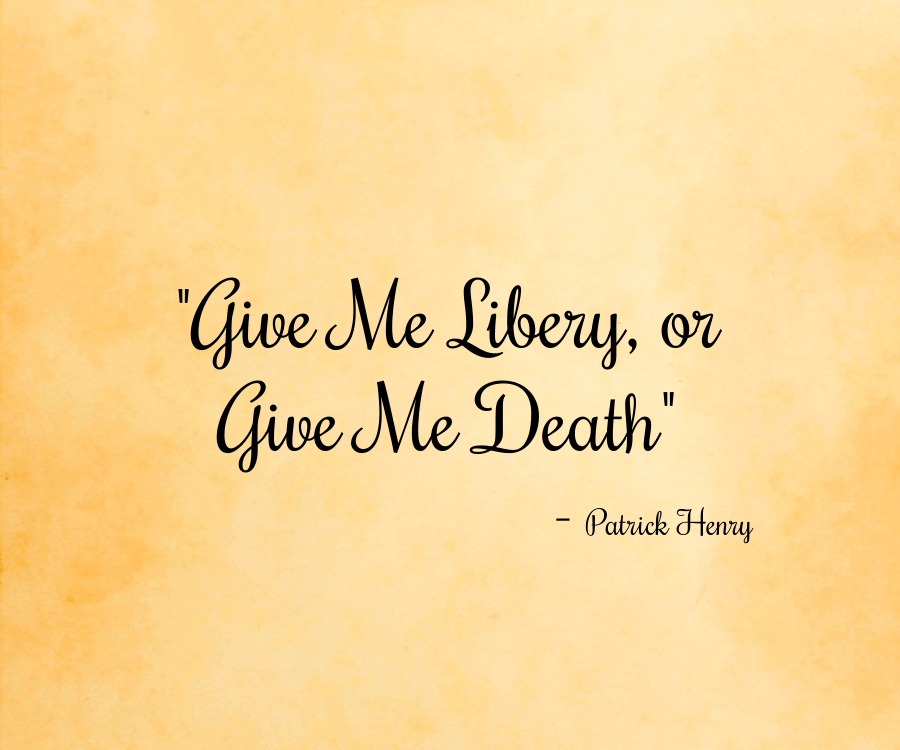
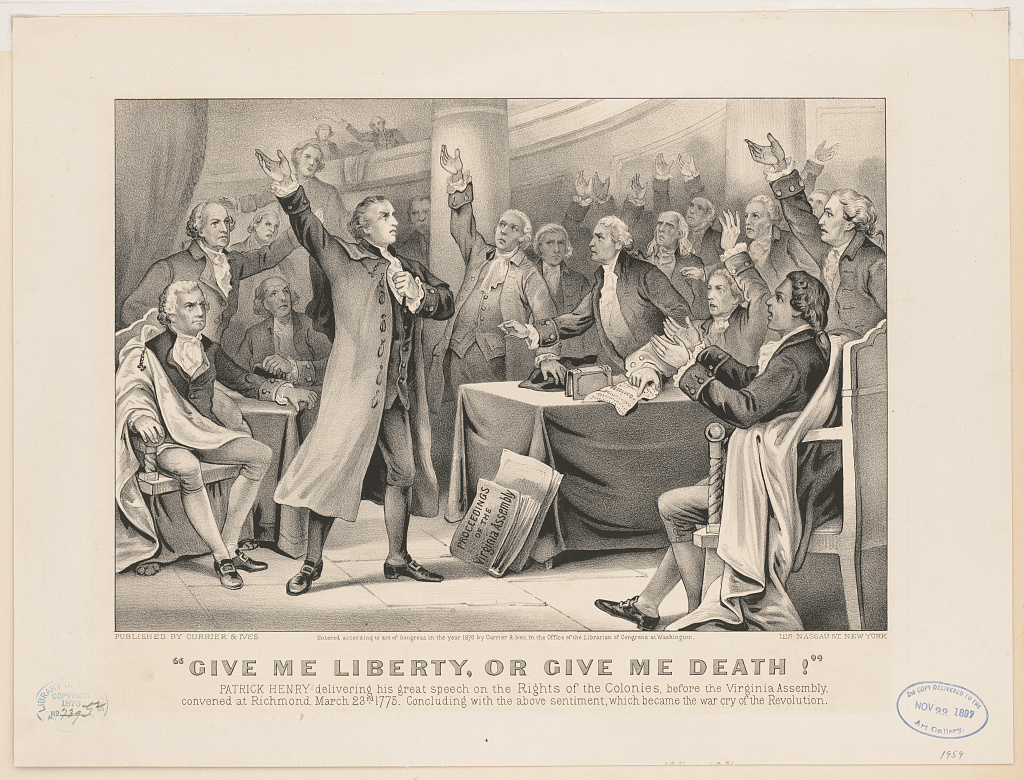
Famous words that finished a speech given by Patrick Henry on 23 March 1775 that encouraged the Second Virginia Convention that was taking place at St. John’s Church in Richmond, Virginia to become a part of the Revolutionary War (or at least put Virginia in a place of defense).
This is a Currier & Ives drawing circa 1876 that can be found at the Library of Congress
After his memorable speech Patrick Henry was named Chairman of the Committee to build the Virginia militia.
No one knows for sure if Patrick Henry said the infamous words or if his biographer, William Wirt, created them. Regardless, men who were in attendance that fateful day claim it is the “boldest, vehement, and animated pieces of eloquence that had ever been delivered” according to John Marshall who spoke on behalf of his dad, Thomas Marshall. George Mason claimed “every word he said not only engages but commands attention”.
Who Was Patrick Henry?
Patrick Henry was born on 29 May 1736 in Virginia. He was born of privilege and at age 10 was taught Latin, Greek, Math, ancient and modern history by his father. He was a self-educated lawyer, who like the philosopher Cato would use speeches as a form of persuasion.
Following the Declaration of Independence, Patrick Henry served as it’s 2nd and 6th Governor (from 1776-1779 and again from 1784-1786). Throughout his life his other vocations were planter, politician, and orator.
He made countless speeches over the years and no one ever wrote them down, a sad tale for his biographers. He was a highly respected man and is considered one of our nations Founding Father’s.
He passed away on 6 June 1799 of stomach cancer.
The Entire Speech
If you would like to read or hear the entire speech given at the Second Virginia Convention, please click here to visit the Colonial Williamsburg website where you can download an MP3 version to listen or read the words already typed out of this speech with the famous ending.
I found the information used above by reading a variety of websites:
When it came to finding conflict in my tree, as that is the theme for this week’s 52 Ancestors in 52 Weeks, one of my biggest puzzles is how George Mullen is related to my to my 2nd-great-grandmother, Anna Maria Leighty.
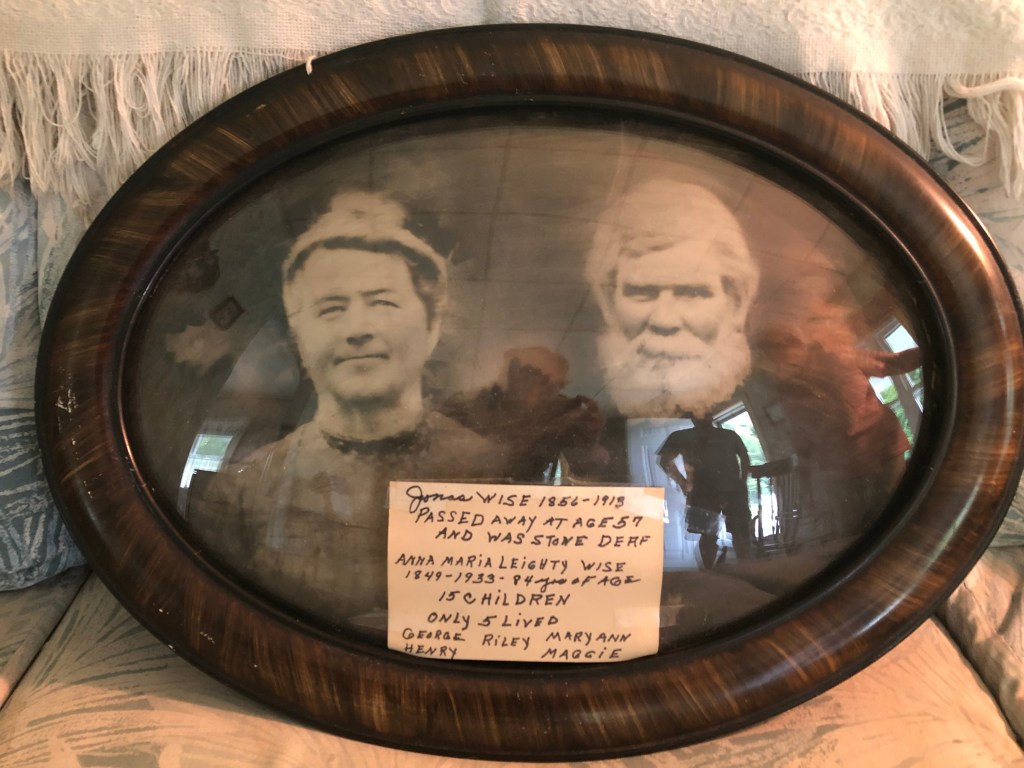
Supposedly George is Anna Maria’s son, but I don’t have any concrete proof that he is her son. I will confess I do have him listed in my family tree software as her son, only because of the below note on the picture of Anna Maria Leighty and her husband, Jonas Wise that my first cousin once removed, Hope, found left behind at a Wise Family Reunion in the 1990’s.
My great-great-grandparents, Anna Maria Leighty and Jonas Wise (shadow in my photo is my husband)
The note states:
Jonas Wise 1856-1913 Passed away at age 57 and was stone deaf
Anna Maria Leighty Wise 1849-1933 84 years of age, 15 children only 5 lived
George, Henry, Riley, Mary Ann, Maggie
Even the note is incorrect, Anna Maria first shows up on a census in 1860 because she was born in 1851. Most documents support Jonas being born in 1855. Their death years are both correct.
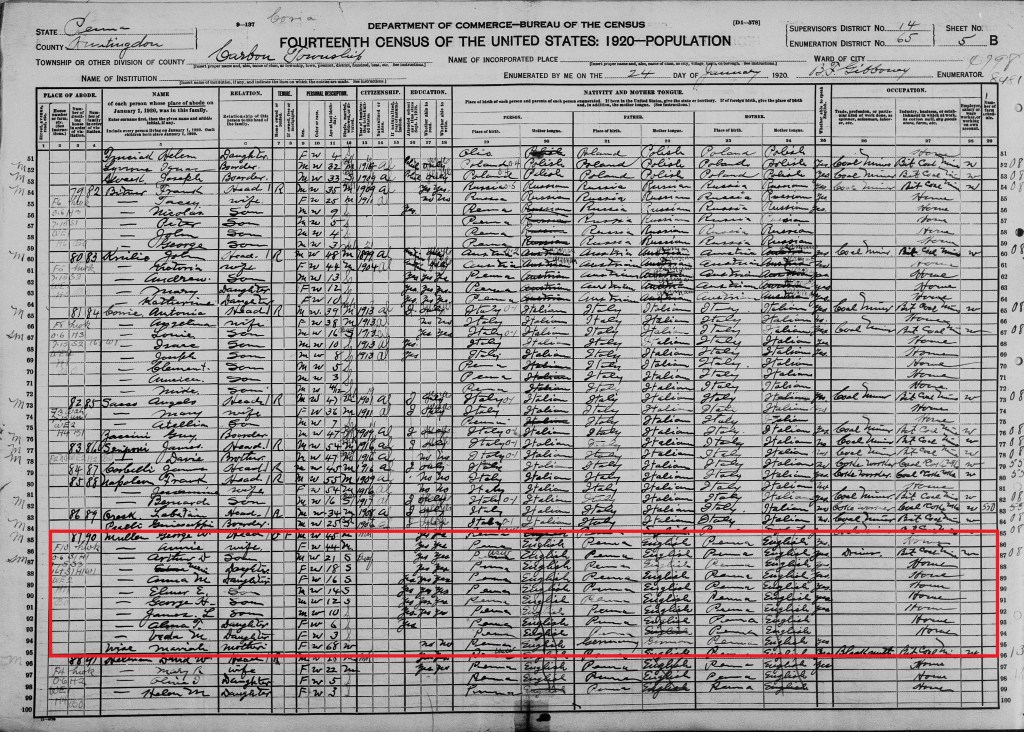
When you put all the pieces of the puzzle together, the only other piece of information that helps me think for a moment that he was her son is that she was living with him and is listed as his mother in the 1920 census (though i know you can’t always go by what the census says).
Within the red box on this 1920 Census, you can see George Mullen listed as the head of household, and on the bottom line is Maria Wise, Mother.
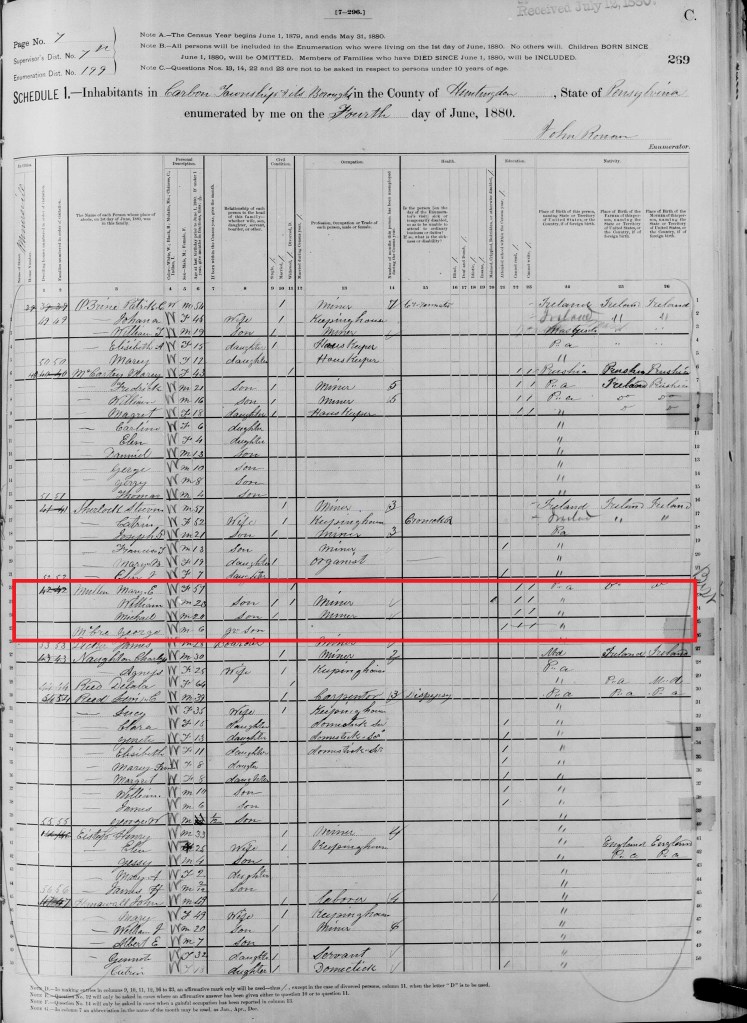
George Mullen was also supposedly born in 1874 but he is not living with Anna Maria Leighty in the 1880 census. He is listed with his grandmother (Anna Maria’s mother) Mary Ellen (Adams) Mullen and her 2 sons (who are younger than Anna Maria), William and Michael Mullen in Carbon, Huntingdon County, Pennsylvania. George is also listed at this time with the last name of McCre. I do realize he may have been visiting, but I don’t have any record of his living with his mother.
On this 1880 Census, in the red box you can see where my 3rd-Great-Grandmother is listed as the head of household with her sons, Michael & William Mullen, and then her grandson, George McCre.
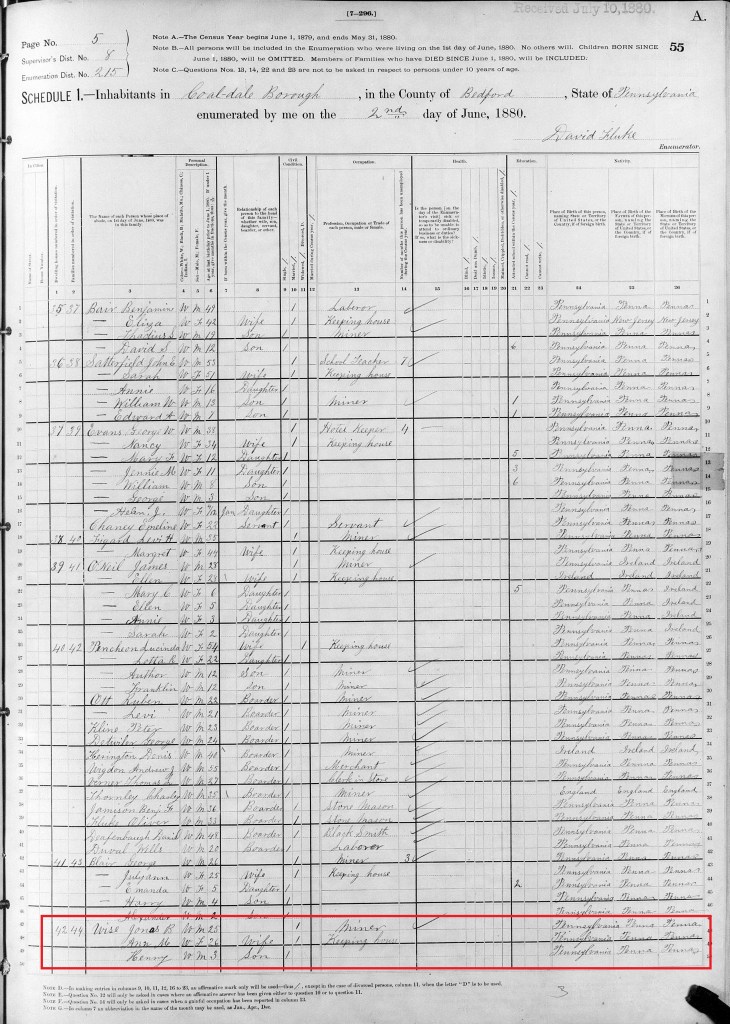
In the 1880 Census, Anna Maria Leighty is married to Jonas Wise and they were living in Coaldale in 1880 with their oldest son, Henry (next door to my 2nd-great-granduncle, George Washington Blair – one of my infamous brick walls). Henry was born in 1876.
The 1880 Census of Coaldale, Bedford County, where Jonas Wise and Anna Maria Leighty were living with their oldest son, Henry (see above my Blair relatives, George Washington Blair, and his family)
Now I did know one of George Mullen’s children, his daughter, Anna Mary, who my grandmother did consider a cousin, but I was little and didn’t think to ask questions. I know Anna Mary died in the early 1980’s and I always thought it a bit peculiar that she carried a doll with her everywhere. I now know she probably had dementia or Alzheimer’s but I didn’t understand as a child of 6, why I couldn’t carry a doll everywhere too. The other thing I think of when I think of Anna Mary is that she was a huge supporter of Nixon, I had a bunch of jewelry supporting Nixon that I was given to play dress up with when at my Grandma’s, I’m sure it was thrown away when my Grandmother passed away, but it would have been an interesting keepsake.
Anna Mary Mullen
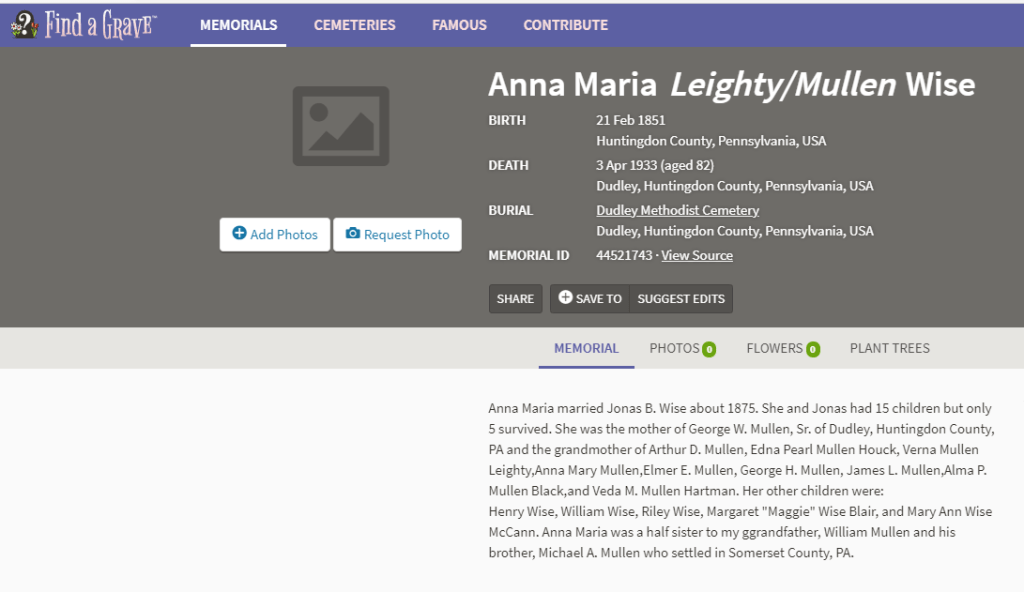
I never would have known until examining the 1920 census that George was Anna Maria’s son if it weren’t for Anna Maria Leighty’s page on Find a Grave. There are so many inconsistencies for whomever it was that wrote out the information that it makes my head hurt.
The person who wrote it was the grandchild (or possibly a great-grandchild) of William Mullen, who was the son of Mary Ellen Adams, half sibling of Anna Maria Leighty. They proceed to list all of George Mullen’s children, and as an after thought lists Anna Maria’s children with Jonas Wise (Henry, Riley, Mary Ann and Margaret). They list Margaret “Maggie” Wise as marrying a Blair, it was her daughter, Anna Maria Morgart who married a Blair. Anna Maria was also never a Mullen herself, her mother was, and I have a feeling since she more than likely raised George, he eventually took on her last name (which at that time was Mullen). Regardless, he was raised by the family and is one of us, I am just trying to figure out if he belongs where others have placed him.
So I’m sure you can understand my conflict.
Lastly, I share no DNA matches with anyone named Mullen. I find this interesting that George and his wife had 9 children and not one of their offspring has taken a DNA test. Or they have and they don’t match. I have even used the Thrulines tool on Ancestry and I have matches with descendants of Henry, Riley, Mary Ann and another for my own great-grandmother, Margaret Dora Wise. But not 1 match for George Mullen. After looking at my other DNA matches though, none of them have George listed as a child of Anna Maria Leighty, either.
Which once again leads to my conflict.
Working on this article I’ve learned that I have a lot to do on my Leighty family. I am missing many censuses for my great-great-grandmother (Anna Maria) and several of her siblings (Mary E., John Quincy, Joseph, George, Uriah, and Sidney). Joseph married an Ellen McCray, could this be a relation to the McCray that is supposedly the father of George?
I also think I am going to try to reach out to anyone who may appear to be a descendant, or at least someone who has researched George Mullen and his family to see if any of them have tested their DNA to see if there is a match. I know it may just be grasping at straws but this may give me insight on who George’s parents are, and confirm if it is my great-great-grandmother.







 Helping History Come Alive