The theme for week 2 in Amy Johnson Crow’s 52 Ancestors in 52 Weeks is “Family Legend” and the story I am going to tell is what popped into my head. I don’t hear many tales from either side of my family, but this is one of the few that I do remember hearing frequently over the course of my life.
The Fairhurst Brothers
My maternal grandfather, Harold Fairhurst, had two older brothers, Wilfred Fairhurst who was born in Leigh, England on 15 July 1914 and Edwin Fairhurst who was born in Jefferson County, Ohio on 23 May 1917. Both were raised in Ohio, moving to Akron by 1930. When World War II claimed the United States, both were working for the rubber companies, Wilfred for Goodrich and Edwin for the Seiberling Rubber Company (this was the Seiberling’s venture after they resigned from Goodyear in 1921). Wilfred joined the Marines while Edwin signed up for the Army.
The Battle of Saipan
On a transport on 5 June 1944 that left Pearl Harbor, Hawaii and made its way to the Pacific Island of Saipan, both Marine Sergeant Wilfred Fairhurst and his brother, Army Staff Sergeant Edwin Fairhurst were on board.
The battle of Saipan was the Pacific Theatre’s D-Day. The battle officially began on 15 June 1944 and ended with a United States victory on 9 July 1944. Initial bombardments began on 13 June 1944 by battleships, destroyers and mine sweepers. Naval bombardments began on 14 June 1944 and then 8,000 Marine Corps landed the West Coast of Saipan on 15 June 1944 that officially began the battle with the Army arriving in Aslito on 16 June 1944.
The fighting was intense despite General Hideki Tojo, Japan’s Prime Minister, swearing that Saipan could not be taken. He was ousted out of office a week after the United States declared victory on 9 July 1944. The battle resulted in 3,000 deaths and 13,000 wounded for the United States and over 27,000 Japanese soldiers were loss, as well as thousands of Saipan’s civilians, fearful of the United States due to the Japanese propaganda, as they jumped to their death from cliff’s at the northern end of the island.
The battle that took place on Saipan was important for the Pacific Theatre as it provided the United States with a strategic location to have a base where our new long-range B-29 bombers could be launched.
Guerilla Attacks
Despite the Battle of Saipan “officially” ending, Japanese resistance soldiers and civilians led by Captain Sakae Oba evaded American troops throughout the jungle and conducted attacks. Though it isn’t clear from any of the news articles I’ve read, I’m guessing that one of these such attacks is what killed my great-uncle, Staff Sergeant Edwin Fairhurst.
On 18 July 1944 while cleaning up after the battle, a Japanese fighter threw a grenade that exploded leaving shrapnel in Edwin’s stomach and legs. He died July 22. Wilfred claims that Edwin “got the fellow before he fell“. The legend in our family lore goes that it was Wilfred who went and picked his brother up off the battlefield and carried him to safety.
Article from 10 Aug 1944 Akron Beacon Journal
He Finally Came Home
It wasn’t until 5 years later that Edwin’s body returned home to be buried. His official funeral took place on 15 January 1949 with his final resting place being Chestnut Hill Cemetery in Cuyahoga Falls (Wilfred is buried there as well, though he passed away in 1956).
If you are a budding genealogist and would like to write more about your family but aren’t sure where to start, take a peek at Amy Johnson Crow’s 52 Ancestors in 52 Weeks series.
The Week 1 theme of Amy Johnson Crow’s series “52 Ancestors in 52 Weeks” is “Beginnings” and all my beginnings lead to one place, Akron, Ohio.
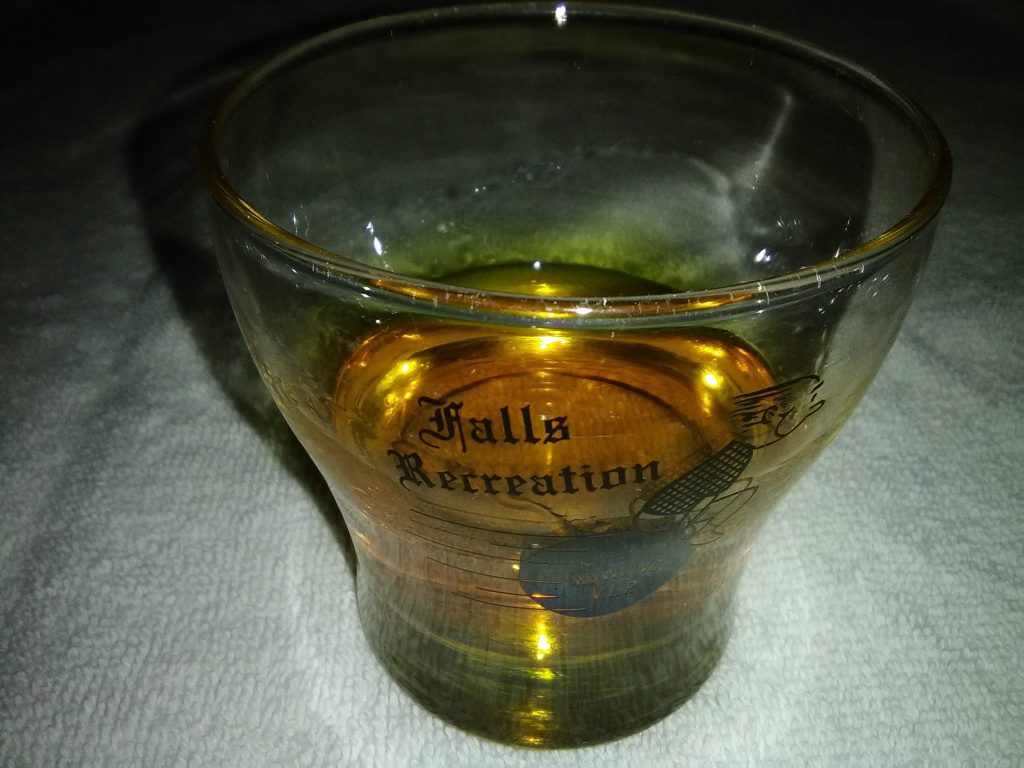
Actually, if I wanted to be precise my beginnings would be linked to Falls Rec, the bowling alley where my parents first met. My dad was bowling one night on a league I believe for Ohio Edison and my mother tended bar. According to her, some guys wanted to introduce her to their friend, Bob, and she was excited as Bob was really good looking, but they brought my dad over instead (your laugh here to her funny tale).
I like to think it was a good thing, but then I’m a little biased.
But this meeting would never have happened had my grandparents, Leroy Blair and Anna Maria Morgart, not moved to Akron in the 1950s. The same can be said of my immigrant great-grandparents James Fairhurst and Phoebe Boone, who came to the United States from Leigh, England in 1913 (James) and 1915 (Phoebe). They originally resided in Amsterdam, Ohio but then moved to Akron by 1930. Lastly, if my great-great-grandmother, Mazie Lorenia Warner, hadn’t moved here in 1916 with her second husband, Samuel Randol with her 2 daughters, all of the pieces to my DNA make-up would not have come together.
Why Akron?
Akron, Ohio was the happening place to be in the early 1900’s. “Between 1910 and 1920 the city’s population tripled to more than 200,000” (britannica.com). This was the time when Akron became known as the Rubber Capital of the World because all three big rubber companies had their headquarters here: Firestone, General Tire, and Goodyear (Goodyear still does).
Many of my Fairhurst relatives (my great-grandfather James, and 2 of his sons, Wilfred and Edwin) all worked for the rubber companies at various times. My grandfather, Harold, worked partly in construction and partly as a golf pro.
When Samuel Randol located to Akron with his family, he worked at the Swinehart Tire & Rubber Company. Here he met the last part of my family, my great-great-grandfather, Clyde Geer (and the Geers have been settled in Akron since Summit County was formed on March 3, 1840, with Clyde’s dad, William Harrison Geer being born on April 2, 1840, just 1 month later).
Leroy Blair originally moved from Pennsylvania to Indiana as he had an apprenticeship to learn the sheet metal trade. He moved from Gary, Indiana to Akron, Ohio in the early 1950s.
When I look at how all the pieces of the puzzle at one point lived all over the world, it’s amazing that my parents even met. The son of 2 English immigrants somehow met up with the daughter of an administrative professional/stenographer and a dad who we thought was one person, only to be another (the wonders of DNA) to have 5 kids, with the oldest meeting the only son of a sheet metal worker and his housekeeper wife.
Wow. Just wow. And in a bowling alley of all places.
Falls Rec
Falls Rec was torn down in the mid-1990s and where it stood is now the parking lot of a Sheraton Hotel in downtown Cuyahoga Falls (the suburb of Akron where I was raised). I remember bowling there once when I was little. I believe my sister did join a kids league (I wasn’t much of a bowler).
My grandparents bowled there, my mom worked there, I believe most of her siblings bowled or worked there as well. It held quite the memories for my family.
Photo by Stephen Fairhurst, this was one of about 4 dozen of these glasses that he had. You earned it for bowling above a 620 Series at Falls Rec in Cuyahoga Falls, Ohio.
More About Akron
I’m lucky that Akron had it’s hey day when it did because without it, I most likely wouldn’t be here. Akron isn’t just known for the rubber companies, it has been voted an All-American City four times (1980, 1981, 1995, and 2008) and has a nationally recognized library (the Akron-Summit County Library – which has lots of great genealogy information in their Special Collections department), it’s home to the Akron Art Museum, the Akron Rubberducks (the AA minor league baseball team to the still presently called Cleveland Indians), and the home of Purell (which has been super important during this Covid-19 filled year).
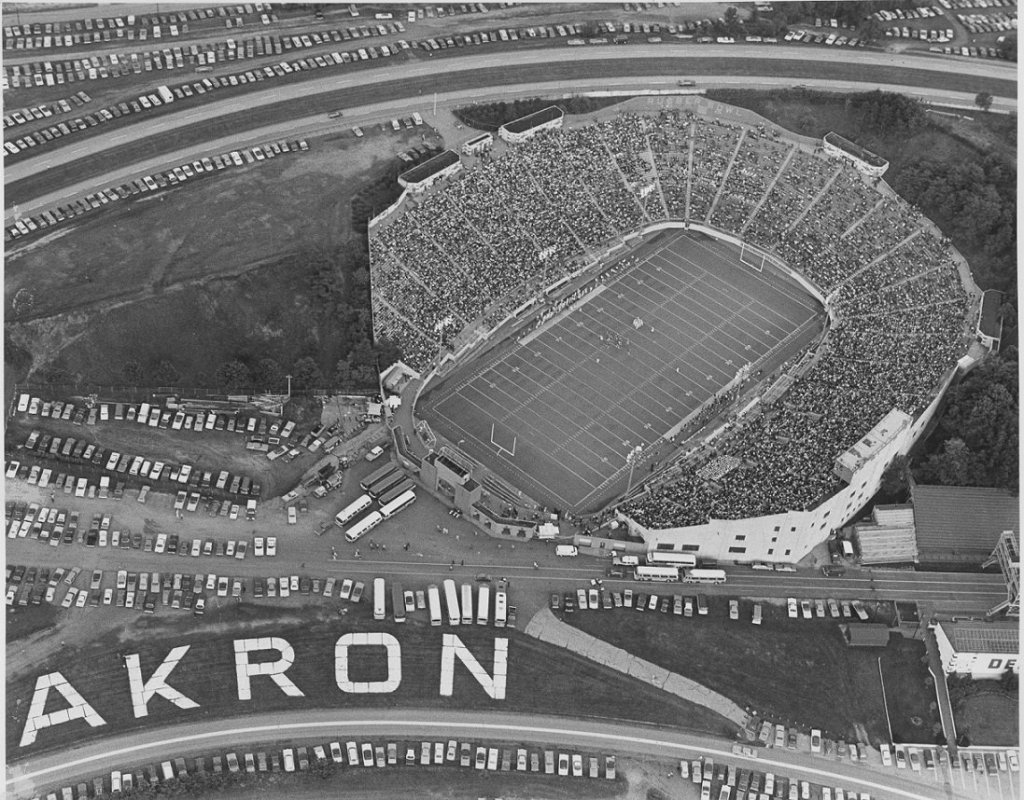
The University of Akron, which is widely known for its polymer research (which goes hand in hand with the rubber companies), and an outstanding Law School. On a related note, for years their football team played in the “Rubber Bowl” which was built as a Works Progress Administration project to put people to work in the late 1930s. The football team moved to their new stadium in Downtown Akron, in the heart of the University at Infocision Stadium in 2008. It was home to more than just football games, as countless concerts took place there as well. Demolition began in 2018, but only part of it has been razed as the other parts could cause structural issues with the roadways surrounding it and Derby Downs.
This photo was in a Twitter feed from the University of Akron from 2018
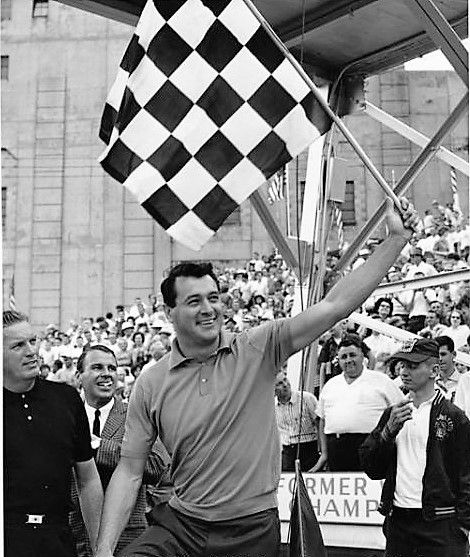
Which brings me to one of the most famous events in Akron is the annual Soap Box Derby , with motorless go-carts that of specific requirements and has been held yearly since 1933. Youths compete in their hometowns and move along until they come to Akron for the national championship. Competitors and their families come from all over to participate. I remember one year when I took summer courses for my degree while attending the University of Akron, as the dorms were used for their overnight accommodations, and it blew me away when I saw just how many children and teens participated in this event in my hometown.
I remember my mom telling me when she was a teenager going to a Soap Box Derby parade and in 1963 Rock Hudson was a celebrity attending, and she was able to touch his hand as he drove by in a car and that was one of the highlights of her life, as he was one of the few actors my mother thought to be dreamy.
Going hand in hand with Akron and Goodyear, I would be remissed if I didn’t discuss the Goodyear Blimp. The blimps were originally created at the blimp hangar in the middle of Akron. I remember my mom telling me that the hanger was so big it actually would rain inside.
Well, it’s been a while since they’ve built blimps at the original hangar, as they now are built at the Wingfoot Lake hangar in Suffield. In 2006, my parents, sister and brother-in-law attended the launch of the Spirit of Innovation in 2006.
A digital scrapbooking layout that was done by my sister, Kellie Blair, of my mother and daughter. I just love the look of wonder in my daughter’s eyes.
Goodyear has always been a huge supporter of a variety of hobbies in our area, the Lighter Than Air Society being one of them. And it’s funny, I’ve grown up with blimps roaming the skies all my life and to this day when I hear that engine I run to see it. Though the new blimps, Wingfoot 1, 2, and 3 are all very quiet so you don’t hear them from within my house anymore.
A photo of one of the Blimps a block from my house as I sat in my car at a red light. No matter how old I get they always make me smile.
Other Popular Places
I’m sure there is a lot of Akron I have missed, but before I forget here are 2 of my favorite places: the Akron Zoo and where I use to work, Stan Hywet Hall & Gardens, which is the 65-room Tudor Revival home that F.A. Seiberling (co-founder of Goodyear with his brother, C.W.) and his wife Gertrude began building in 1912 and moved into in 1915. I think my favorite part of the house is how they had an architect (Charles Schneider) that designed the house and a landscape architect (Warren Manning) that made the gardens be extensions of the rooms. For example the Breakfast Room is designed in the colors of blue and yellow (Goodyear’s colors) and the garden that was around it was made up of blue and yellow flowers. It is now a historic estate that people can tour the house and grounds, along with various special events they have throughout the year.
Stan Hywet Hall & Gardens on 22 Dec 2018 during their Deck the Hall! program.
As for the Akron Zoo, my daughter can not get enough of it, even as a teenager and more often than not we have a membership.
My son and daughter from 2019, he tried to look as miserable as possible in most every picture we took of him that day while my daughter is as happy as can be.
Summit MetroParks
I can’t believe I almost forgot one of my favorite features of where I live – the Summit Metroparks. I’ve been told by many fellow classmates that this is the one feature of our area that is so often overlooked and the most missed once people move onto other areas of the country.
The Summit MetroParks is a non-profit organization that cares for a 16 parks compiled of 14,000 acres with a variety of things to do in them like hiking, ice skating, soccer, baseball, archery, biking, paddling, kayaking, fishing, swimming and more.
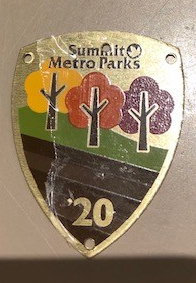
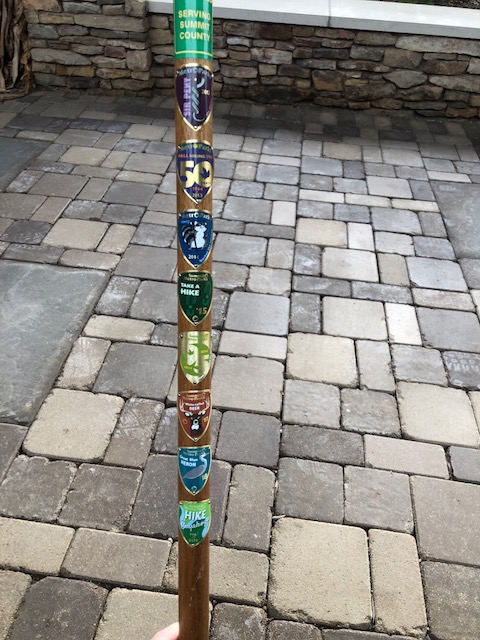
For 57 years the MetroParks has hosted the Fall Hiking Spree. It’s funny as I originally tried to complete this when I was in 10th grade. I was in Enriched Biology and the main thing that separated us from the regular class were projects that were due each grading period. The first was easy, participate in the Fall Hiking Spree. 6 Hikes was an A, 5 a B, and so on. I did 6 with my dad. We found group hikes that were led by Naturalists and advertised each week in the Akron Beacon Journal and that’s where we went, so we not only learned about the natural surroundings but any history tidbits that were involved as well. To earn your hiking stick and shield, you complete 8 hikes, and my dad and I had every intention to do them, but it’s Ohio, and the weather turned cold and wet and we never did. Fast forward 24 years and I’m 39 years old and I put earning said shield and stick on my bucket list of things to do before turning 40. I was so happy the day I earned it with my friend, Pam. I’ve continued to do the hiking spree each year since having earned 9 total shields (but there are people who have hiked every year).
The below photo is the 2020 Shield on the left and a photo of my stick from 2019. Normally they have volunteers who will put the shield on for you but with Covid this year, they did not have this service. Bets on how long it takes my husband to get the shield on? It’s already January and it’s not done.
Writing this has been very therapeutic since being a girl who has wanted to move to New York City for over half her life, I realize just how lucky I am to be born and more or less raised in this wonderful area. It is the place where I have to begin my genealogical journey as it’s where I was born, my husband and children were born here, my mom, and her mom (my dad was born in Indiana). From there I spread to Pennsylvania on every front but the Fairhurst’s, which is England.
If you are interested in taking part in Amy Johnson Crow’s 52 Ancestors in 52 Weeks challenge please click here for more information. Come back next week as I tackle week #2!
Until I read a post on the Chiddicks Family Tree blog, I never really thought about having goals for my genealogical journey. Halfway through 2020 I saw his 6 month review of the progress he was making and I realized I needed to do that for my own accountability.
#1 Cleaning Up My Personal Tree
I already mentioned how I am focusing my time going through my software program and add all applicable citations, add the many documents I’ve saved on folders in the cloud where most of my information is, and get those included in my software. I’m hoping by working on everything and analyzing what I have, I might stand a better chance of breaking down some of my brick walls.
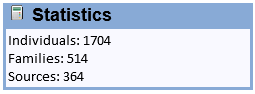
Below are my present statistics from my software – I’m not worried about the number of individuals and families but would be happy to have more citations than people by the end of the year. I’m horrible about putting people in with the thought I’ll get to the other stuff “later”.
#2 Getting Out of my Comfort Zone
I am determined to learn more about my family and their environments by reading about the areas where they lived, and who knows, possibly learning more about them. I am so reliant of going to Ancestry or FamilySearch and plopping the names in the search boxes and discovering seeing the same search results for the same people and never really obtaining new information. I guess a better title of this paragraph is “finding patience” as I learn to manually hunt for things in collections that have yet to be transcribed so finding the information will bring me that much more satisfaction.
#3 Being a Better Blogger
I need to learn to be better and sharing my finds and the stories. I say this as I have finally given out my website out to family members and so now that I know they are reading, they may get a kick out of reading stories about their family members.
Part of this objective will be covered as I am going to do my darndest to achieve all 52 weeks of Amy Johnson Crow’s 52 Ancestors and in 52 Weeks challenge that she hosts. I’ve already got this week’s written – I just need to tweak it a bit with a few more photos and it will be ready. I’m so thankful she gave us 10 days to do the first so I can begin to focus on what I’m going to write for week 2.
But in the end the purpose of my blog was to share what I know about my family and by discussing how I found out something may help someone else find their long lost family member, and that’s the whole reason. Not to mention I hope that maybe my stories are as interesting as the other blogs I read.
#4 Get a Handle on Scanning Photographs
I’ve learned scanning is not as easy as it looks. Sure, you lay your photographs on the glass of the scanner but it’s so much more than that. It’s identifying the people in the photo, where it may have been taken and the worst part… when it was taken. If it’s not listed on the back of the photo you really have to do some thinking! (Or a lot of asking! I don’t know where I would be without my dad, my aunt and my uncle (and my other uncle that my aunt asks as I don’t think I have my other uncle’s phone number, but I doubt he would want me to bug him about such things).
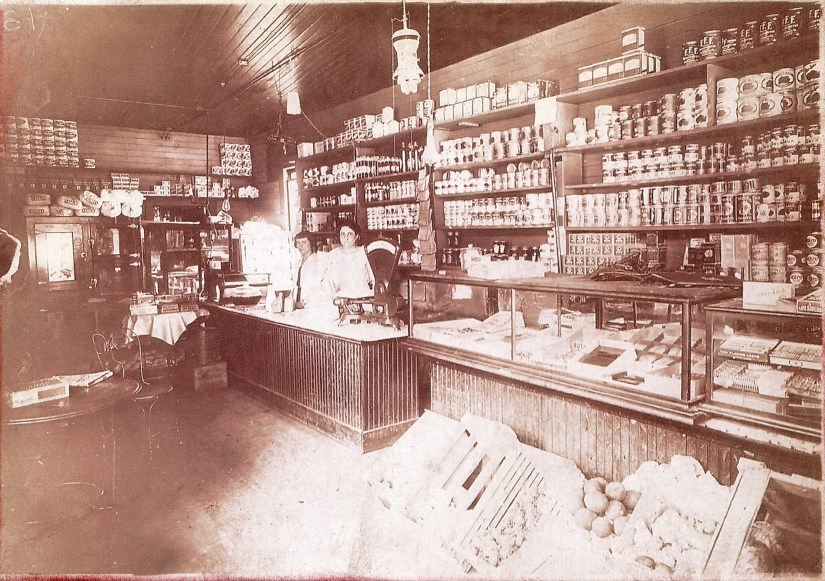
This is SJ Randol Store, not sure of the year but the only city directory with this store listed in it was the 1924 edition, so this is in the range of 1923-1925, it was located on Howard Street in Akron, Ohio (I pass it every day on my drive to work, or at least where it stood, there is just a brick wall now). The mystery is the 2 ladies. The store was owned by Samuel Randol and his wife, Mazie Warner (my 2nd-great-grandmother), the woman on the left looks like Mazie’s sister, Cymanthia, but she passed in 1925 in California, so could it be her other sister, Janette? (Not 100% sure what Janette looked like but she was in Ohio by this time and did not pass until 1930).
Looking Ahead
I am excited about this new year and what awaits me and my family’s history. May this be my most successful year yet! (And I hope Paul doesn’t mind my stealing a bit of his inspiration!)
I took the time and wrote down all the people who had just a year or the month of January as a birth or death date in my software (as they all came up as having a birthday or such on December 31) so I could try to find better records. I used a steno book and if memory serves it took 4 pages back and front. Way too many.
I also ran the potential problems report, which was just 2 pages and I fixed them quickly (page 2 had just 2 people on it). Many were transposed numbers – like I had a person dying in 1894 instead of his rightful year of 1984 (which was really bad since he was also born at some point in the 1900’s) or that a child was born more than 25 years after the parents were married, there isn’t a whole lot I can do to change that.
I hope each and every one of you brought the new year in safe and happy, and I look forward to reading about all your genealogical finds over the course of the next year.
Are many of you like me, where I sit down to begin researching a specific person in my family tree and before I know it I am on the opposite side looking up the exact opposite person?
These are the moments when I take a deep breath and remind myself to focus.
But then I decide to peruse a webinar (presently my only subscription – www.familytreewwebinars.com) on FAN’s (friends, family, associates and neighbors) and Elizabeth Shown Mills makes it look so easy with her arrows and people with common names and as soon as the webinar is over I rush to my own censuses for my Andrew and Susannah and no one has the same names, and they are in a different county in 1850 to 1860 to 1870 and…
And I tell myself to take a deep breath and focus.
I love learning but when you sit down to begin do you ever just become overwhelmed with what to begin working on first?
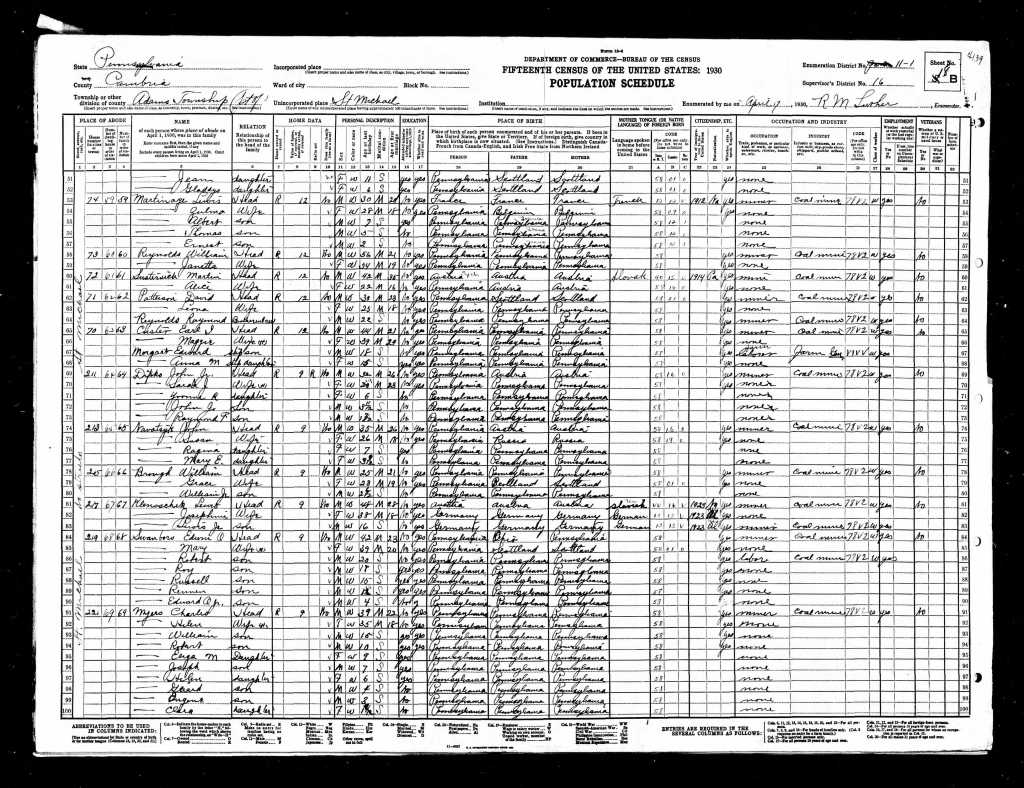
Sometimes I start with my grandparents and look at what I am missing. My Grandma Blair (Anna Maria Morgart) is pretty complete but I am missing the 1930 census of my grandfather, her husband, Leroy Blair.
The above is the 1930 census listing my paternal grandmother, Anna Maria Morgart. This census was found on FamilySearch. She is listed on line 68.
Leroy passed away in 1975 when I was 2 years old. I’ve discussed with my dad if he knew where his dad may have been in 1930. In the late 1920’s Leroy was working in the mines, like his dad. His dad (my great-grandfather, Andrew Jackson Blair) died in 1926 when the mine he was working in collapsed, crushing his chest. Apparently Leroy had a close call in the same spot as his dad, and that’s when he left mining behind him.
My dad has also told me that Leroy moved to Akron, Ohio before he met my Grandma (Akron is where they ended up settling in the 1950’s). I’ve always wondered if it was around 1930. I’ve looked in both Ohio and Pennsylvania to see if I could find Leroy Blair in the 1930 census. I’ve even used his original name of Charley Wilmer Blair (before his mom decided she liked Leroy better) on the chance he decided to go by it instead. Still no luck.
I’ll admit I get a little closed minded when it comes to how to misspell my last name. Blair is just not a name that is misspelled. Blare, Belare, Belaire, Blain. I’ve tried just an “L” for the first name, sometimes I’ve just used the surname (shocker, when putting in the misspellings it always comes up with Blair as a result).
I’ll admit I haven’t tried going page by page through all the counties of Summit, OH; Blair, PA; Cambria, PA; Bedford, PA; Huntingdon, PA; Fulton, PA; or Somerset, PA because he has family in all of these areas so he could be anywhere.
Or maybe he had a rental (more like a boarding room) in any of these areas and was just missed (this is my dad’s thought). Or this was when he was in the process of moving to Akron to work in the cottage cheese plant (he could never eat cottage cheese again after this experience, according to my dad).
Would you believe I have the same issue with my great-grandfather, Charles Jackson Morgart (who would have been Leroy’s father-in-law) in the 1900 census?
And what is considered an “exhaustive search”? (Well, looking through all the pages through all those vicinities I am sure is a good start).
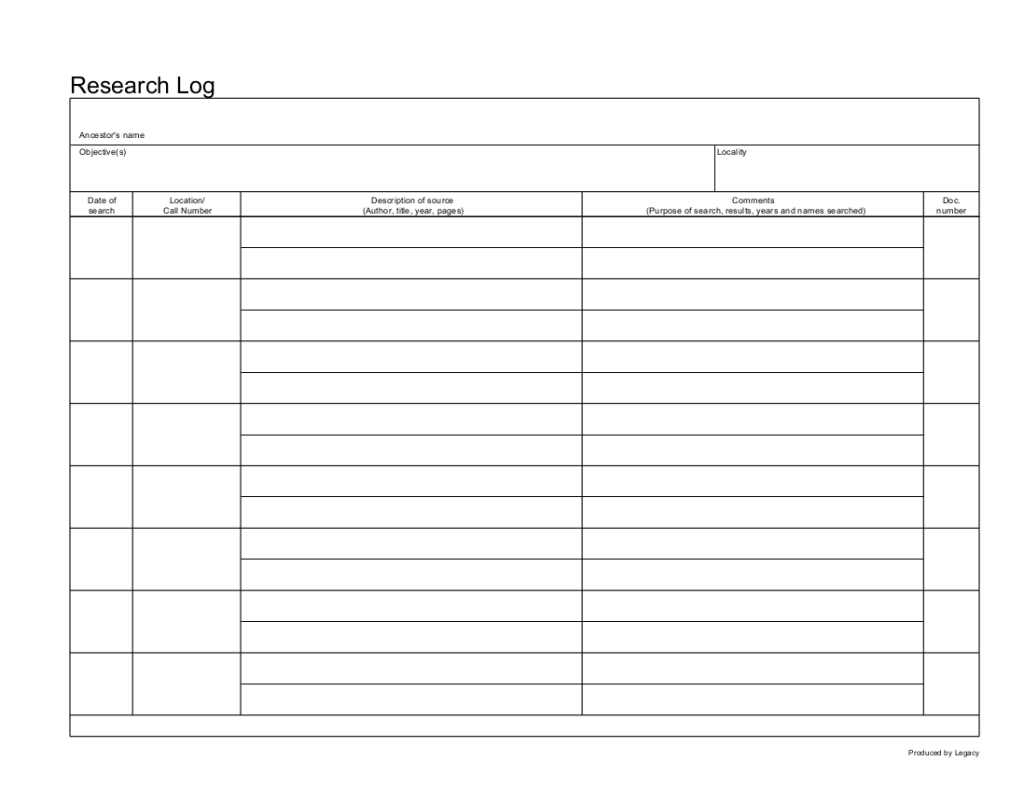
This is where research logs come in handy.
This is the research log that comes with the Legacy Family Tree software, which is what I use for my family tree.
I have always been a very unorganized genealogist. That I had tables made in excel highlighting who I was looking for when I went to Bedford County 18 months ago was HUGE!
I am the girl who sits down and decides “I think I’ll do this today”. But in 2021 I am going to be more organized. I am going to begin logging what I’ve searched in and effort to keep myself on track.
And as I’ve read/watched/listened repeatedly by all kinds of professionals – it’s not always what you find that is important, but what you don’t find.
Research logs help you keep track of the sources you have already searched so you don’t duplicate your efforts.
And if you haven’t guessed, they should help you minimize your need to take a deep breath and focus – because that’s their main purpose!
So my primary goal of 2021 is to focus, focus, focus! I am determined to expand my horizons to books and other documentation that’s not just found by putting names in a search box.
So cheers to your 2021 genealogical resolutions! Feel free to share what you hope to accomplish in the comments below.
I’ll admit, I love all the records a certain subscription site offers when I am working on my genealogy. Especially for Pennsylvania, and that’s where my paternal ancestors all reside (and half of my maternal for a while). But sometimes it’s so easy to just keep clicking away at those hints that I try to take my time and examine things before I click yes (and often click ignore) but I know I may still go awry.
So in less than a week my latest membership expires. I’ll admit, I don’t have the money to pay the full price for six months worth of research (I’m a “wait a handful of months and get a better deal” type). So I’m going to work on my family tree using what is at my disposal for free (except I’m still in the midst of a Newspaper.com subscription that may be renewed if they offer the deal up again just because it offers me so many Pennsylvania newspapers).
This will also give me the opportunity to re-examine my tree. And in my remaining week I’ll try to catch up on stuff I have already added to my own Legacy Family Tree software and complete the citations (I know I am horrible as I should be doing them as I enter the information).
Have you ever taken the time to re-focus on your genealogy research? If you have any tips I’d appreciate them!
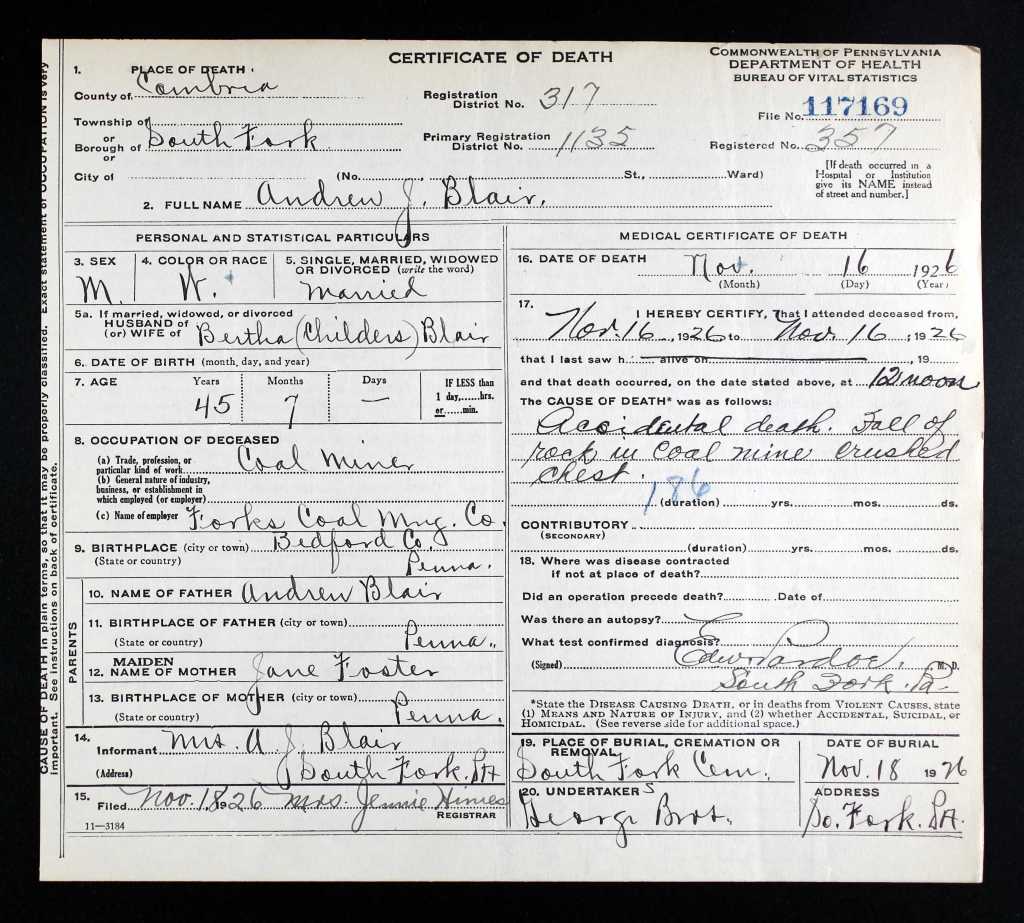
It was a sad day for my family 94 years ago today. My great-grandfather, Andrew Jackson Blair (also referred to as AJ) was killed when he was caught beneath falling rock within a coal mine owned by the Forks Coal Mining Company located in South Fork, Cambria County, Pennsylvania. Andrew was a pick miner and the tragedy happened between 12-1pm.
Andrew Jackson Blair left behind a widow, Bertha Childers Blair: two daughters, Vada (age 18) and Genevieve (age 16); and two sons, Leroy (my grandfather, age 14) and Donald (age 9).
The only photo we have of Andrew Jackson Blair, it was part of a group photo from Sunday School.
Death Certificate found at Ancestry.com in their collection of Pennsylvania Death Certificates
When I was younger I knew my great-grandfather had died in the mines, but I never knew the detail involved. It makes me cry to think of what his last moments must have been like.
Despite cleaning the attic so I can attempt to create homemade Christmas Cards this year (it was something my mom had done the last several years of her life and I, along with my sister, are attempting to carry on this tradition of hers this year), I did take some time this past week to work on my genealogy during Family History Month.
What I Worked On
This past week I found myself drawn to my maternal grandmothers paternal side. I had not really delved in as much once I figured out who her father really was since taking my DNA test. I discovered that a part of my family really was embedded in the area of the world I live in, where I thought most of my relatives are from Pennsylvania (don’t get me wrong – 75% of my family is from Pennsylvania – and one day I’ll find my way out of Pennsylvania), and thinking all had arrived here in Ohio in the late 1800’s or early 1900’s, I found out on my great-grandfather’s dad’s side, they had been settled here for a while.
The Dailey’s and the Geer’s
Amelia Dailey is my 3rd-great-grandmother and she was born on 14 Mar 1844 in Cuyahoga Falls, Ohio. In entering her and her father into my Legacy Family Tree software I found out that he, Andrew Dailey, was a founding family of Summit County, Ohio. Summit County was formed from 3-other counties (Portage, Medina and Stark) in 1840. I found this to be rather exciting because when I joined the Summit County Chapter of the Ohio Genealogical Society, I didn’t think I had any longtime family members in the area, and here I found out I did.
Andrew Dailey’s mother, my 5th-great-grandmother, Margaret Cackler was the daughter of Christian Cackler, a published author and founder of Portage County, Ohio. His book, “Recollections of an Old Settler”, is his interactions as a new settler coming to the area with Native Americans in the region. I was lucky it is a Google book and I was able to download it for free.
Amelia Dailey married William Harrison Geer in 1865. William was also born in Summit County on 2 Apr 1840 (he was born in Akron). He fought in the Civil War being mustered in on 24 Dec 1863, his grandfather, Captain Samuel Geer fought in the War of 1812 and his father, Captain Gurdon Geer fought in the Revolutionary War. So quite the historic branch of service I have on this one direct line of my family tree.
So it wasn’t a ton of time I spent on my family tree but I felt I learned a great deal in the past week on this new branch of my family. I am looking forward to learning more about these fascinating people in the weeks to come. Hopefully you made some exciting discoveries about your own family during this fabulous month dedicated to what I feel is the world’s greatest hobby.








 Helping History Come Alive
