Genealogy, My Family Tree, Paternal Side

George Ritchey – My 3rd-Great-Grandfather

Over a year ago I began a bit of focused research on my 3rd-great-grandfather, George Ritchey. I still have a few bits of information to figure out, one being to finalize that his parents are Heinrich Ritchey and Catherine Strickler, and who are all his siblings, but for most everything else, I think I’ve been able to gather a lot of information about him.

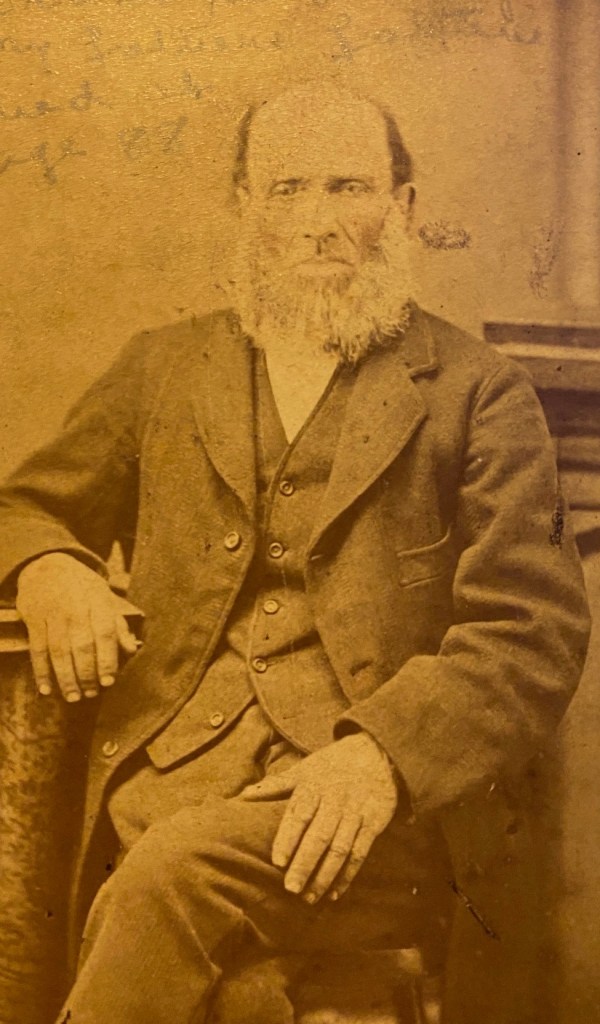
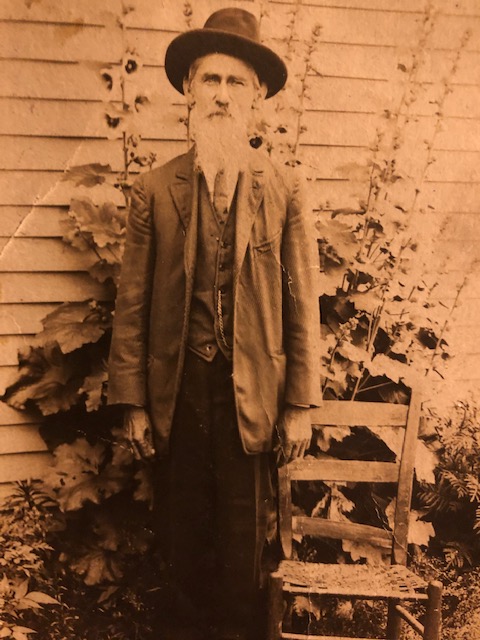
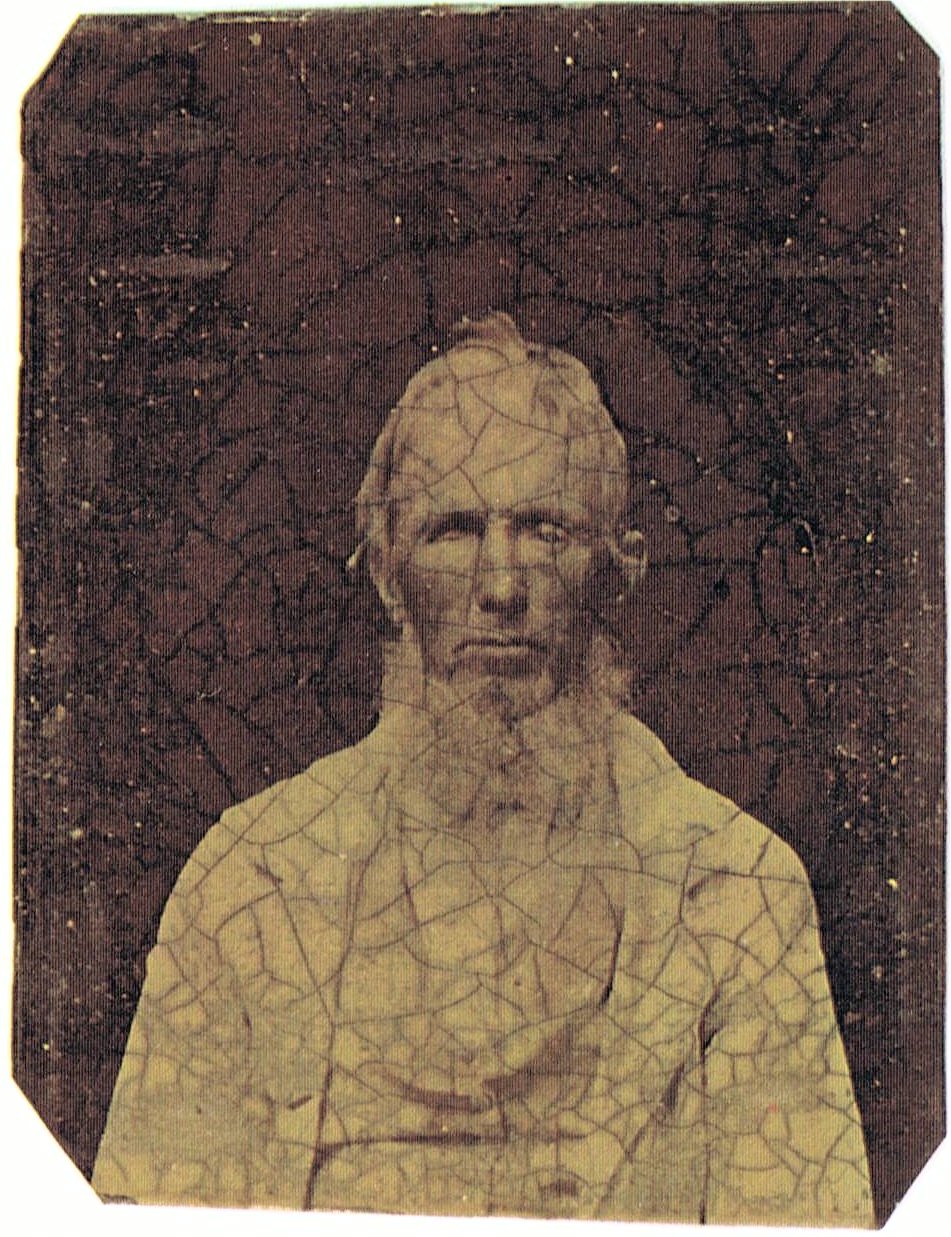
One thing that surprised me was a photo that is listed on FamilySearch.org of him. I shall post it here – I have no idea if this is truly him, but it’s exciting to think this is what he looked like. I love photos so much!

This photo was uploaded onto FamilySearch.org

His Birth

George Ritchey was born 15 July 1810 in Providence, Bedford County, Pennsylvania. This date was eluded to in his obituary with the statement of “88 years, 4 months, and 4 days” (taken from the Everett Press). I believe this to be accurate because the 1850, 1860, 1870, and 1880 censuses all seem to back up his year of birth as well.

Who Are His Parents?

As previously mentioned, confirming that Heinrich “Henry” Ritchey and Catherine Strickler are his parents is something I have not yet proven. I believe I must have noted that they were his parents from the big tree on FamilySearch.org. Just about every tree on Ancestry.com notes the same parents, but I really don’t see them having any proof either. George’s obituary does not mention anything about his parents. It only mentioned his wife, children, and brothers.

I did try to do a search through Newspapers.com to see if there were any articles in reference to Henry Ritchey but did not get any hits. I have searched both FamilySearch.org and Ancestry.com to see if I could find a will for Heinrich “Henry” Ritchey that could note his children, but came up short so far. I reached out to Bedford County for a Will from 1856 for a Henry Ritchey, hoping that maybe it was for mine, that it just took 7 years to get through everything, but it did not seem to be my Henry Ritchey.

My next plan is to begin with the (4) children of Heinrich and Catherine that I am aware of and work from there. FamilySearch.org has 9 children listed for them so I have a lot of work to do on this couple.

I, George, Take Thee, Anna

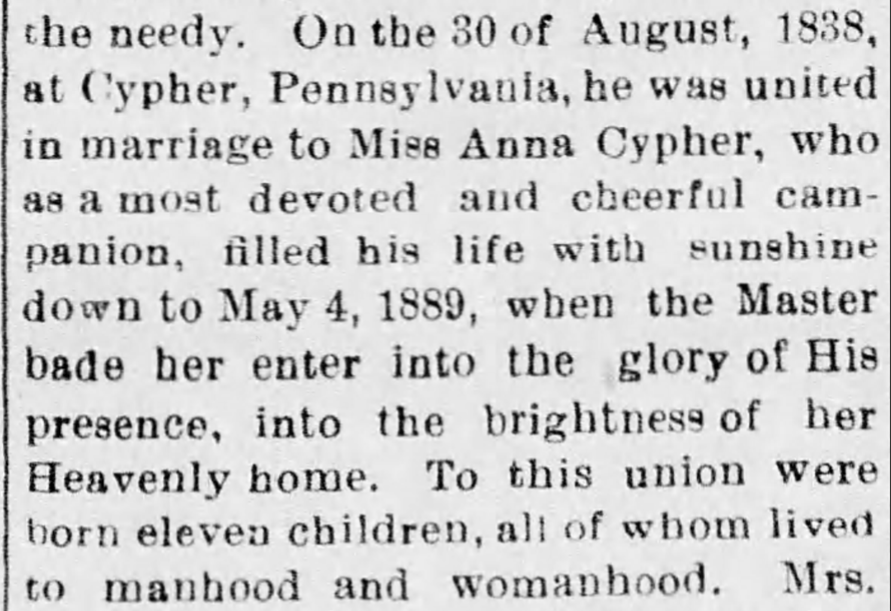
George Ritchey married the former Anna Cypher on 30 August 1838 in Bedford County, Pennsylvania. The reference of his marriage is one of my favorite parts of George’s lengthy obituary, I’ve placed a snippet from the Everett Press write-up below, but I’ll only transcribe a portion here. “On the 30 of August, 1838, at Cypher, Pennsylvania, he was united in marriage to Miss Anna Cypher, who as a most devoted and cheerful companion, filled his life with sunshine…”. Isn’t that just one of the most wonderful things anyone could have written about her? What a remarkable way to be remembered.

This snippet was taken from George Ritchey’s obituary from the Everett Press on Newspapers.com

Eleven Kids?

As the Everett Press snippet above states, George and Anna had 11 kids who all lived into adulthood.

  • Catherine Ritchey Bessor
  • Elizabeth Ritchey Grove
  • Rachel Ritchey Eshelman
  • Sarah Ritchey Smith
  • William Cypher Ritchey
  • Mary Ann Ritchey Morgart Hughes*
  • Daniel Edward Ritchey
  • Amanda Jane Ritchey McGraw
  • Alice Emma Ritchey Barton
  • George Grant Ritchey
  • David Theodore Ritchey

They were a blessed couple to have such a large family. Anna was aged 19-47 (only having been 47 for a week with David) when she had her children. Most were clockwork every 2-years except the last few which were closer to 3-4 years apart. I placed an asterisk next to Mary Ann Ritchey as she is who I descend from.

They raised this family in East Providence, Bedford County, Pennsylvania. The 1850, 1860, 1870, and 1880 Censuses all list them as dwelling in East Providence. I believe that both George and Anna lived in Bedford County their entire lives.

His Work & Interests

According to all (4) censuses, George was a farmer. When I did a quick search of the types of crops grown in Bedford County between 1850-1895, it appeared they could have grown a variety of staple crops including grains, potatoes, fruits and vegetables. Livestock was also bred in this area of the country which would provide both dairy and meat for this large family. I still need to look up tax records and maybe this will detail this information.

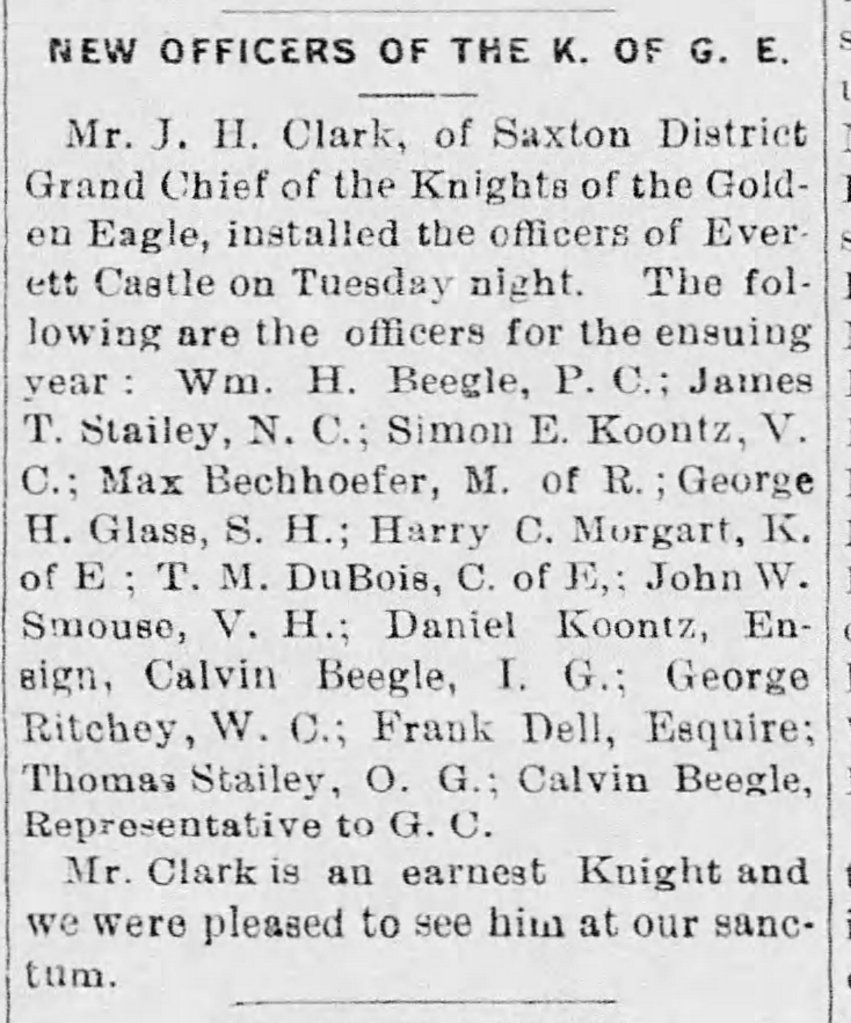
George belonged to the Knights of the Golden Eagle, which was a fraternal organization that began in 1873 whose rituals were based on those of the Crusaders. George was a member of the Everett Castle and had been installed as an officer the year he passed away. He was the W.C. or Worthy Chief, which was the presiding officer of the local chapter.

This article was taken from the Everett Press from 7 January 1898

He was known to host huge picnics on his property where people could fish in the nearby stream.

In another article from the newspaper, he lost his wallet, or in this case his “pocket book” which makes so much sense. I found it interesting the reward.

This article was found on Newspaper.com in the Bedford Inquirer on 12 April 1861

His Death

George passed away on 19 November 1898. His family provided an outstanding obituary that detailed his life (everything but his parents) and helped me quite a bit as I have attempted to research him.

This is the entire obituary found on Newspapers.com from the Everett Press
Genealogy, Maternal Side, My Family Tree

I’m Doing It Again

I have gone almost a month without a blog post. It just seems like I’ve been so busy and can barely find time to even work on genealogy – despite one of the things keeping me busy in January was a genealogy workshop where I focused on my 3rd-Great-Grandfather, George Ritchey. But I’m still investigating him so I’ll write about him when I get more answers (and I will get more answers – as my research just brought about more questions – don’t you hate that?).

So once again I’m participating in the 10 Days of Chronicles with my PAAncestors.com group. In this particular post I’m finishing up the last 5 days that I wrote about in January – but I’ll make sure I do another post about the Chronicles I’ve been writing for February. Denys has done an excellent job of coming up with prompts that make me think. Enough that most of my posts are coming late in the evening for the simple fact it takes me all day to come up with a proper response. 

Anyhow – here are days 6-10 for the month of January:

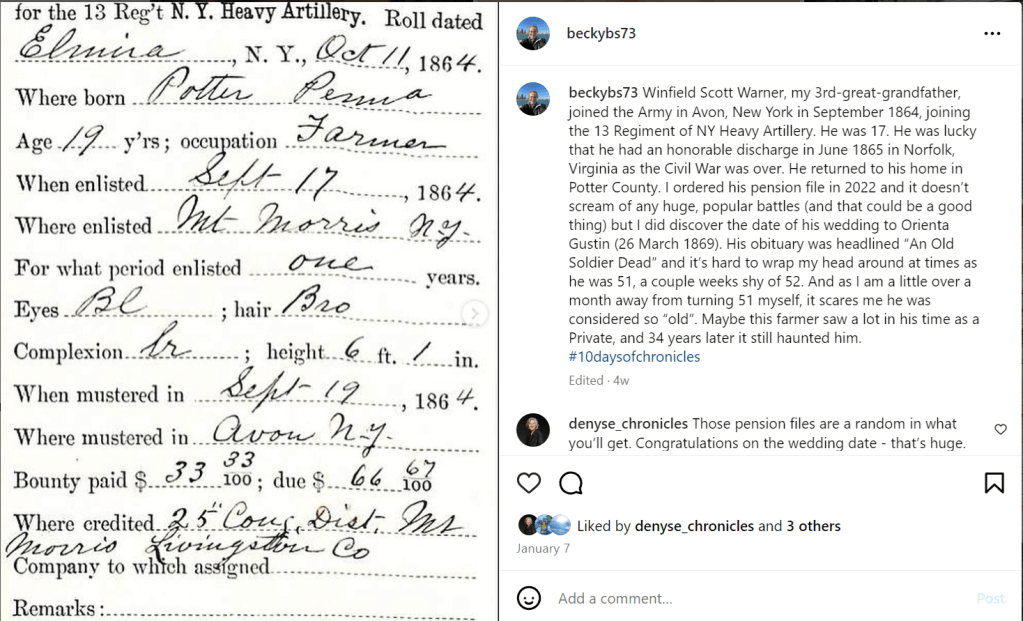
Day 6 I wrote about my 3rd-Great-Grandfather, Winfield Warner, and his involvement in the Civil War.
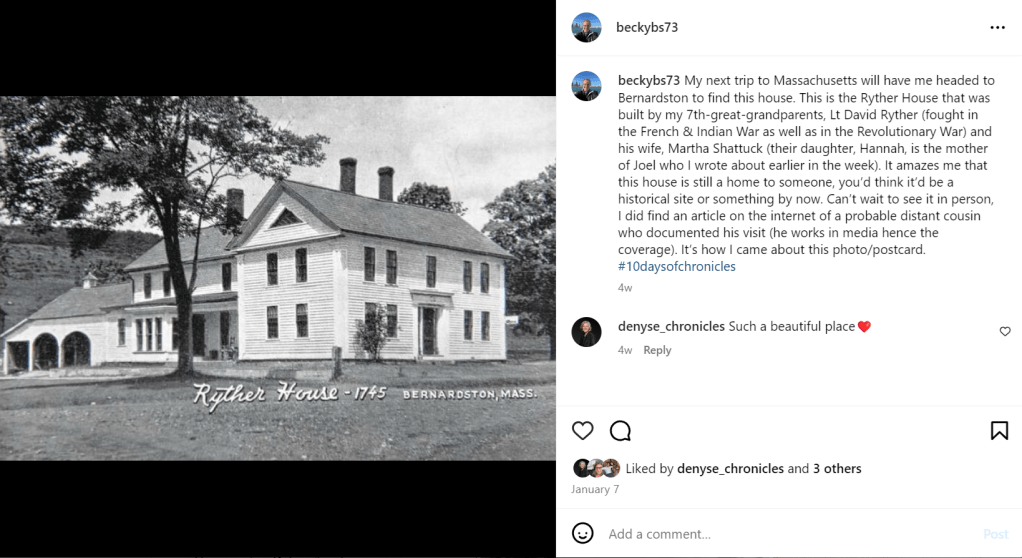
Day 7 we talked about a family home. Since I don’t have any photos of anyone closer to me, I posted the photo of the Ryther House in Bernardston, Massachusetts which was built by my 7th-great-grandparents.
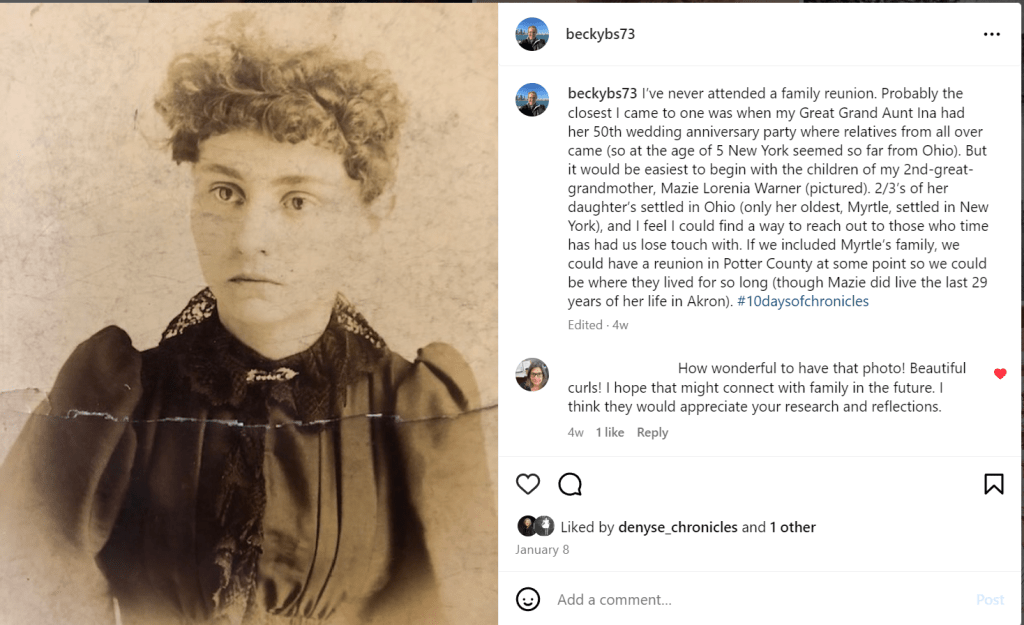
Day 8 was the topic of family reunions – so I chose the descendants of my 2nd-great-grandmother, Mazie Warner to meet up with, as many are still in the Akron area.
Day 9 was reconstructing the day in the life of an ancestor. I chose my great-grandmother, Mildred Dunbar, as I inherited some of her clothes when she passed away and she babysat me when I was little.
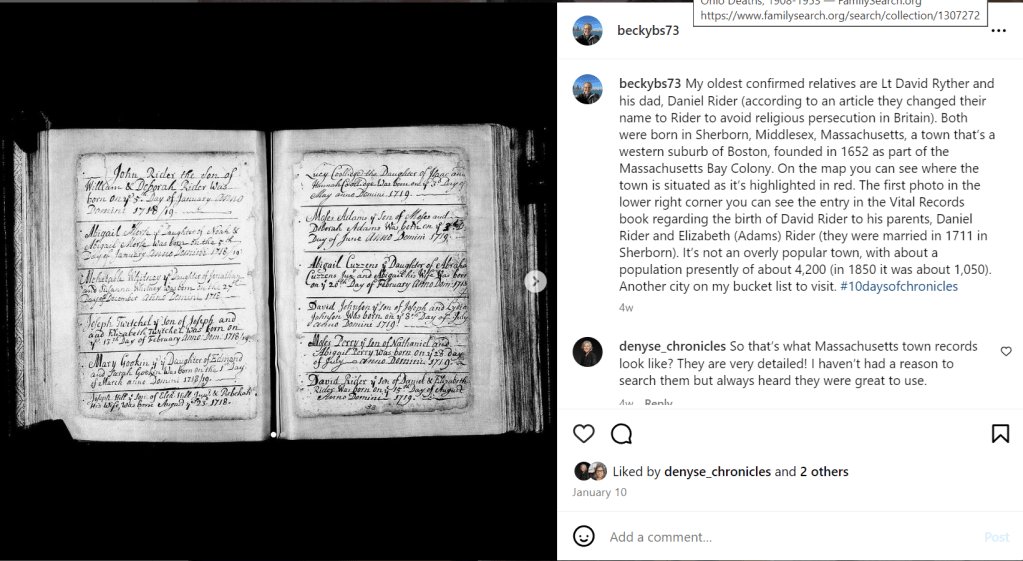
On Day 10 it was discussing the birthplace of your ancestor so I chose to share the birth record from Sherborn, Massachusetts of my 7th-great-grandfather, David Ryther (though changed to Rider due to religious persecution). He was born in 1719.

This exericse is a great way to get little stories just written down about your ancestor. If you think you may want to sign up for March – make a comment and I’ll make sure I put a link for you to sign up. 

Genealogy, My Family Tree, Paternal Side

Down the Rabbit Hole

So this morning I got up, ate my breakfast, and grabbed my computer so I could start sorting things out with my Ritchey family as I’ve decided they are going to be my focus of the “Discover Your Ancestors Workshop” I am beginning Tuesday. I’m excited, I did one in the fall where I attempted to find Suzanna Akers before 1850. Shocker, I was unsuccessful – but all in good time. So this time I’m focusing on a different part of my family, the Ritchey’s, who I do know something about, mostly my 2nd-great-grandmother, Mary Ann Ritchey, but haven’t really delved in to them much further.

The rabbit hole I found myself in was when I looked at Ancestry and had 1 death date for my 3rd-great-grandfather, George Ritchey, and I had another in my software. So I decided to go over to FamilySearch to see what it had to say, the tiebreaker if you will (insert your laugh or eye roll here).

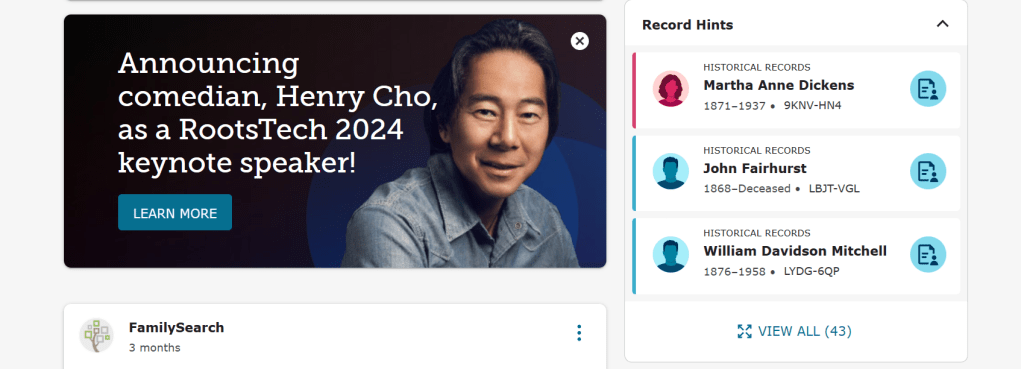
But I didn’t even make it to George right away because of the “tasks” or I guess they are now called “Record Hints” on the front page that I saw FamilySearch had waiting there for me. Have you ever worked on these? I often will click on these people and help “clean them up”. Most of the time it’s just a “hint” that FamilySearch has found, a document that needs to be attached to the person as a source. This can be done in about 30 seconds (my direct line people I can do it this quickly, either it’s them or it’s not). Others I will stay away from, as they will be people whose names I don’t immediately recognize and I don’t want to screw anything up on the big tree. But then I fix one person and see their wife’s name and down the rabbit hole I go, only to realize I need to probably spend way more time than I want to because I’m finding duplicate people so I need to merge people and move things around and that’s a project for another day (which is probably why the big tree is as messed up as it is because people really do have intentions of going back in and then they never do). Now I’m feeling guilty.

You can see the Record Hints listed on the right hand side of the graphic, starting with Martha Anne Dickens, John Fairhurst, then William Davidson Mitchell

But see how easy it was to go down that rabbit hole?

For the record, it was my software that was correct, the year was wrong on my Ancestry tree and has now been corrected to 1898 (there was a newspaper article that supported the date of 19 November 1898 which coincides with Probate starting in 1899). However, when I went to FamilySearch I was excited to see someone had apparently posted a photo of George Ritchey on his profile that I hadn’t seen (see what happens when you get so tied up with one set of grandparents, you ignore the others and miss fascinating finds). I was so excited to see this!

Anyhow – I’m sure I’ll share the photo in the near future as I learn more about my Ritchey roots. I hope everyone has a nice weekend – it’s quite blustery here this weekend as a polar vortex is hitting the area. I hear that the Buffalo Bills are willing to pay fans to help shovel out their stadium (here in Ohio we aren’t getting as much snow as we are just getting cold). I don’t blame Buffalo, though, you work hard for a playoff game with home-field advantage, and you don’t want to lose it.

Genealogy

My 5 Genealogical Goals for 2024

Each year in the back of my mind I try to have some sort of goal for the next year. Any goals I had for this past calendar year I know I fell short as I feel as if I didn’t spend any time really working on my own family tree, but I do hope to change that in the coming year.

So here are my goals for 2024.

5) Make Some Headway with my Family Tree

This past year I have met a distant cousin because of this blog and our goal is to try to find out more about our shared 6th-great-grandfather, Philip Morgart. We know he is the father to Peter, but who are his other children? Who are his parents? We want to know!

And let us not forget Andrew Blair and Suzanna Akers – they are always in my thoughts and maybe this will be the year that I chip away at that brick wall (I can only hope).

4) Clean Up my Software

I am not always as good about entering my supporting information into my Legacy Family Tree software so I’m going to try to do better about filling in the missing pieces of information for all the many people in my family tree. Some may say why? But I work so hard to have an accurate tree, and if I don’t have the sources connected to my ancestors, then it could look like I’ve just plopped information into my program and not truly done the research.

3) Create a Locality Guide for Bedford County, Pennsylvania

With so many of my ancestors being in the vicinity of Bedford County, Pennsylvania, I’m going to work on creating a locality guide for this area of the world. For all I know one could already exist out there – if it does I really haven’t seen one, so this would be a helpful tool for me in my continued research.

2) Finish my NGS “Family Foundations” Course

I’ve done the first 2 sessions of the “Family Foundations” course offered by the National Genealogical Society. You have 6 months to go through a variety of modules that educate you in all types of topics related to doing your family tree. FamilySearch, Newspapers, Cemeteries, Vital Records, Research Plans, these are just some of the topics you learn about in the first 2 sessions. I still have part 3 to take covering Probate Records, DNA, Religious Records, and more! I really have learned a great deal taking these courses. They do have a cost (reduced for members) but it’s been well worth it.

1) Do a Better Job of Posting Here

I miss making discoveries that I can share here. Not only do I enjoy sharing what I find – but I have discovered a handful of cousins this way (not realizing when I began this that many people use a blog to do just that, not me – I just wanted what I learn to be out there and possibly help others). So I am going to once again focus on my family history and try to go back to introducing not only stories about my family but new techniques and websites as I did in the past because quite frankly, it helped me to learn, too!

Here is wishing you all a wonderful and Happy New Year! May you achieve all of your own goals this upcoming year!

Genealogy

Bringin’ It Home 2021

Today is an exciting day! It’s the first day of the Ohio Genealogical Society Conference with the theme of “Bringin’ It Home”. When the co-chairs came up with the theme they had no idea that we would still be living in a virtual world, but here we are, having the conference from the comforts of our living rooms, or porches, or attics, or dining rooms!

The first day is workshops and this year I signed up for one. When I went to my first conference 2 years ago when it was in Mason, Ohio (a suburb of Cincinnati) I opted to do the meet and greet. This year I am attending my first workshop that will discuss what it takes to be a professional genealogist.

Then Thursday through Saturday we begin the many classes and online exhibitors. What makes this years a little more unique is that any session that is pre-recorded you can watch anytime through April 20 so you can try to seize the “live” sessions so you can get even more knowledge than you thought!

I’m looking forward to learning a great deal. Last week I attended a couple of sessions that the Indiana Genealogical Society offered and on Saturday, Lisa Louise Cooke was the speaker and what stuck with me was her comment about how every day we are a better researcher than the day before because we are always learning new things. And that is so true. You are never looking at the same document in the same way because every day we become more knowledgeable with what we are doing and learning.

So keep that in mind when you go check out at an old document, you have probably learned quite a bit since you last looked at.

Wishing all those attending this week’s Ohio Genealogical Society Conference a wonderful time!

The official logo for the Conference and it’s main sponsor, Vivid-Pix.

52 Ancestors in 52 Weeks, Maternal Side, My Family Tree, Paternal Side

Week 11: Fortune

The theme for this week’s 52 Ancestor’s in 52 Weeks is “Fortune”. To my knowledge none of my ancestors were rich. They all were hard workers, many working in the mines (south central Pennsylvania relatives and those who immigrated from England to Jefferson County, Ohio), or were laborers, waggoneers, chairmakers, soldiers, farmers, stenographers, store owners, truckers, firemen, construction workers, sheet metal workers, rubber workers, nurses, and apartment managers.

The real fortune for me are the records and documents that my family left behind. Each and every piece, from a photograph to a census to a newspaper article all help give me a better perspective of all the people who help me become me.

This is why I do my family history. And though this is probably one of the shortest posts of these themes, I am grateful for each and every ancestor, because without them, I wouldn’t be here.

52 Ancestors in 52 Weeks

Week 1: A Fresh Start

I’m a little late in starting but I’ve decided I’m going to partake in Amy Johnson Crow’s family history writing exercise “52 Ancestors in 52 Weeks”.  Seeing as writing about my ancestors always seems so daunting, I hope that doing it weekly on a different member of my family that maybe, just maybe, I’ll feel more comfortable.

Week 1’s topic is “A Fresh Start”.  I’m going to be super generic and talk about myself – I’m going through a fresh start in my genealogical journey as I am going through all my people and making sure they belong and that I have the documents I need for them, and that I have the full information for each ancestor.

For example on New Year’s Eve, I discovered in my Legacy software all the people who I have just a year down for their birth date or death date – all their reminders came up on December 31.  And it wasn’t just a few I had, it was for 134 dates!

In some ways I stand by the dates, something is better than nothing, so when I see a child who shows up on a Census or two and all I have is that random year of birth that’s given, I use it with a hope of someday finding additional information such as a month or an actual day to go with it.

I also ran a potential problem report and was fortunate it was only a page in length.  I’ve fixed most of these mistakes as one person had a death date before their birth date (I typed 1930 for their birth instead of 1830 – an easily fixed typographical error, but an error nonetheless).

Going more in-depth and trying to find out what I don’t know is going to make me a better family historian.  We all deserve a fresh start every now and then – and mine has begun, even with this challenge, as it will allow me to get to know my ancestors even better.

If you are interested in doing your own writing journey, 52 Ancestors in 52 Weeks is where you can sign up and see the listing of all the prompts for this year’s challenge.

Good luck!

Genealogy

Mind Mapping

I’m presently taking a class on genealogy and one of the things they briefly went over in last week’s portion is mind mapping.  I’ll be honest, I never really knew what mind mapping was, now I could sum it up to it being brainstorming on a piece of paper.  But I decided to take a little more in-depth examination of mind mapping and how it can help you with your family history research.

What is Mind Mapping

Using the Wikipedia definition, a “mind map is a diagram used to visually organize information”. It’s hierarchal and shows relationships among the pieces of the whole. According to MindMapping.com, it’s a “highly effective way of getting information in and out of your brain” as it’s both creative and logical at the same time.  Mind maps are illustrations of what you are thinking.

Which goes back to my original statement of it being like brainstorming on a piece of paper.

Characteristics of Mind Mapping

There are certain characteristics that each mind map must possess.

Main Idea

Each mind map has a main idea.  It’s the theme of what your mind map is about.

Branches

These are the main ideas that branch off of your main idea that create connections.

Keywords

These words or ideas that support or describe your main idea are summarized into keywords, no sentences allowed.

Twigs

Lastly, you have less important ideas that aid in describing the keywords, and these branch off onto smaller lines, or twigs.

Creating Mind Maps

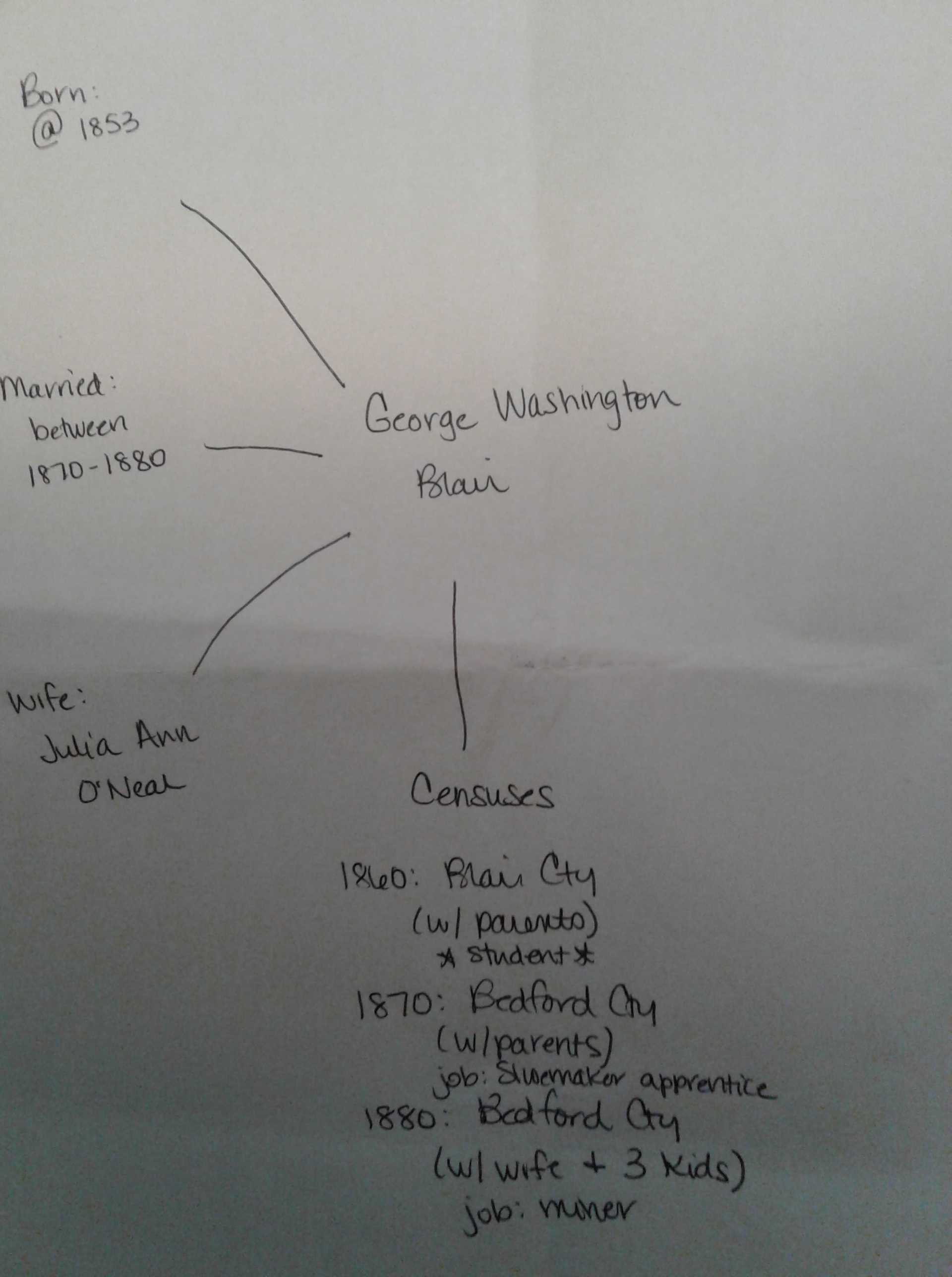
There are different ways to create mind maps.  You can draw from hand (I apologize for my bad photo – somehow my paper got folded but something told me trying to re-write it wouldn’t work as I’d probably just mess it up and get totally frustrated).

20191112_193005

Mind maps can also be made with computer software.  Some of the software that you can use are the following: Coggle, Mindly, Draw.io, iMindMap, MindMup, MindMeister, Scapple, and SmartDraw to name just a few.

MindMapping_mindmap_handdrawn-796x531
Photo found at MindMeister.com

Using Your Mind Map

Mind mapping is a tool that helps make you a better thinker. When you come across a problem, even something that really has you stumped like a brick wall, write it down, all of it, you may just get pointed in the right direction on where to look next.

The one I did above is one of my brick walls, which actually leads to a bigger brick wall.  George Washington Blair is the 4th child of my great-great-great-grandparents.  I only have 1 death certificate listing my 3x-great-grandmothers name and I strongly feel that if I can find George Washington Blair’s death certificate, that maybe it will give me some insight on my 3x-great-grandparents.

A mind map isn’t going to solve your problems, but it will allow you to see your information in a logical flow and give you the opportunity to see what you still need to find, and then you can best decide where to go to seek your answers.

Good luck!

Genealogy

Writing Your Family History

I constantly read how I should be writing my family history down but the question is HOW?  I obviously want it to be entertaining and not cause people to be snoring within minutes, but do you just plop down the statistics?  Do you try to give it personality?  These are the things this inquiring mind wants to know.

Blank 3.5 x 2 in

How You Will Share Your Writing

What form of media will you use to share your family history?  This is a very important decision.  Will you write a book? A newsletter?  A blog?

The format of your writing determines how formal your writing needs to be.  If you choose a blog (I obviously write about my own family discoveries along with tips of how to do your family history) you need to be a little more entertaining to keep your reader’s attention (hopefully I succeed in this).  This would probably be similar advice if you thought of doing a newsletter.

If you are going to write a book you obviously want people to enjoy what they are reading but you can also make sure you throw in statistics you have gathered about your relatives/ancestors if that is the only information you have.

Photographs

If you have photographs of the people you are writing about, make sure you include them. This is probably a no-brainer but it’s worth stating.  I know whenever I come across a photo of a relative I get so excited to see how they looked at whatever stage in their life.  I am hoping to one day find a photograph of my great-grandfather, Charles Morgart, as he is the infant/toddler in my blog’s header.  I have yet to see an adult photo of him but so wish I had one.

Photographs also make people real.  Face it, you can tell people that this is when they were born and this is when they died – but it’s when you give the details of how they lived and what they looked like that makes a person become alive.

Add Some History

You may be thinking,  “of course I am going to write history, I’m writing my family’s history”, but sometimes it’s nice to give your writing a little bit of historical context.  Relate to your reader what is going on in the world to give a better sense of the time period when your ancestor lived.

For example, I am presently reading “National Geographic’s Atlas of the Civil War” as my great-great-great-grandfather, George Henry Fesler, fought in the Civil War.  I have obtained his military file and it details all the battles that he fought in and where he was stationed.  George fought in many battles but I will confess they tend to be a lot of the smaller battles, not Antietam, Vicksburg or Gettysburg, the battles that the average person has heard of, so I’m reading this in-depth book about all the battles so I can include better details in reference to him.

There are different ways you can highlight historical events, you can just do a sidebar of big events that happened during the time period or you could have a timeline listing similar details.

Setting Your Book Up

When writing a book you can always highlight a different ancestor in a chapter.  For example, you can have a chapter on your mother, then a chapter on her mom and a chapter on her dad and within the chapters referring to her parents you can detail her siblings.

You may not have any intimate details about some of your relative’s lives but when you come across those initially you can just put the vital statistic information that you have on these individuals.  Sometimes you may just have very limited information, but if you have gathered any city directories about your ancestor, often they list where they worked, which helps give a little more insight into them.  Censuses will often list a general occupation as well which is still helpful in painting a picture of your relative’s life.

Make a Video

I know on my mom’s side of the family, my aunt and uncle were occasionally asking me how I was progressing on my research.  Not having anything written down, but having found photos of various members of my mom’s side of my family, I made a minute-long video that briefly highlighted my grandmother, great-grandmother, great-great-grandmother and lastly my great-great-great-grandmother and my great-great-great-grandparents (the photo of my 4th great grandmother happened to be a photo with her husband). I used the online video maker Adobe Spark which is free to use and even can be made with background music (the default was surprisingly fitting for my video). I shared the video with my aunt, uncle and many cousins and they loved it!  It was long enough to be interesting and short enough to keep their attention.

Your Program May Write the Book for You

I use Legacy Family Tree to store all my family’s information and there is a way to print a book using all the information I have entered into the program.  It fills in written accounts listed in the notes on each individual as well listing all the sources that you have attached for all the records included. This is a nice, no-brainer way of writing a book with the click of a button.

Brings Your Research Together

Writing about your family is a great way to make your research more interesting to the average person.  Family Historians often find such neat information about our ancestors through vital statistics, newspapers, and family lore, compiling them all together for future generations just makes sense.

No matter what form of media you choose to use – book, newsletter, or blog, anyway that interests you in writing down your information is how you should publish your work.

You don’t have to stop all of your research to begin writing a book, but it may be something to focus on one day a week in order to get ideas together on what you may want to do. I know I have been thinking about how I want to do mine for a while and I like about taking it an ancestor at a time.  It may provide you with who you want to focus on for a bit as well, and if you have all your writing on a computer you can always continue to add the further along you go with your tree.

No matter how you opt to write your genealogical findings, I wish you great success in your journey.  Sharing your research with the world is one of the greatest honors we as family historians have.

Good luck!


Genealogy

Scrapbooking

“Scrapbooking is a method of preserving, presenting, and arranging personal and family history in the form of a book, box or card” – Wikipedia.


For a few years, I was really into scrapbooking. My aunt introduced me to it one weekend when she set up a bunch of tables in her attic and had several friends and family over for a “crop”.

Never having done this before I grabbed the set my mom had ordered me off QVC and headed over with some photos (not really sure why we had these on hand, I am guessing it was something that had crossed our minds – and my mom could not resist a “Today’s Special Value”  to save her soul).

I was hooked after one time. I got up the next morning and went to the store to purchase key tools that I would need and convinced my husband it was going to be a good investment (I still have and use these items). The photos I chose were my honeymoon pictures. I figured a week’s worth of memories from Busch Gardens (Williamsburg), Myrtle Beach, and Savannah would be enough to keep me occupied for an evening,.

I had so much fun creating the pages, bringing those moments to life in a fun, whimsical way – including journaling – that allows my kids to know what was happening the first week of June in 2003 with their crazy parents.

On the next crop, I convinced my mom to go and she did the same as I did, she chose photos from a specific event (I think it was the 30th-anniversary party I threw for her and my dad) and used her set to begin her own creative journey.

My mom ended up taking her scrapbooking to a much higher level than me. She learned new techniques by taking classes from a variety of experts in the field that she discovered online. She also tried her hand at digi-scrapping which is when everything is done on the computer. She loved all sorts of concepts and took different challenges about herself, the past, everything (though her favorite topics were my kids, her only grandchildren).

My mother completed a number of layouts that pertained to genealogy/family history.  A few are posted below but more of her work can be seen on her website at Gramma’s Happy Place (she passed in late May 2018 so I have no idea how long it will stay up).

Scrapbooks have been around for a long time, not so much as their modern renditions,  but often included with photos were mementos that went along with an event – ticket stubs, hair, flowers, booklets, brochures, coins – all sorts of ephemera. These keepsakes are wonderful ways for us to learn more about our ancestors, assuming we are lucky enough to find such treasures.

My goal as I go along on my genealogical journey is to begin scrapbooking again (I’ve been blessed with all my mom’s supplies, I technically shouldn’t have to purchase anything other than glue/adhesive for years).

Do you scrapbook? Share some of your favorite pages below, it’s always a treat to see what people at their creative best.