
For two years I’ve had a brick wall in my great-great aunt Margaret Blair who was born in October 1879. She is on the 1880 census as this is how I know she lived. She has been one of my biggest mysteries. By the time the 1900 census comes around, Margaret would have been 20 so I never knew if she had passed away in childhood or just gotten married with her license just eluding me.
Frustrated I reached out to two different Facebook groups last Friday where I received great advice and suggestions from so many supportive family historians. One very helpful commenter suggested that I examine the 1900 and 1910 census because they both state how many total children a woman had and how many were still alive.
You know that emoji where it looks like a woman smacking herself on the forehead? It’s my favorite emoji, and my most used. That was me after reading the recommendation. OVER TWO YEARS and the answer was in front of me the entire time.
I remembered seeing that column on the census way back when I first found the censuses for many family members.
So make sure you know what your census has to offer. Over the years the US government has asked different questions of its population on the census forms.
1790 Census
The first census of the United States was pretty basic. It was all about free white males 16 and older, free white males under 16, free white females of all ages were lumped together, then other free persons, and then slaves. Only the heads of household were listed, along with the state and county.
1800 Census
The second census of the United States expanded on the first one, where it became a little more precise with the age groups of the free white males and free white females, then it was all other free persons, and then slaves.
1810 Census
The third census of the United States was not really that creative and was pretty much the same as in 1800.
1820 Census
The fourth census of the United States still had the same breakdown of free white males and free white females, but this particular year they were interested about foreigners who were not yet naturalized, who was earning a living in agriculture, commerce or manufacturing, then it went into more detail about the ages of slaves, and the ages of free colored persons.
1830 Census
The fifth census of the United States was more of the same, but along with the age increments of all segments of the population, the government also wanted to know who was deaf, dumb (as in couldn’t speak), blind (these were also spread out below age 14, between 14 and 25, and above 25 for both whites and blacks), and they still wanted to know who was an unnaturalized foreigner.
1840 Census
The sixth census of the United States was similar to the 1830 census, but it was also curious about who were pensioners of the Revolutionary War, occupations expanded from just three categories to mining, agriculture, manufacturing, navigation of the ocean, navigation of lakes and rivers, or worked as a professional engineer. There were also questions referencing education/college.
1850 Census
The seventh census of the United States, also the first census most people like as it lists the name of everyone living in a house, age, sex, color, value of real estate, profession, place of birth, married, if they attended school, if they could read or write, and whether deaf, dumb, blind, insane, idiotic, pauper or convict.
1860 Census
The eighth census of the United States was very similar to the 1850 census but along with the value of the real estate, it also asked the value of one’s personal estate.
1870 Census
The ninth census of the United States inquired a lot of the basic information of 1860, but was curious about whether your parents were foreign-born and if so, where? Also asked if you were born or married within the past year, what month? If you had attended school within the past year? And if you were a male citizen 21 years or older, and if you were 21 and older and if your right to vote is denied due to crimes or rebellion.
1880 Census
The tenth census of the United States began asking questions such as what street you lived on, your relation to the head of the household, single, married, widow, your profession, if you had been unemployed in the past year, if you were sick or disabled, blind, deaf, dumb, insane, if you had attended school, and where you born, and where your parents were born.
1900 Census
The twelfth census of the United States was the first of two with how many children a woman bore and how many survived as of the census, it also asked what year you immigrated to the US, and how long you have lived here, and if you were naturalized. It asked for a profession, if you attended school, knew English and if you owned or rented your home, if it was a farm or a house, and the farm schedule.
1910 Census
The thirteenth census of the United States delved a little deeper into one’s profession, only cared to know if you were deaf or blind, and also asked if you were an Army or Navy member during the Civil War.
1920 Census
The fourteenth census of the United States delved a little deeper into the ethnicity of people, as it asked where you from but also your mother tongue for both fathers and mothers as well as oneself.
1930 Census
The fifteenth census of the United States was similar to the previous ones, but it also asked what your age on your last birthday was, how old you were when you married, whether you were a veteran, did you work?
1940 Census
The sixteenth census of the United States along with all the information of the previous census’ wanted to know what your highest level/grade of school, if the individual worked for the WPA, what your occupation was and the industry you worked for, and how much money you made.
Margaret
I had seen the line items on the 1900 and 1910 census about the number of children born and the number of children who were still surviving at the point in time. Here is the 1910 Census for my great-great-grandmother, Susan Jane Foster (Blair). Both the 1900 and the 1910 Census state the same numbers, but on the 1910 census she is at the top of a sheet.
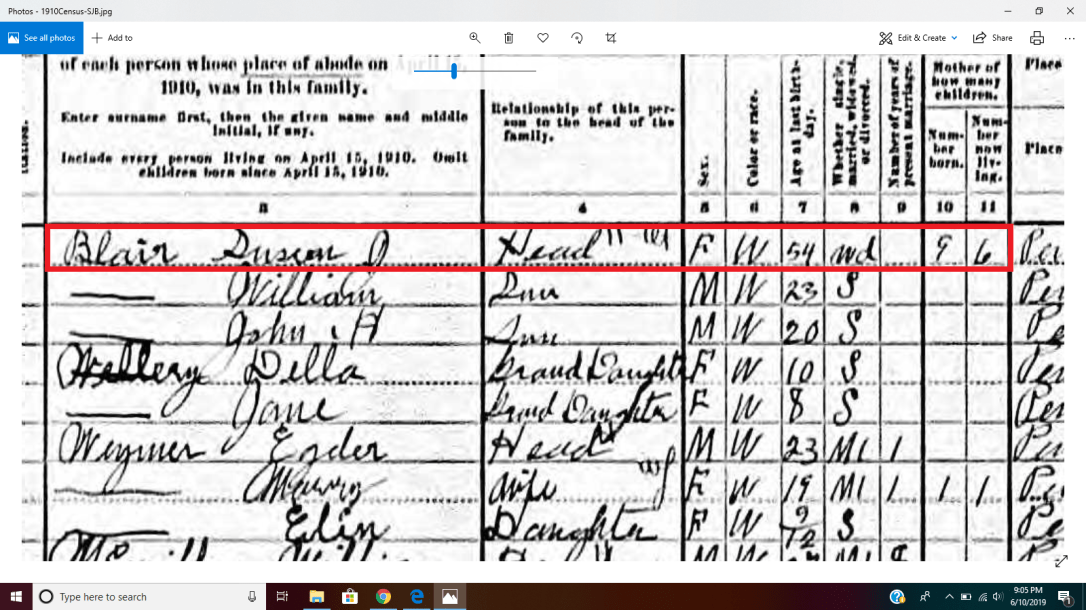
Susan had 9 total children and 6 survived. I can account for her 6 living children: Phoebe Jane Blair, Loretto Jane Blair, Andrew Jackson Blair, Minnie Blair, William Blair, and John Blair. She had 3 that died, Margaret was one of them.
This had me sad. I really hoped she ran off and got married and I just hadn’t tracked her marriage information yet. In a months time, I’m going to head to Pennsylvania and visit some relatives, cemeteries and the Bedford County courthouse, where I hope I am able to find out what happened to poor Margaret. I have two others to find as well.
The Moral of the Story
Pay attention to the details that your census offers, because even though they give you names and approximate birth dates for your ancestors, they can solve your brick walls too.
So many of us use computer programs where we upload the document into our system, and yes we look at enumeration districts and who else is listed when we share our document with all who are on it for citations but do we really KNOW what it’s telling us?
So your homework is to go print off clean copies of the census, and transcribe what you see onto the clean sheet of paper for your relatives, so you can know them better, and tell their stories in a whole new way.
 Helping History Come Alive