Ever since the clock struck midnight on Friday, April 1 the genealogical world has gone crazy trying to find their ancestors in the newly released 1950 census. Were you prepared to know where you had to search for your loved ones? I was a last-minute person, looking up the enumeration district for my mom and giving my dad a call to find out what state he was living in when 1950 rolled around. You see this was the first census my parents are in so I will admit I was a little excited.
I contemplated staying up until midnight when it was released to the world, but I was so tired I knew I wouldn’t have been able to stay awake that long. So, I made sure I got up at my usual 6:11am (the time I normally get up to get ready when my kids are going to school, they happened to be on Spring Break last week, so I was able to sleep in an extra hour), got ready, ate early and made sure I had a good solid hour before having to head out the door to focus on the 1950 census.
My Mom
Of my parents, finding my mom was a little easier. I thought initially she and her parents were already living on North Main Street in Akron, Ohio but I was wrong. I am glad I took the time to look up their information in the City Directory to find them living in Cuyahoga Falls, which is where I myself was born and raised (and it’s literally a 2-minute drive in either direction from where I live presently). It made it even easier for me to find except I selected the wrong enumeration district. Where they lived on Second Street there were multiple choices. It was odd though, I never had paid attention that they lived there before and here I drove by where their house was every day when I took my kids to school, or when I was a member of the Natatorium a few years back. (It appears that it’s a vacant lot where the building once stood).
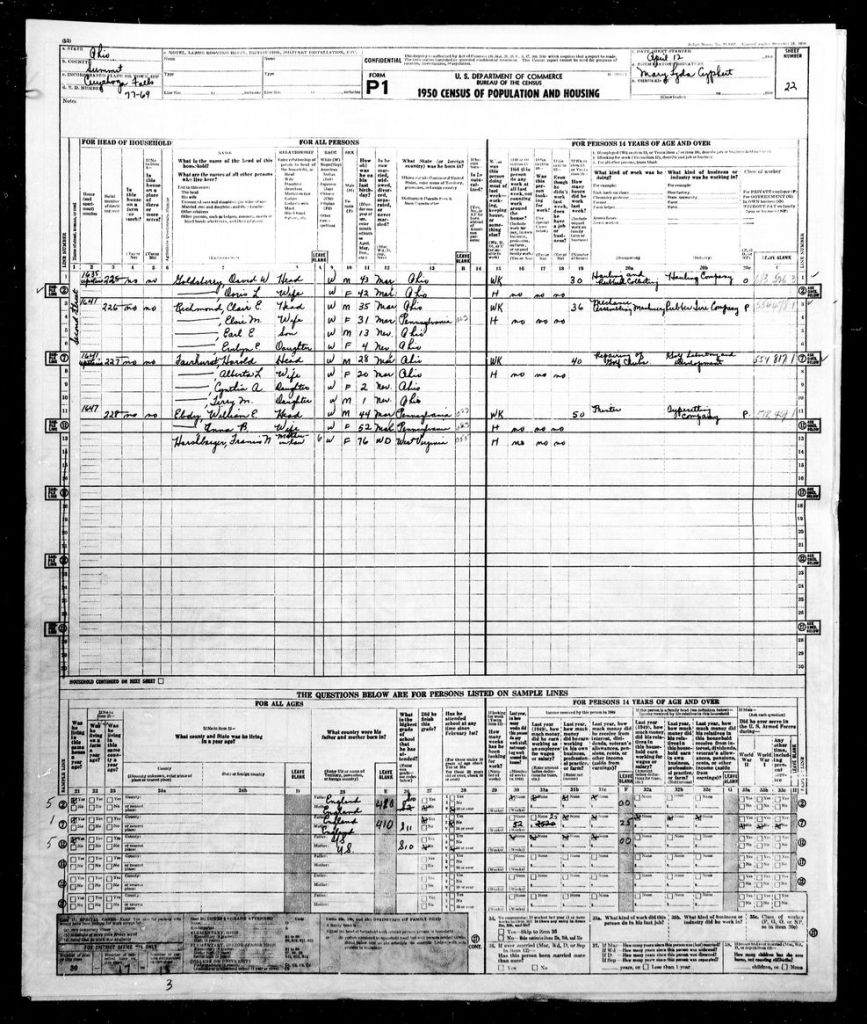
I found my Mom in the 1950 using the National Archives website in enumeration district 77-69 for Summit County, Ohio. They were of course on the very last page. Harold Fairhurst was the head of household.
On my mom’s side of the family, I found her parents, Harold Fairhurst, Alberta Lou Fairhurst, herself, Cynthia Anne Fairhurst, and her younger sister, Terry (Teri) Mildred Fairhurst.
My Dad
My dad was a little trickier. I had called him the night before to ask if he knew if they were in Ohio yet, or if they (he and his parents) were still living in Indiana. My dad would have been 7 in 1950 and apparently all of his schooling was here in Ohio, so that narrowed it down. However, when they first moved to Ohio, they didn’t live in Akron, they lived in the Village of Lakemore, which was near Akron. This is one of those places that I have heard of, but I am not sure if I have ever been there.
I threw “Lakemore” into the enumeration district page to see if anything came up, but it wasn’t helpful. Luckily Google exists. I searched Lakemore, Ohio and luckily it came up and I was able to discover the zip code for it.
I then went to the Ancestry.com and they had a tool you could throw in your zip code and such and it would provide the enumeration districts for the area. So, I put in 44250 and I was able to narrow my search to 77-114, 115, 116, or 117, which translates to about 100 total pages to scan.
I lucked out, they were halfway through 115, and not only did I find my dad and grandparents, but my grandfather’s brother was living right next door with two of their kids as well! So, the total family I found for my dad was his dad, Leroy Blair, his mom, Anna Maria Morgart, his uncle, Donald Blair, his aunt, Anna Smzrlich, and two of their children.
My grandfather, Leroy Blair, is about 4 people down and is the head of household. This can be found at the National Archives website.
Everybody Else
I’ll admit I have hundreds of people I am sure I need to look up and find in the 1950 census. My great-grandparents on all sides of my family would have all been alive and kicking still, but I’m more than happy to wait until I can search by name and save it that way. I figure if I come across someone else that I just need to find, I will, but I have time (and not fully understanding the layout of Pennsylvania towns, who knows how long it would take me to find them).
Did you enjoy the fun of finding your ancestors in the 1950 census? How many people did you find? Share in the comments below!
One of the most important tools you should use when doing your family history is completing a research log. I will admit, I am horrible at getting one out and using one but I am also a very scattered researcher. I flit from one side of the family to another and don’t think anything of it, and I also duplicate my efforts because as good as my old noggin’ is for remembering things, I can’t remember everything.
And that is where a research log comes into play. Not only do they allow you to visually look at what you have discovered in a specific source (be it a census, book, magazine, newspaper, etc.) it allows you to see where you didn’t find information, and that can be just as valuable.
Where Can I Find a Research Log?
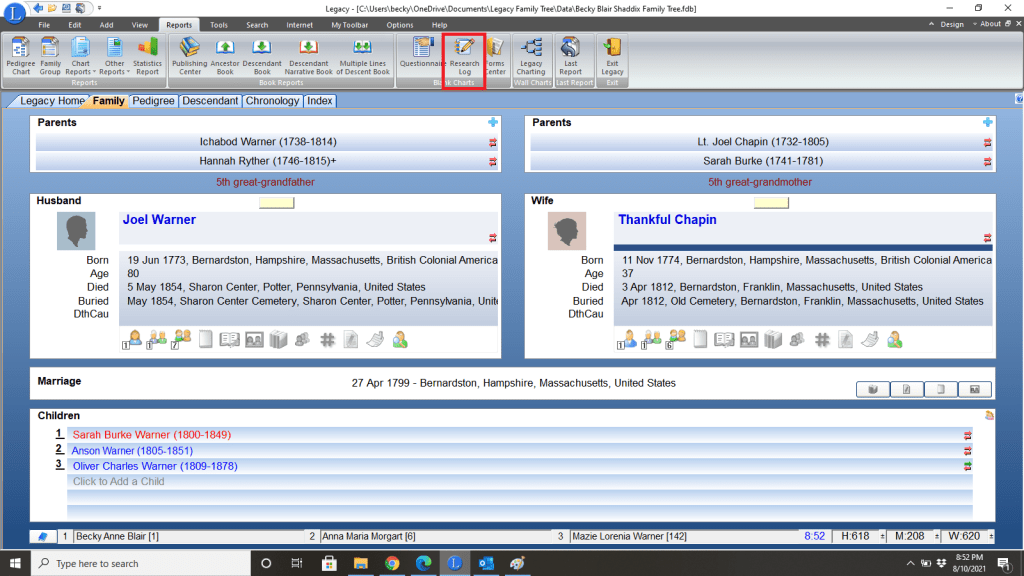
Research logs come in many different formats and can be found pre-made for you to download. I know the one I tend to use can be printed from my Legacy Family Tree software. I can imagine most of the other brands of genealogy software have research logs ready-made for you as well. In the screenshot of my program below, I have boxed in red the “research log” tab where you can print one off lickety-split.
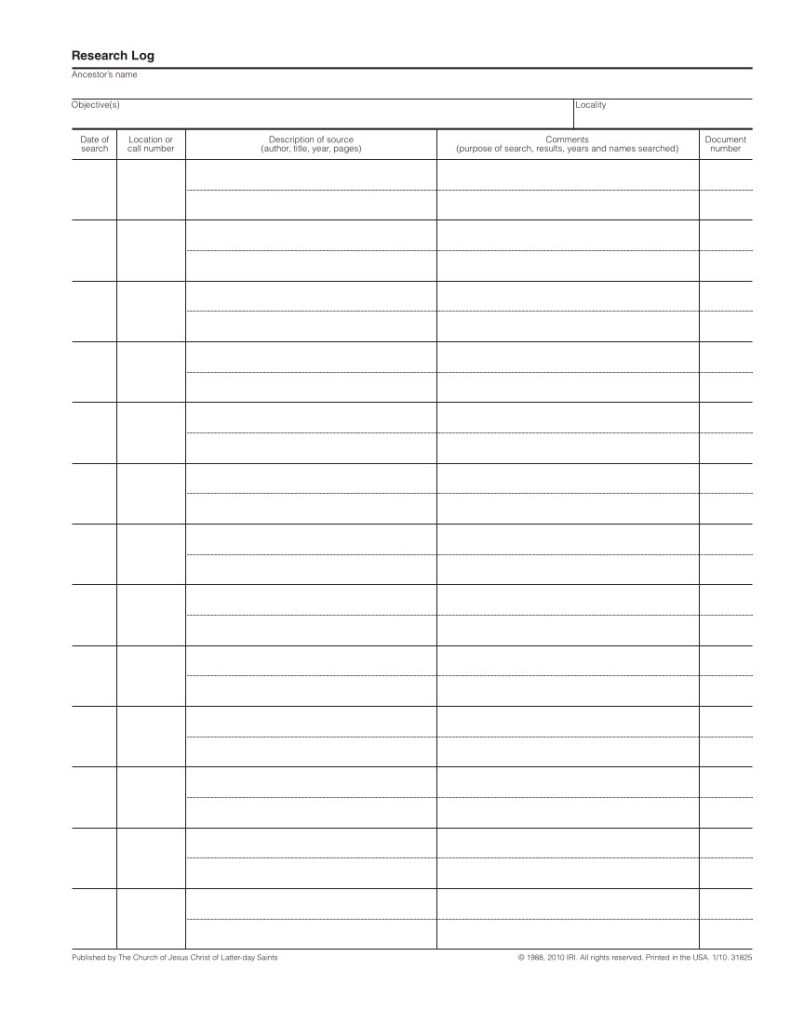
Here is what the research log looks like that Legacy offers. I’ll also show an example I downloaded from FamilySearch.
If you prefer to have an “online” research log, you can always create a document in either Excel, Google Spreadsheets, or even creating a table in Word or Google Docs. Thomas MacEntee has this handy dandy sheet available by just Googling “genealogy research log in excel”, it was the first item that came up, I clicked and it led straight to the directions on creating your own spreadsheet.
Every Good Research Log Should Ask a Question
Like my subtitle above states, a research log should always ask a question, and you should use 1 research log for 1 question on 1 individual. If you have another question about the same individual, you begin a new research log. And the question should be very specific in reference to your person.
I do not have any concrete evidence of who the parents of Oliver Charles Warner, my fourth great-grandfather on my maternal side of the family, are. I sadly must have done the biggest of no-no’s and just gone off the one big tree for who his parents are, so here I am, doing my due diligence to prove his parents are Joel Warner and Thankful Chapin (as Thankful would have been Joel’s wife in 1809, but now that I think about it, many don’t even have Oliver listed as their child, many only have Sharon Burke Warner, their oldest daughter).
Who are the parents of Oliver Charles Warner, born approximately 1809 in Franklin County, Massachusetts?
You are best to be as specific as possible for your question, to make sure you are not confusing the person you are researching with another potential candidate. I’d like to think that my Oliver Charles Warner was the only one born in 1809 in Franklin County, Massachusetts. But we shall see.
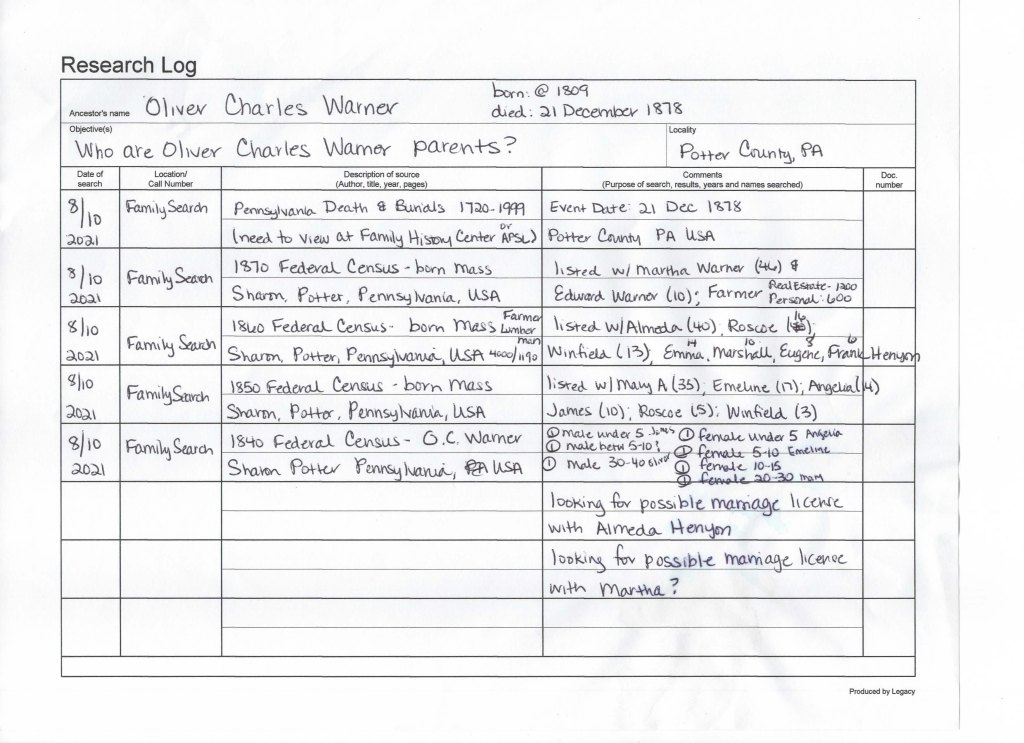
When I make a log for the documents that I do have on Oliver Charles Warner, not one mentions who his parents are. He is married in all the census records I can find, and his death record, which I should be able to open at a Family History Affiliate, came up empty when I went to the library (a FamilySearch affiliate). One day a Saturday will be free for me to visit the Family History Center nearby to see if I have luck there.
My starter research log on Oliver Charles Warner, listing the documents I have found for him and realize none list his parents.
With Oliver Charles Warner being born in approximately 1809, this is the world of tick marks on the census. My goal is to first find a census that will show Oliver being born on the census with Joel and Thankful in 1810. Please note this will not give me concrete proof of any means, it’s just a start to see if Oliver is in the household with Joel in 1810.
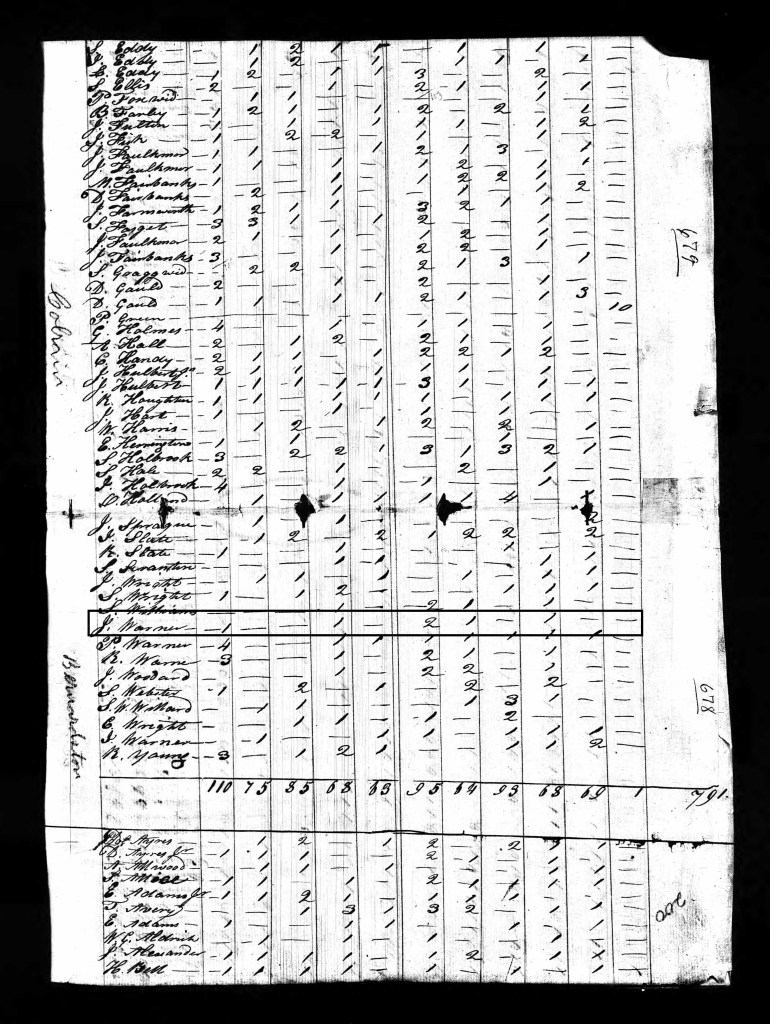
When I go to consult my files, I find it strangely ironic that the only census I am missing for Joel Warner is the 1810 Census. Ideally, this census should show Joel Warner as the head of household, and other dependents including his wife, Thankful, his daughter, Sharon Burke Warner, and two sons, Anson, approximately 5, and Oliver, approximately 1 (possibly less).
When I found the 1810 Census using Ancestry.com, it had not yet been indexed so that could explain why the 1810 Census had been missing in my files and on my profile of Joel Warner on Ancestry (however, the 1810 census is now saved in my computerized files).
The above 1810 Census can be found on Ancestry.com, J Warner is boxed off near where the word “Bernardston” is written on the left-hand side of the page.
The perplexing challenge I face with the 1810 Census is that it states that “J Warner” and his spouse (at this time I do not know for certain if this is Thankful) are raising 1-boy under 10; 2-girls under 10; 1-girl 10-16; and both the man and the woman in the house are between the ages of 26-45. Why this is perplexing is that many records have Joel having another son, Anson, born in 1805, with Oliver Charles supposedly being born in 1809, which leaves him with 2-sons under 10. I am also unaware of any daughters under 10 and this lists 2.
This census also lists Joel’s siblings, Pliny and Roswell, which is why I’m confident my “J Warner” is Joel. Both of his brothers are listed as having sons under the age of 10 as well (or at least boys in their homes). Pliny has 4, while Roswell has 3, more possibilities on who Oliver’s parents might be. (Joel also has one other younger brother, Seth, who could also be a parental possibility, and Seth, like Joel, moved to Potter County, Pennsylvania).
Now while looking through some of the birth records from Bernardston, Hampshire, Massachusetts, it’s quite odd that on 15 November 1804 Alson Warner was born to Pliny and Jerusha Warner. I now wonder if the mysterious “Anson” could be “Alson” (the Anson I have found was born in 1805 and I’ve never seen any other record relating him to my Warner’s, I have a hunch I have found information on an Anson that doesn’t belong to my family as there are many Connecticut ties). But does that mean that Oliver Charles Warner is the “boy under 10” on the 1810 Census for Joel?
Also, Oliver was supposedly born in Franklin County in 1809. And though Franklin and Hampshire are next to one another, was Oliver born in Franklin County or in Hampshire? It’s entirely possible they moved, as Thankful died in Franklin County as well in 1812. In fact, it appears that Bernardston has changed what county it is in (or at least I have it down as two different counties, maybe Franklin was formed from Hampshire). A simple Google search provides me the answer, Franklin county was formed in 1811 “from the northern third of Hampshire county”.
So now my latest deduction is if Oliver Charles Warner was born in Franklin County, how accurate is his 1809 birth year since Franklin was formed in 1811? Oliver is not listed in any birth records for Bernardston, only Sarah Burke Warner, the oldest child of Joel and Thankful, is listed as being born in the vital records of Bernardston, Massachusetts. None of the other children that are represented on the 1810 Census are listed either. So, my next task is to look through other city’s vital records in Franklin County to see if Joel Warner is listed with offspring. This also includes me creating a new research log with the question:
Where in Massachusetts was Oliver Charles Warner born in 1809?
I’ll keep the year the same because as I look through the documents listed I’m sure if he was born a few years later I should still find him. It’s possible as I find the vital records about Oliver that maybe I will find information about the girls under 10 that are also listed in the 1810 Census under Joel Warner.
Other research logs I could work on were extending my research to the collateral members of the Warner family, finding out the name of the children of Pliny, Roswell, and Seth Warner as well, to make sure my Oliver Charles didn’t belong to them. It’s always possible that the girls listed with Joel could have been nieces of his, nothing is guaranteed that the girls are his daughters.
Research Logs Keep You Focus
If nothing else research logs keep you focused. You may end up working on multiple research logs simultaneously but it’s worth it to keep yourself from duplicating work. Not to mention we all know how easy it is to go down the rabbit hole when you get distracted by bright, shiny objects, I’m not saying you won’t still do that, but hopefully, you will have a new research log for each hole you go down, and then some.
As for me and Oliver Charles Warner… I am still in the throes of trying to find towns in the vicinity and going through the online records. Many of these vital records have been digitized but you have to go through each record page by page. Where Bernardston’s records are all alphabetical and are just beautiful, not every town is Bernardston. It is just taking me longer than I anticipated to narrow down areas and figure out where to look. Part of me thinks I should do more of the collateral search first to discover all the children of Joel’s brothers to verify the names of all of their children to aid in my search, and that finding those records may assist me in narrowing things down. But I am determined to find what I need, hoping beyond hope that Joel and Thankful are Oliver’s parents.
If I’ve learned anything from the countless classes, webinars, and presentations I have attended/watched over the last six years is that you need to branch out to get the full story about your ancestors. Branching out includes researching your collateral relatives and even researching the town(s) where your family lived.
Collateral Relatives
In case you are not aware of what a “collateral relative” is, it is your aunt, uncle and cousins, however distant they may be. It may seem strange to investigate these non-direct relatives, but sometimes you can learn things about your direct relative as researching their sons and daughters can find missing pieces of your own genealogical puzzle.
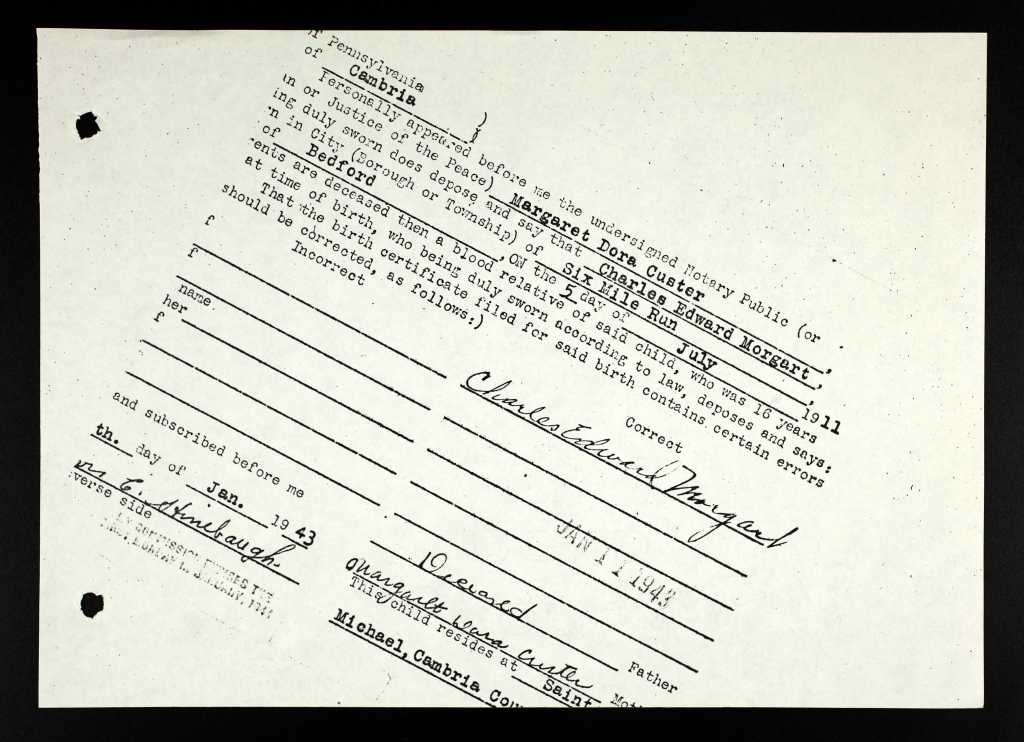
As I was looking up information on my Grandma Blair’s older brother, Charles Edward Morgart, referred to by my Grandma as “Eddie”, I came across both his birth certificate and a delayed birth certificate that they went and applied for on 11 January 1943. I don’t even have to look the date up, as I thought it was funny that they went and got this delayed birth certificate the same day my Grandma gave birth to my dad in Indiana. But that isn’t the only interesting thing I found out, when signing her name to the delayed birth certificate, my great-grandmother, Margaret “Maggie” Wise signed her full name, Margaret Dora Custer (she was married to her second husband, Earl Custer, at the time). Until this document I was unaware of what the “D” stood for.
Revised or delayed birth certificate for Charles Edward Morgart found on Ancestry.com
Another reason searching for information on your collateral family members is a smart thing to do, sometimes names are spelled incorrectly, and people don’t always show up in search results. By getting as many documents as possible for your extended family you may find missing relatives intermingled with others. For example, parents and grandparents can be found living with their children or grandchildren.
Cities and Towns
You can indirectly learn information about your ancestors by researching the cities and towns they lived in. If they were farmers, you can get an idea about what type of farm your relative had by researching the area where they lived, which comes in handy for someone like me whose relatives live in a state where the agricultural index for the census has been destroyed.
Sometimes you may be lucky enough that your family was important enough to be written about in a book about the history of the town. I was lucky enough to have the Morgart Tavern listed in a photographic book about Bedford County. My elation when I recognized names when I came across the book, simply trying to find out more about Bedford County, I wanted to jump up and down for joy. It’s a shame one has to be quiet in a library. (I thought I had taken photos of the book to share with others, but apparently I didn’t – presently hanging my head in shame).
Branching out in your genealogical research is essential to finding everything you need to know in your family tree. I always research all siblings and children of my relatives. I don’t always research parents of spouses of extended people because sometimes you have to stop, but there are times when I still do, like siblings married siblings so sometimes when you can’t find where a person is the answer may be with the other set of associated parents (I have done this with George Washington Blair, son of Andrew Blair and Susannah Akers, as he is married to his younger brother, Samuel Alexander’s wife’s sister).
Have you found out any interesting facts about your direct line ancestors by researching collateral relatives or where they lived? I would love for you to share in the comments.
A great way to learn about history is to read. I just recently finished reading the book “Mayflower” by Nathaniel Philbrick for two reasons: I wanted to learn what really happened back in 1620, and I potentially have Mayflower ancestors, so it was a way to read a little bit about my connection (he was hardly mentioned, but in the grand scheme of things, that is good).
From the opening pages of “Mayflower” I realized that Mr. Philbrick did a great deal of research on the book, the number of pages that are dedicated to the Notes section alone testify to that. The book was also not a fast read. Where many books I can read in just a few days, with all the different Indian tribes mentioned in the book from the New England area over the span of 60 years, along with all the key players, it was easy to just slow down the reading just trying to say all the names properly in my head (and who knows if I was anywhere near being correct).
The book highlighted names we were taught in history class, William Bradford, Edward Winslow, Squanto, to name a few off the top of my head. But there was so much more that I was not aware of until reading this book, things that I had read about in my genealogy groups in reference to how life in Plymouth Colony really went down as opposed to the sunshine, lollipops and rainbows we learned about in grade school, you know the tale, that Squanto showed the Pilgrims how to survive that first year and that the Pilgrims and the Indians had a wonderful Thanksgiving feast together.
Well, that’s not really what happened at all. Squanto helped, seeing as he had already been enslaved by the English and had traveled to Europe he was able to speak to the Pilgrims when they arrived in Plymouth. The Native Americans did assist in helping the Pilgrims plant their first successful harvest during their first year, and the Pilgrims did celebrate with a feast, but it wasn’t the hand in hand big dinner as we think, it was amongst themselves.
You go on to learn that agreements the original Pilgrims made with the various tribes in the New England area seemed to fade as the next generation took over. This happened on both sides, with the various Native American tribes as well as the Englishmen. They began thinking the Native Americans were evil, so much so, that they would ship them to the Caribbean and into slavery.
As a person who has been working on their genealogy, I’ll confess that I have always been relieved that I have no southern ancestors simply because I dodge the bullet of slavery. But this is no longer the case. I have no concrete proof yet. but I am fairly certain I will eventually find Mayflower lineage in my family tree. But knowing that they could still be embroiled into sending others into slavery has me quite disheartened. I know I am not responsible, but it’s not exactly the thrilling story to tell the others around the holiday table. Especially when it’s something that has been somewhat glazed over in the past 400 years of history.
Mr. Philbrick goes on to write about Prince Philip’s War which was another feature of our history I hadn’t been aware of, which has mainly been taught in the New England area of the United States.
The book really is a good and I recommend if you aren’t familiar with what is more than likely the true story of how the United States began. This book has made me want to read more about the earlier portions of our history to discover the true basis of our country.
The book is still available to be purchased on many online stores as well available in your local library.
As you begin your family tree, one item is essential: you must have a strong foundation.
What is the foundation of your family tree, you ask? That is simple. It all begins with you. And then your parents, your grandparents, your great-grandparents, I am sure that you get my meaning. You have to have good, solid facts on yourself, your mom and dad, everything in order to have a strong tree.
Trust me, I know the lure of just adding person after person in your tree. It’s exciting as you get up higher and higher into the branches as you find a fifth-great-grandmother here, and a seventh-great-grandfather there. But if you haven’t done your due diligence down below, you know, where YOU are, and YOUR PARENTS are… you aren’t going to know for certain if your fifth-great-grandmother is really who you are related too.
I am a person who does the horrible, awful no-good type of researching because I skip around (and I have a feeling there are more people like me out there than aren’t). They say you should just work on one branch at a time. I am sure that is the smart way of doing things but there are days I want to work on my dad’s side of the family, and other days when I feel like getting my mom’s family a little more under control. It’s called variety, and I love variety (it is the spice of life, after all). Not to mention sometimes you have people on both sides of your family curious about what you are finding, and you don’t want to disappoint anyone, so I skip around and do both.
Sometimes on the same day.
But you always begin with you. And once you know about you, you can move onto your parents, and their siblings which leads to your grandparents, and their siblings, and so on. Yes, I’m the type that likes to work on the collateral people as I work my way up because you never know when you are going to find a distant aunt or cousin that may come back and help you figure out a puzzle later on (like, great-great-grandma was living with an aunt, and it wasn’t popping up in an Ancestry or FamilySearch search).
But it’s always best to find everything you can, or at least all the vital records and census records before moving up to the next direct line ancestor. This gives you a strong foundation for your genealogical research. And a strong foundation helps you build a very healthy tree.
Have you joined a genealogical society? A few years ago I joined three different societies, beginning with my local county chapter of the Ohio Genealogical Society (also known as OGS), OGS, and the National Genealogical Society. Later I joined a fourth, an online only society in an area of the United States that pertains to my ancestral journey.
Why Join a Genealogy Society?
I love genealogical societies, because they are a great resource for your research. At the various levels, whether it’s county, state, or national, each has something that stands out to make it unique.
County Level
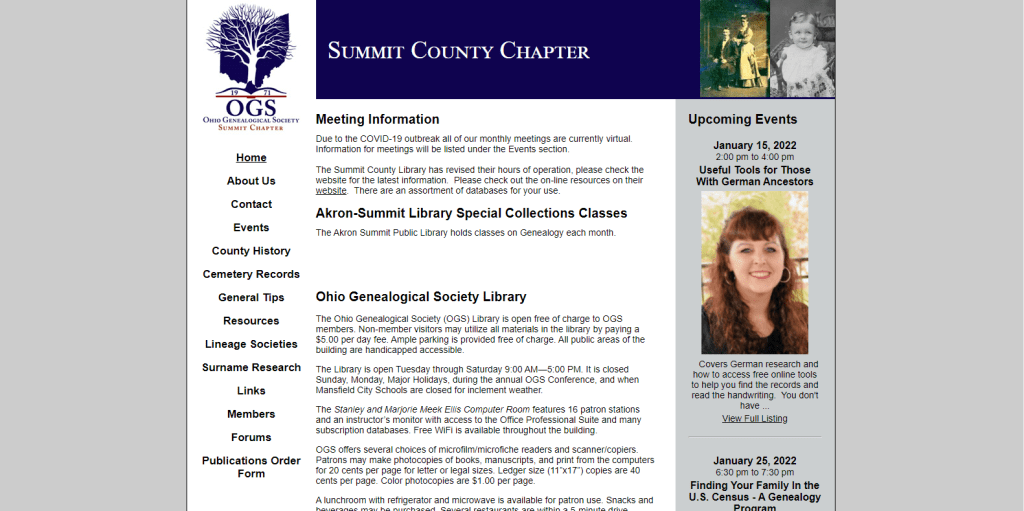
My local Summit County Chapter of the Ohio Genealogical Society is a wonderful resource because it meets monthly (except in August and December). At these meetings, which are the third Saturday of the month, we have speakers pertaining to different topics. As I type this tomorrow is our meeting, and our program is “Useful Tools for Those with German Ancestors” by Dana Palmer. She is one of my favorite presenters, discovering her at a Family History Day at the Summit County Family History Center in October 2018.
This past year we attempted to have a research day at the Akron-Summit County Public Library in the Special Collections department, which has several computers available for access to online databases (Ancestry, FamilySearch, MyHeritage, FindMyPast, AmericanAncestors, and more, you just need a library card). They also have books on local history and genealogy from all over the country (possibly all 50 states, if not, it’s close) to aid in sources not online. We ended up doing mostly solo research, but it was nice to know others were there in case we needed to float ideas.
Presently our meetings are hybrid, meaning we meet in person at a conference room at the main library but members can also be a part of the meeting from their homes via Zoom.
Summit County Chapter of the Ohio Genealogical Society (www.summitogs.org)
Ohio Genealogical Society
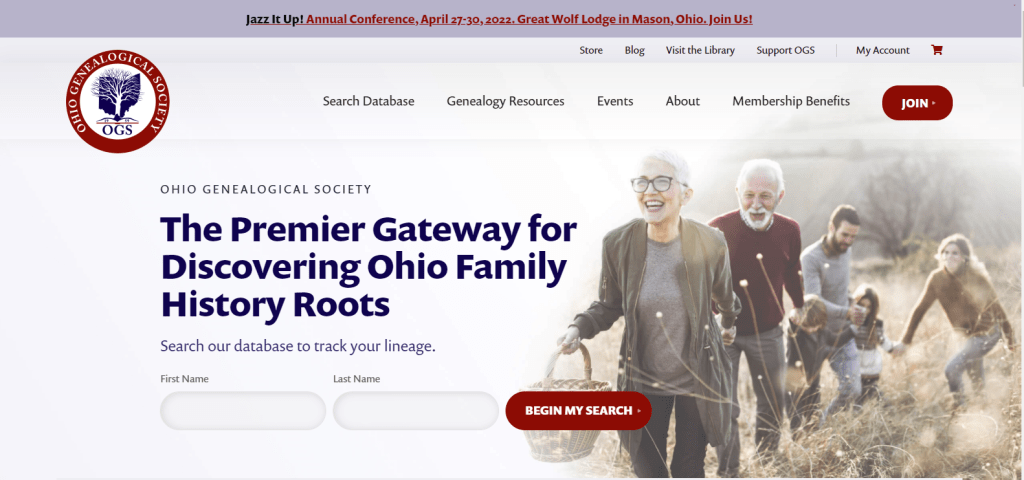
The Ohio Genealogical Society is the largest genealogical society in the United States and has a wonderful 4-day conference each spring that moves between three locations: Cincinnati, Columbus, and Sandusky (I wish they would do one in my area, not that the drive has prevented me from attending).
They also do a weekend retreat in the Fall at a rustic getaway (picture cabins in the woods) with high profile speakers discussing topics of interest. I looked at their event page and not much was listed, but their recently updated website has a number of genealogical resources available, but you must be a member to view.
There is a higher price tag to become a member for the National Genealogical Society but I find it to be worth it. Along with free classes there are classes you can purchase in order to be a better family historian.
Like OGS, NGS has a yearly conference that takes place in a different location every year. Since I’ve been a member they have been in St. Louis, Salt Lake City, Richmond, and this years is to take place in Sacramento. They have both in person, virtual, and on-demand options for attending.
A little over a year ago NGS merged with the Federation of Genealogical Societies and now have these societies as a focus in the NGS Magazine. By combining both organizations they can focus on caring for the needs of all areas of family historians.
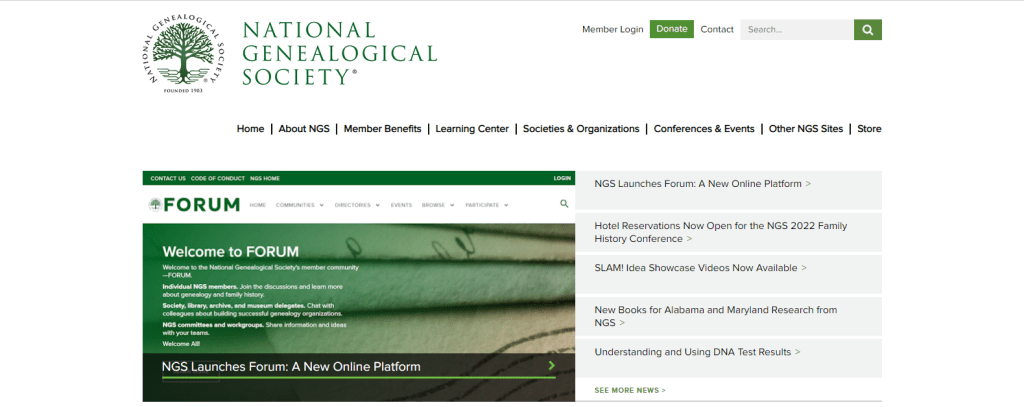
This past week (or maybe it was last week), NGS launched Forum, a member community where members can discuss family history with each other, but societies, libraries, archives, and museums associates can “discuss building successful genealogy organizations”. This sounds like a great way for ideas to be bounced around and for you to communicate with others, possibly where you are researching.
NGS also has two wonderful magazines, one with a hodge podge of information, the NGS Magazine, and one that is filled with case studies, National Genealogical Society Quarterly. Both are valuable tools for the family historian.
The NGS website also lists a number of events on their website for their own sponsored events as well as other genealogical societies across the United States. They are all quite helpful for those who want to continue to learn.
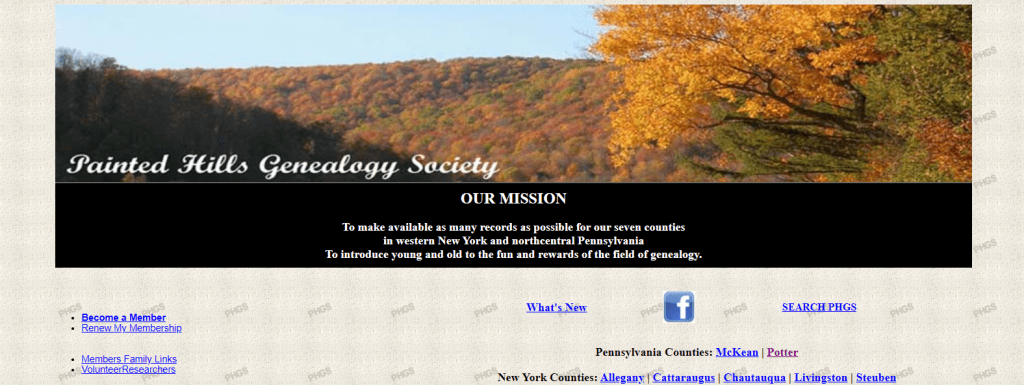
Painted Hills Genealogy Society is a website I stumbled upon and that I value so much. It has so much information on the website, and your dues allow you access to an exclusive Facebook group. The website pertains to southwestern New York counties (Allegany, Cattaraugus, Chatauqua, Livingston, and Steuben) and two northwestern Pennsylvania counties (Potter and McKean). These are the counties (both New York and Pennsylvania) where my Dunbar, Williams, and Gustin families all hail from on my maternal side of the family. Joining a society that is all about the area you are researching is simply invaluable.
So, whether you join just locally or want to broaden your horizons, there is so much to gain by becoming a member of a genealogical society. Each society has something to offer, and you can normally learn a lot about them by visiting their website (I’ve included links above to all the ones I’ve talked about today).
Take some time from your researching to check out these valuable resources. If your budget is limited choose only one to sign up for but make sure it’s one you know you will get the most bang for your buck. Sometimes it’s worth signing up for society in the area of the country that will most benefit your researching (as I have the Painted Hills Genealogy).
I know my local society allows visitors to check them out, or even if they have a program that you are interested in. Everyone is always welcome, so take a chance and become involved! You’re only going to find people with the same hobby as you!
The final week of 52 Ancestors in 52 Week’s has a heavier topic than normal (I type as I laugh as some of the themes have really made me think hard). This week’s is no exception with the prompt of “Future”.
Family Lines
I’m going to seize the moment and really focus on 2 lines from each side of my family. The Warner’s and Gustin’s on my Mom’s side and the Blair’s and Aker’s on my Dad’s side. I’m sure others may pop up with interest (for example, my Dunbar’s married a Warner so I could stray a bit that way), or maybe I’ll have a moment when I want to research my maternal grandfather’s side of the family, and since they are all in England, you utilize that mood when it strikes.
The Warner’s
My genealogy future will be me going into a little more detail on my mom’s side of the family, the Warner’s to be precise. While attempting to look up some information on Thankful Chapin, who I believe to be my fifth-great-grandmother on my maternal side of the family, I realized not only do I not have the paperwork to back this up (though her years of being alive do) but I don’t have confirmation that her supposed son, Oliver Charles Warner, is a son of Joel Warner. By exploring this portion of my tree, it will help me explore other areas of this side, and since my great-great-grandmother, Mazie, was a Warner, they are extra special (because for some reason she is extra special to me, I truly feel she would have liked me).
The Gustin’s
If I am going to write more about the Warner’s I may as well learn more about Mazie’s mother, Orienta Gustin and her parents, Benjamin Gustin and Nancy Return Gault. I remember being so tickled upon finding Orienta’s photo that I want to know more about this amazing lady and her lineage as well.
The Blair’s
Oh, it wouldn’t be a year of genealogy if I didn’t try to work on my Blair brick wall, now would it? Observing in the past weeks of various DNA matches I saw that a person who was placed in the middle of my Blair’s on FamilySearch’s one big tree is on a DNA matches tree. Though there is a possibility that the person has the wrong fellow in his tree, just in case that I am somehow related to the infamous Andrew Sloan Blair I am investigating him by putting him on an experimental, private tree. I will never know if there is some sort of distant connection until I build a tree and flesh it out. The worse thing I do is waste my time. (And honestly, I have no idea how this will all pan out).
The Aker’s
And it’s not fair to write about the Blair’s and not bring in Susanna Akers. I so wish to know more about my third-great-grandmother on my paternal side. Just how they appear and disappear from thin air has me especially intrigued. I hope to find her. Or whatever Susanna’s last name is. I still feel the key is with their second youngest son, George Washington Blair.
Expanding My Researching
This year I plan on doing something I have never done before. Going to specific places to research, and try to utilize knowledge from groups I already belong too.
Family History Center
I am going to get the courage to go into my local Family History Center and ask for help on how to use their facility (assuming they are open – with the different Covid variants running around, this may be another pipe dream). I know that there are files for Oliver Charles Warner that I can hopefully view in the Family History Center, so this is one of the reasons why I am planning on using this wonderful place to find out what I need.
AmericanAncestors.org
I signed up for the AmericanAncestors.org website to utilize as my mother’s family is from New England (you may recognize these names, the Warner’s, the Chapin’s – all from Massachusetts). This appears to have so much great information that I plan on utilizing it more for my research so I can better understand this area of the world and hopefully learn so much more about my relatives. As a person who absolutely loves the history involving the beginning of our country, this should be a wonderful treat me for me.
The Genealogy Center
Since I live within four hours of Fort Wayne, Indiana, I hope that I can go and visit the Genealogy Center in the Allen County Public Library over a weekend. I know I need to be ready to research what I need to find out if I go there, but it just seems like a great resource for me to go since I just live in the state next door.
Continue with my Blog
My other goal is to continue with my blog. I know I was able to increase those who follow me this past year and that is great. I like to think that means people are enjoying what I’m writing. I hope to add more history book reviews in the mix, and more how to articles, as well as the occasional prompt for 52 Ancestors in 52 Weeks (I’ve still signed up for it – just may not do it every week – I’ll write when the feeling strikes or the theme is too enticing that I can’t say no).
I enjoy sharing what I know that if maybe it helps someone else with their research, all the better. And I’ve actually chatted via email/Facebook messenger with distant cousins because of my blog and that had made it that more exciting!
Continue to Learn
I love to read books about genealogy. I have various books on finding church records, the Genealogical Proof Standard, books detailing women’s lives (The Hidden Half of the Family), researching newspapers, and the like. I’m also trying to get more out of the genealogical memberships that I belong to from my local county chapter to my state and even NHS as they have all kinds of learning opportunities for free and some classes you can purchase. All of them will allow me to be the best researcher I can be.
I also want to be a better participant in the Facebook groups and on Twitter. If you aren’t a part of the Twitter genealogy scene, you are missing out. So many wonderful people in the social media world.
So that is what my genealogical future holds. All in all it’s about learning. You can never learn too much!
All my life my favorite holiday has been Christmas. My mom always preferred Thanksgiving because family would get together for simpler things: family and food, she felt with Christmas and Easter the gifts and candy were the reasons people got together. But it wasn’t just gifts that have made me love Christmas, it was the tree and all the decorations, baking cookies and that little bit of magic that all the very special ornaments and lights can bring.
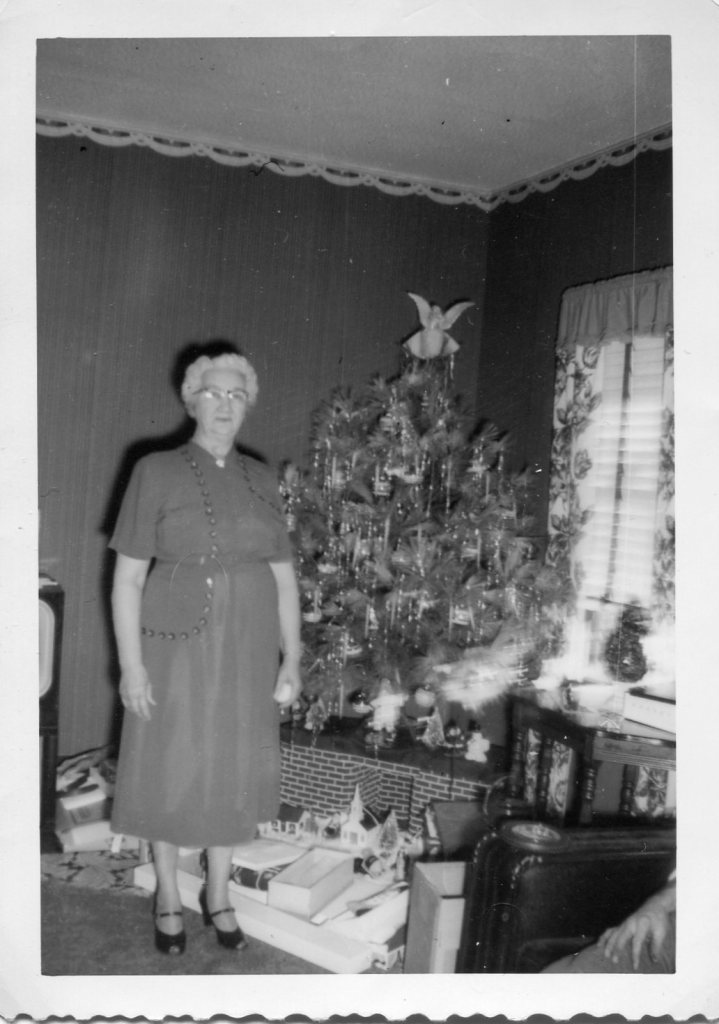
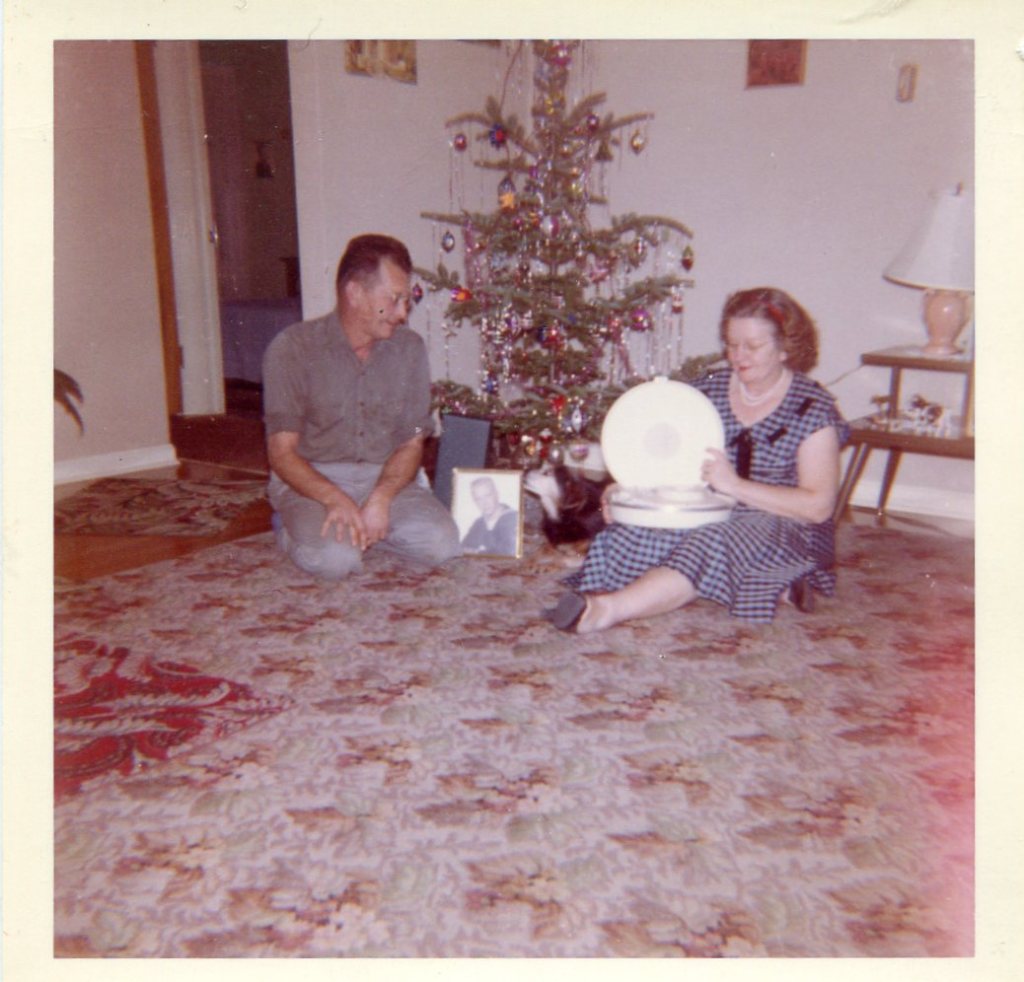
As I have gone through the photographs that once belonged to my Grandma Blair (aka Anna Maria Morgart) and her mother, Margaret Dora Wise, I saw photographs of Christmases past. This delighted me to no end, as it made me feel that my love of Christmas was something that is in my soul, and that I have inherited from those who came before me.
Christmas 1953 – Margaret Dora Wise standing in front of her tree.
My Grandparents – Leroy Blair and Anna Maria Morgart in their home on Christmas Day, 1963 (You can see the photo of my dad as he was off in the Navy at this time).
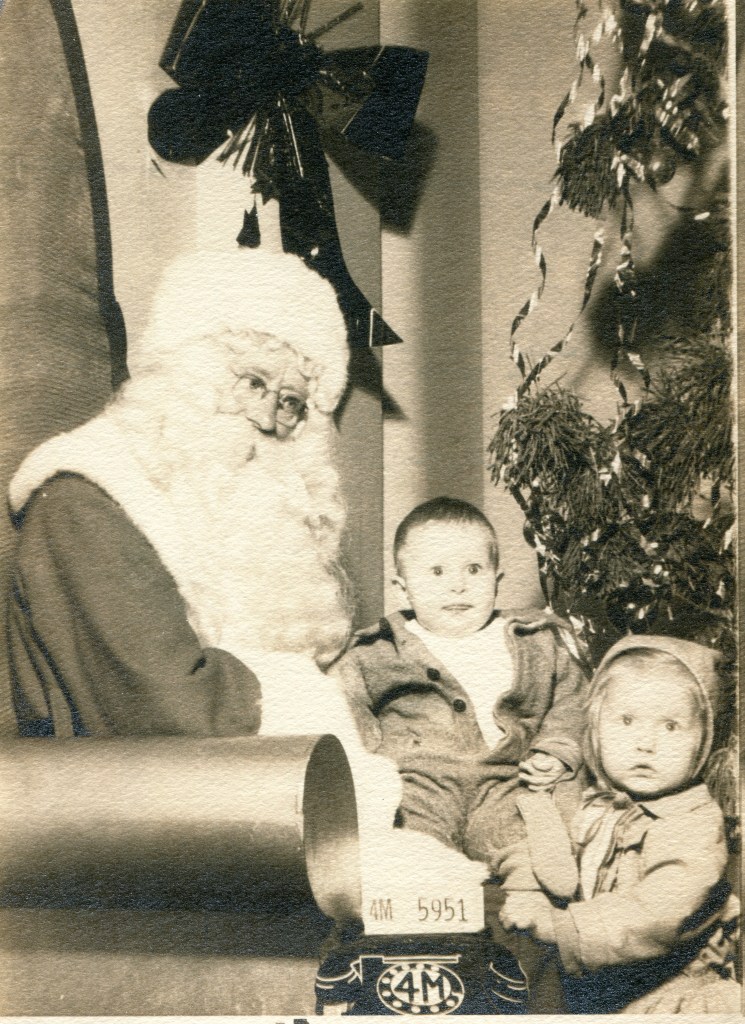
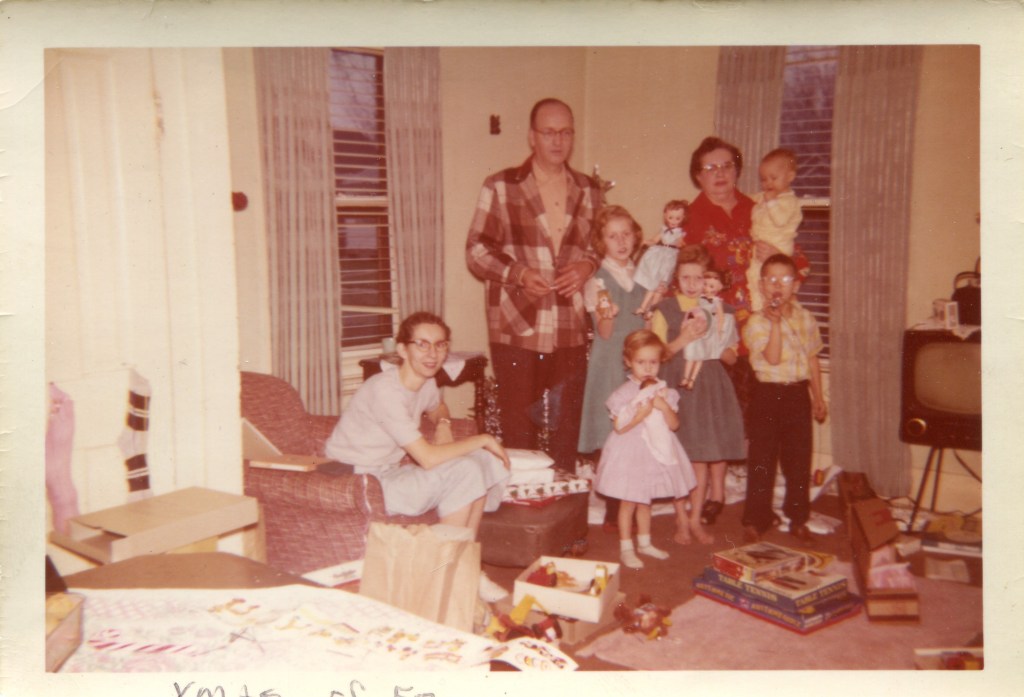
But not on just my dad’s side of the family, oh no, my maternal grandmother, Alberta Lou Fleming, loved Christmas as well. I have so many photos between Christmas day and her yearly Christmas Eve parties when she returned from living in Florida.
Here is a photo from Christmas 1949 of Santa, my aunt, Terry (Teri) Mildred Fairhurst, and my mom, Cynthia Anne Fairhurst.
This one is from Christmas 1957 and has all my mom’s siblings. From left to right is Alberta Lou Fleming, Howard Fleming, Cynthia Anne Fairhurst (in blue), Mildred Laura Dunbar (in red), and the other blue-grey jumper is my aunt, Terry Mildred Fairhurst. The other three are still alive so I’ll respect their privacy.
This was either the late 80’s or early 90’s at a Cardinal Village home that my grandparents use to manage in Bedford, Ohio. My mom, Cynthia Anne Fairhurst, is seated to the left, her face partially covered by her hand), standing is my Grandma Metzger (aka Alberta Lou Fleming, and facing the tree in red is her husband, James Edward Metzger.
Though Christmas is my favorite, to me the holidays more or less begin on Thanksgiving and don’t really end until New Year’s Day. So many wonderful memories throughout the years and sometimes they all just flow together. If no other time family gets together, it’s a holiday. We get together with my husband’s family on Memorial Day and Labor Day each year. We changed it up and have gone to my cousin’s on the 4th of July (which is nice as it’s our shared uncle’s birthday, too).
All in all, holidays are just very special days, no matter how you celebrate them. It’s just extra special to share them with those you love.
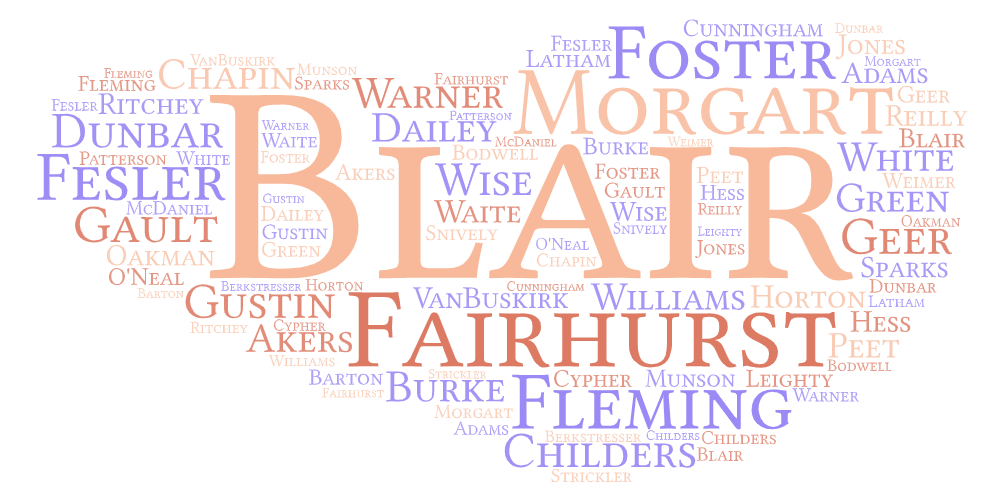
It doesn’t take long for our ancestral lines to quickly multiply within our family trees. By the time I arrive at my great-great-grandparents I already have 16. I have a total of 61 surnames on my family tree, and I am sure there are just as many, if not more, unknown to me.
Sadly, there are some I know more than others. I tend to be more familiar with my paternal side than my maternal side as I didn’t do much research on my mom’s side as she always seemed to be upset with whatever information I found. Odd part was I didn’t even work on her dad’s side of the family because I know she wasn’t fond of him. But when I came home with information about my great-grandmother, I think that made her even more unhappy (as I’ve stated in past posts, like my Grandma Blair was to me, my mom was very fond of her maternal grandmother, Mildred Laura Dunbar, and to be clear, I loved her very much as well).
My goal in the coming year is to get to flesh out some of my family more. I’ll admit working on 52 Ancestors in 52 Weeks does get me writing, but I’m a full-time working girl, it doesn’t give me a lot of time to actually research. I miss that. So, I’ve signed up, but I do not anticipate writing every week (but I’m happy that even though I didn’t get it published on the week it was due, I will have gotten all 52 prompts done this year).
Below is word art of my 61 surnames (or I hope I got them all), or my known ancestral lines. So much to learn. Always learning.






 Helping History Come Alive