Genealogy

Mind Mapping

I’m presently taking a class on genealogy and one of the things they briefly went over in last week’s portion is mind mapping.  I’ll be honest, I never really knew what mind mapping was, now I could sum it up to it being brainstorming on a piece of paper.  But I decided to take a little more in-depth examination of mind mapping and how it can help you with your family history research.

What is Mind Mapping

Using the Wikipedia definition, a “mind map is a diagram used to visually organize information”. It’s hierarchal and shows relationships among the pieces of the whole. According to MindMapping.com, it’s a “highly effective way of getting information in and out of your brain” as it’s both creative and logical at the same time.  Mind maps are illustrations of what you are thinking.

Which goes back to my original statement of it being like brainstorming on a piece of paper.

Characteristics of Mind Mapping

There are certain characteristics that each mind map must possess.

Main Idea

Each mind map has a main idea.  It’s the theme of what your mind map is about.

Branches

These are the main ideas that branch off of your main idea that create connections.

Keywords

These words or ideas that support or describe your main idea are summarized into keywords, no sentences allowed.

Twigs

Lastly, you have less important ideas that aid in describing the keywords, and these branch off onto smaller lines, or twigs.

Creating Mind Maps

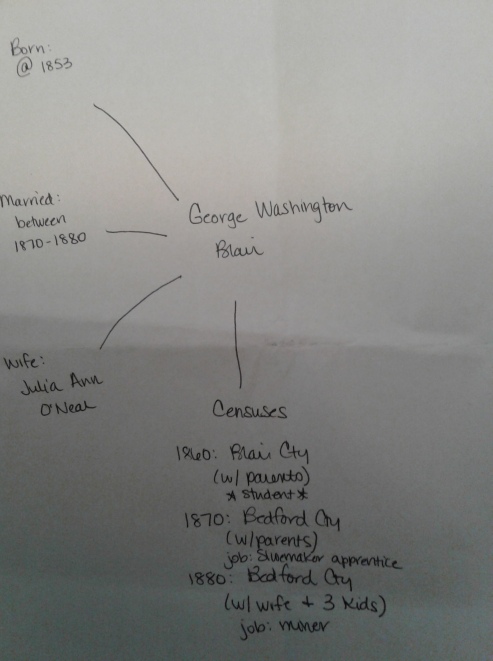
There are different ways to create mind maps.  You can draw from hand (I apologize for my bad photo – somehow my paper got folded but something told me trying to re-write it wouldn’t work as I’d probably just mess it up and get totally frustrated).

20191112_193005

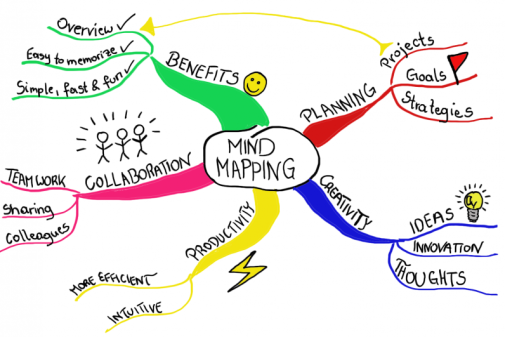
Mind maps can also be made with computer software.  Some of the software that you can use are the following: Coggle, Mindly, Draw.io, iMindMap, MindMup, MindMeister, Scapple, and SmartDraw to name just a few.

MindMapping_mindmap_handdrawn-796x531
Photo found at MindMeister.com

Using Your Mind Map

Mind mapping is a tool that helps make you a better thinker. When you come across a problem, even something that really has you stumped like a brick wall, write it down, all of it, you may just get pointed in the right direction on where to look next.

The one I did above is one of my brick walls, which actually leads to a bigger brick wall.  George Washington Blair is the 4th child of my great-great-great-grandparents.  I only have 1 death certificate listing my 3x-great-grandmothers name and I strongly feel that if I can find George Washington Blair’s death certificate, that maybe it will give me some insight on my 3x-great-grandparents.

A mind map isn’t going to solve your problems, but it will allow you to see your information in a logical flow and give you the opportunity to see what you still need to find, and then you can best decide where to go to seek your answers.

Good luck!

Genealogy

Writing Your Family History

I constantly read how I should be writing my family history down but the question is HOW?  I obviously want it to be entertaining and not cause people to be snoring within minutes, but do you just plop down the statistics?  Do you try to give it personality?  These are the things this inquiring mind wants to know.

Blank 3.5 x 2 in

How You Will Share Your Writing

What form of media will you use to share your family history?  This is a very important decision.  Will you write a book? A newsletter?  A blog?

The format of your writing determines how formal your writing needs to be.  If you choose a blog (I obviously write about my own family discoveries along with tips of how to do your family history) you need to be a little more entertaining to keep your reader’s attention (hopefully I succeed in this).  This would probably be similar advice if you thought of doing a newsletter.

If you are going to write a book you obviously want people to enjoy what they are reading but you can also make sure you throw in statistics you have gathered about your relatives/ancestors if that is the only information you have.

Photographs

If you have photographs of the people you are writing about, make sure you include them. This is probably a no-brainer but it’s worth stating.  I know whenever I come across a photo of a relative I get so excited to see how they looked at whatever stage in their life.  I am hoping to one day find a photograph of my great-grandfather, Charles Morgart, as he is the infant/toddler in my blog’s header.  I have yet to see an adult photo of him but so wish I had one.

Photographs also make people real.  Face it, you can tell people that this is when they were born and this is when they died – but it’s when you give the details of how they lived and what they looked like that makes a person become alive.

Add Some History

You may be thinking,  “of course I am going to write history, I’m writing my family’s history”, but sometimes it’s nice to give your writing a little bit of historical context.  Relate to your reader what is going on in the world to give a better sense of the time period when your ancestor lived.

For example, I am presently reading “National Geographic’s Atlas of the Civil War” as my great-great-great-grandfather, George Henry Fesler, fought in the Civil War.  I have obtained his military file and it details all the battles that he fought in and where he was stationed.  George fought in many battles but I will confess they tend to be a lot of the smaller battles, not Antietam, Vicksburg or Gettysburg, the battles that the average person has heard of, so I’m reading this in-depth book about all the battles so I can include better details in reference to him.

There are different ways you can highlight historical events, you can just do a sidebar of big events that happened during the time period or you could have a timeline listing similar details.

Setting Your Book Up

When writing a book you can always highlight a different ancestor in a chapter.  For example, you can have a chapter on your mother, then a chapter on her mom and a chapter on her dad and within the chapters referring to her parents you can detail her siblings.

You may not have any intimate details about some of your relative’s lives but when you come across those initially you can just put the vital statistic information that you have on these individuals.  Sometimes you may just have very limited information, but if you have gathered any city directories about your ancestor, often they list where they worked, which helps give a little more insight into them.  Censuses will often list a general occupation as well which is still helpful in painting a picture of your relative’s life.

Make a Video

I know on my mom’s side of the family, my aunt and uncle were occasionally asking me how I was progressing on my research.  Not having anything written down, but having found photos of various members of my mom’s side of my family, I made a minute-long video that briefly highlighted my grandmother, great-grandmother, great-great-grandmother and lastly my great-great-great-grandmother and my great-great-great-grandparents (the photo of my 4th great grandmother happened to be a photo with her husband). I used the online video maker Adobe Spark which is free to use and even can be made with background music (the default was surprisingly fitting for my video). I shared the video with my aunt, uncle and many cousins and they loved it!  It was long enough to be interesting and short enough to keep their attention.

Your Program May Write the Book for You

I use Legacy Family Tree to store all my family’s information and there is a way to print a book using all the information I have entered into the program.  It fills in written accounts listed in the notes on each individual as well listing all the sources that you have attached for all the records included. This is a nice, no-brainer way of writing a book with the click of a button.

Brings Your Research Together

Writing about your family is a great way to make your research more interesting to the average person.  Family Historians often find such neat information about our ancestors through vital statistics, newspapers, and family lore, compiling them all together for future generations just makes sense.

No matter what form of media you choose to use – book, newsletter, or blog, anyway that interests you in writing down your information is how you should publish your work.

You don’t have to stop all of your research to begin writing a book, but it may be something to focus on one day a week in order to get ideas together on what you may want to do. I know I have been thinking about how I want to do mine for a while and I like about taking it an ancestor at a time.  It may provide you with who you want to focus on for a bit as well, and if you have all your writing on a computer you can always continue to add the further along you go with your tree.

No matter how you opt to write your genealogical findings, I wish you great success in your journey.  Sharing your research with the world is one of the greatest honors we as family historians have.

Good luck!


Genealogy

Family History Month

Family History Month

October is Family History Month and this past weekend I had two days of events to help me in my genealogical journey.

Friday night my library hosted a Late Night at the Library where you could research at the Special Collections area from 6:30-10:30pm.  They gave a tour of the department for those who hadn’t been there before.  I am very fortunate to have a library that has books from most of the 50 states (if not all), microfilm from various newspapers, maps, and free access to a number of subscription genealogical sites.  Representatives from different organizations were also on hand to assist, one being National Society United States Daughters of 1812.

Saturday had me spending most of the day at my local Family History Center where they had a day filled with classes to learn more about researching genealogy.  Here are the classes that I took:

  1. Interpreting DNA Results
  2. Scottish Research
  3. Latest Computer Tech for Genealogists
  4. Family Search App
  5. Internet Sites for Genealogists

Other classes that were offered included Prussian Research, Czech/Slovak Research, Until Death Do Us Part, Are You a Good Ancestor?, and FamilySearch questions.

Family History Centers are locations that allow you to access all records on FamilySearch and like the library, they also provide free access to many subscription sites to help you in your research.  They are located all across the United States.

You should take a moment and check to see if your local library or Family History Center has any genealogy programs going on before October is over.  Both of my local events were free., there is a chance could be too!


Genealogy

Death Certificates

Death certificates are one of my favorite tools to find when working on my family tree.  Granted it’s always sad that your ancestor passed away, but death certificates offer so much information that when you find them it’s like hitting the family history jackpot.

Different States, Different Availability

The downside of death certificates when searching in the United States is that each state differs when they began keeping vital statistic records, and their availability for each is different as well.  I am fortunate that I live in the state of Ohio and we can go and get a birth certificate from anywhere, at any time.  There are limitations, like you have to be in the county where the person died (my grandfathers are both eluding me as one died in Jefferson County and the other in Monroe), or if the person passed away between 1908-1953 you can find them on FamilySearch but if they died between 1954-1963 you have to contact the Ohio History Center in Columbus to obtain those.  The cost is $7 plus tax but I can honestly say when I mailed in my check for the two I needed, I sent away on a Thursday and my death certificates were emailed to me the following Monday (my check hadn’t even cleared yet).

Most of my relatives are from Pennsylvania which has a much stricter policy for the release of their vital statistics.  Birth certificates are available 106 years after birth.  Death certificates are available 50 years after they die. Next year I will finally be able to get my grandmother’s birth certificate as she was born in 1914.  I will be ordering my grandfather’s at the same time as he was born in 1912.

Make sure you check with the state you are researching to find out when you are able to obtain these valuable vital statistics records and find out how much it will cost to obtain these records.  In Pennsylvania, it is presently $5 each.

Birth Certificates vs. Death Certificates

Though birth certificates are very important (when recently coming across my great-aunt’s birth certificate on Ancestry, I discovered that her father was not my great-grandfather). Death certificates give you birth dates, death dates, spouse, parent’s names, where they are buried, if they are buried, when they were buried, how they died, where they lived, where they were born.  Granted, the information is only as reliable as the informant, but it gives you something to go with as far as your person is concerned, especially if you know little about the person.

My Most Memorable Death Certificate

My most surprising death certificate I found using Ancestry Library Edition.  I am fortunate for my local library to have this, and so I would often go to my local branch and spend an hour or more at least once a week utilizing the records they had.  This is when I came across my second cousin twice removed’s death certificate.

RalphReedDeathCertificate

Discovering that one of your relatives was executed by the state of Ohio is always a little alarming.  I am sure if I ever find another (I truly hope I don’t) that I will be just as amazed.  (And I know I’ve shown this before, but some surprises you just never get over).

However, look at all the information that you can discover on the above death certificate.

  • Name: Ralph Reed
  • Birth Date: 1 Jun 1921
  • Place of Birth: Johnstown, Cambria, Pennsylvania
  • Father: Thomas Reed
  • Mother: Margaret Phillips
  • Occupation: Baker
  • Date of Death: 4 May 1949
  • Place of Death: Columbus, Franklin, Ohio
  • Cause of Death: Electrocution by Legal Execution
  • Informant: Mrs. Margaret Reed (his mother)
  • Burial: Headrick Cemetery
  • Date of Burial: 7 May 1949

All this information is from one piece of paper. Now in Ralph’s case, we are fortunate that the informant was his mother so it was a person who had a great deal of knowledge of his life.  Many times we aren’t as lucky.  So often I find “I don’t know” or “Unknown” for a parent’s name because the children of a person aren’t always aware of their grandparent’s names, especially if they passed away before they were born.

It is highly recommended that you gather all the vital statistics that you can for each member of your family.  These include birth certificates, marriage licenses, and death certificates.

New England States

Most states began keeping death records between 1900-1930.  If you are lucky enough to have relatives in the New England states where religion was the backbone of the community, you will be fortunate to have ledgers with birth and death dates.  When I was finally able to leave Potter County, Pennsylvania and go to Franklin/Hampshire County, Massachusetts, I was amazed at how many vital statistic records I was able to obtain for my family where they were absent in PA.

The Frontier

As settlers moved west towards the new frontier, keeping records wasn’t at the top priority.  As far as religion went, most of these areas had itinerant ministers.  These circuit riders went from community to community, performing weddings, baptisms, and possibly funerals, but the documents weren’t always filed.  This is why records throughout the mid-west are more challenging to find.

In Bedford County, Pennsylvania, where a majority of my father’s family came from, records are available in a handwritten book from 1890 to 1905.  But anything before that is a mystery, often relying on gravestones for the answers for vital records, along with census records for birth dates.

Sources for Family History

Though there are many important documents to find in genealogy, I find that death certificates are one of the more important ones.  Death certificates don’t always have the answers you are seeking for your people, but they are still valuable documents to have in your possession to obtain needed information about your ancestors.  I know I presently have a death certificate for my second great-great-uncle and it is the only hint I have of what my third great-grandmother’s name is (I’m still hoping to hunt down her fourth living child in a hope of his death certificate giving me the same name).  Both Ancestry and FamilySearch provide online images of death certificates so utilize these valuable sources, you never know what kind of interesting facts you will discover about your ancestors.

History

October 6, 1926

Babe Ruth Sets World Series Record

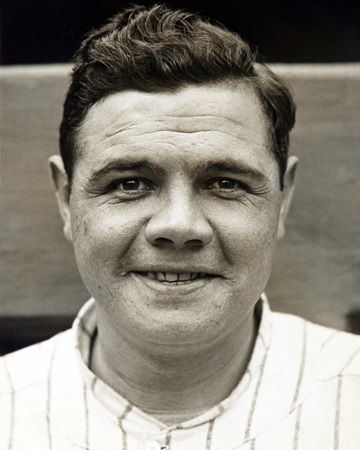
In a world where we just began the Major League Baseball playoffs, back in the 1920’s they were already in the midst of the World Series.  On this day, October 6, 1926, George Herman “Babe” Ruth hit 3-home runs against the St. Louis Cardinals in Game 4 of the World Series.  This wasn’t duplicated until 1977 when Reggie Jackson, also a member of the New York Yankees, became Mr. October against the Los Angeles Dodgers.


babe-ruth-medium
George Herman “Babe” Ruth. Photo found at On This Day

* I found this bit of history using History.com

Maternal Side, My Family Tree

I Took a DNA Test & Figured Out a Mystery

So for a while now I’ve been on the fence about taking a DNA test.  I became even more curious about 18 months ago when my mother-in-law got my husband one for his birthday.  It took him a while to finally take the test (I came home from an Evening of Genealogy at the library where I saw a mutual friend and Sandy advised he had better do it as it’s possible that it had an expiration date). So he did and though his tree was limited it was fascinating to see his ethnicity estimate and the DNA matches he had.

So ever since then, I’d been on a teeter-totter, half wanting to take a test and half afraid like so many others about big brother finding me (though I’m not sure exactly why). But this past Fourth of July convinced me to take a test when I went and spent the day with my mom’s side of the family at my cousin’s house and my aunt told me offhandedly “You know there is a chance that who you think is mom’s dad isn’t”.  Her reference to mom was my maternal grandmother.

Now, if you are any sort of genealogist you know what I am thinking at this point.  This person, we’ll call him hubby #2, who I have listed as my great-grandfather, because that’s what my grandmother’s birth certificate states, who I’ve spent hours researching, hoping to make sense of why he ignored her, even as an adult… may not be my great-grandfather?

The DNA Test

On this day AncestryDNA was on sale and it was the last day of the sale.  At 11:51pm I purchased my kit and just had to wait.

The following Wednesday the kit arrived in the mail.  I was ready – I came home, spit in the vial and boxed it up and by 8:30am the next day, it was at the post office being mailed.  The following Monday as my husband and I went cemetery hopping, I got the email stating that it had arrived at the testing facility, and by Friday, July 26 I had my results.

  • 84% England, Wales & Northwestern Europe
  • 12% Ireland & Scotland
  • 4% Germanic

Well, if nothing else the ethnicity estimate summed up why my skin coloring is so pasty white (I’m fair – like I was wearing a black dress and black flats the other day and you’d think I had on white tights pale).

But one over the course of the next week and a half that I figured out was missing were matches to any of hubby #2’s surnames.  So I guess what my Great-Great-Aunt Ina stated after my great-grandmother’s funeral was correct – hubby #2 wasn’t my grandmother’s dad.

But who was?

The Search is On

So a week or so passed and one evening I sat in my recliner and decided to just focus on the third cousins who make up my DNA matches and put them in the categories of my ancestors: Blair/Foster’s; Childers/Fesler’s; Ritchey/Cypher’s – you get my point.  But there was a name that kept popping up – so I decided to focus on it.

So I pulled up the 1930 census to see if there were any “V’s” living in the vicinity of my great-grandmother (her name was Mildred) as I knew she lived in the realm as I now live, an area called North Hill.  Sadly by the 1930 census, she is living with her second husband in Cuyahoga Falls (FYI – my grandmother, was born in 1929).

When I didn’t find the information I was looking for in the census, I decided to look up the “V’s” in the 1930 City Directory.  There I found a “V” who was a lawyer with an office at a main intersection in the area.  I had seen his name on a family tree of one of my “matches” and he was in my great-grandmother’s age range, but as odd as it was I saw another “V” who lived just a few blocks from where I live now listed and I decided to further investigate.

I threw this second “V” into Ancestry and found him right away.  He was 89 in 1930 and my Great-Grandmother would have been 22 – I hoped he wasn’t who I was looking for.  I looked to see if he had a son, he did, so I clicked to see some information about him, wondering if he was married or had children because they would probably be Mildred’s age (she was born in 1908 – he passed away in 1906).  When I clicked on the link to Find A Grave, I couldn’t believe my eyes, it was a photo of a tombstone of 89-year-old “V”, his son, wife, and daughter.  But was most surprising was that the daughter’s last name rang bells in my head… it was the same last name as my great-grandmother, Mildred’s, hubby #1!!!

Mildred’s divorce from hubby #1 was final on September 5, 1929. She married hubby #2 on September 29 and my grandmother was born prematurely on October 2. With all the DNA matches to the “V’s” this made total sense.  What further proved my hypothesis was the following photos.  The first is the obituary photo from the February 28, 1984 edition of the Akron Beacon Journal of hubby #1 while the other is a photo of my Grandmother I believe taken in the 1990s.

It’s the same nose and the same high cheekbones.  If hubby #1 isn’t her father, I need to find out who in his family is (but I do have matches to both “V’s and “G’s”, I just have to go up to my 4x great-grandparents on the “G” side).

Sharing the News

I was so excited when I discovered all this.  I quickly got on Facebook and shared what I found with my Aunt who began this whole mystery for me.  I was surprised she was still up at 11pm.

All my research of hubby #2 and his family wasn’t a total loss. In the end, he was still my great-grandmother’s second husband.  I’ve just disconnected him as the father of my grandmother and now have hubby #1 in that place (he was already listed in my program as well).

I’ll admit I was happy to find out her first husband was my grandmother’s dad. I considered my great-grandmother a strong woman for divorcing him in the late 1920s and then hubby #2 in the early 1930s because they weren’t the men she deserved.  But the thought of someone else intermingled didn’t exactly thrill me either.

My great-grandmother had reasons for divorcing hubby #1, he was apparently gambling their money away.

Hubby #1 didn’t get married a second time until 1939, 10 years after his divorce with my great-grandmother was final.  He was married to his second wife until he passed in 1984.  I like to think in those 10 years he grew up.  From the comments on his second wife’s obituary, they were both wonderful people who everyone seemed to love.  This makes me feel good.

Then again, who is going to go onto a website and say how awful someone was?  Well, at least not on an obituary site (I hope not anyhow).

What I am still puzzled about was there was a point in my grandmother’s marriage to my grandfather where he forced her to go meet her dad, hubby #2.  The entire visit he did nothing but ignore her. Not one word was said.  I’ve heard that story from different people and it’s the same.  I can’t believe he would be so mean to my grandmother.  My guess is that he knew she wasn’t his.  He noted on other documents I found that he had no children.  This is fine.  But why not just tell her when she was an adult visiting him?  Why keep quiet?  At this time what was to be gained?

My Aunt commented to me it just goes to show how much Mildred wanted out of her marriage that she didn’t want to risk hubby #1 finding out he had a child.  But it makes me wonder if everyone’s life would have changed had they known?  Maybe he would have straightened up earlier?  

Or maybe he did know?

Ninety years later, we will never know.

* I’ve used the simplistic codenames of hubby #1, hubby #2, and hubby #3 in regard to my great-grandmother’s husbands for the simple fact that hubby #1 was remarried and has a daughter.  At this time I am mulling over whether I should contact her, but since to my knowledge she is unaware I thought I’d respect her privacy, so no names.  I know she could do a search of her dad’s photo and find out, but I’m also DNA matches with her relatives so there is that chance she may find out anyhow (or who knows, maybe she is a match).  One of my matches was actually a girl I went to school with, who is semi-related to my friend’s husband and I believe she has been told (I was excited to share my story with someone interested in genealogy having no clue her hubby was related to them).  Maybe one day I’ll add the picture of the headstone that tied everything together. 

Genealogy

How to use PERSI

Are you in the same boat as me and really get befuddled on how to use PERSI?  In case you are unaware of what PERSI is, it is the PERiodical Source Index (PERSI for short).  Ever since I took my first class at my local library about genealogy I have heard nothing but wonderful things about PERSI.  Trouble is – I can never seem to have any success with it myself.  So today’s goal is to learn what PERSI is, and how to use it.

What is PERSI?

So I know I already told you it is the PERiodical Source Index but what is it really? Organized by the Allen County Public Library Genealogy Center (ACPLGA) and Find My Past, PERSI connects you with thousands of articles for genealogy and local history.  Though initially just an index relaying articles and their locations to users, the ACPLGA and Find My Past are working to digitize the articles to give family historians instant gratification.

How to Use PERSI

I’ve always understood what PERSI is, my trouble has been actually using it.  So here are some tips I’ve accumulated in my search.

How to Find PERSI

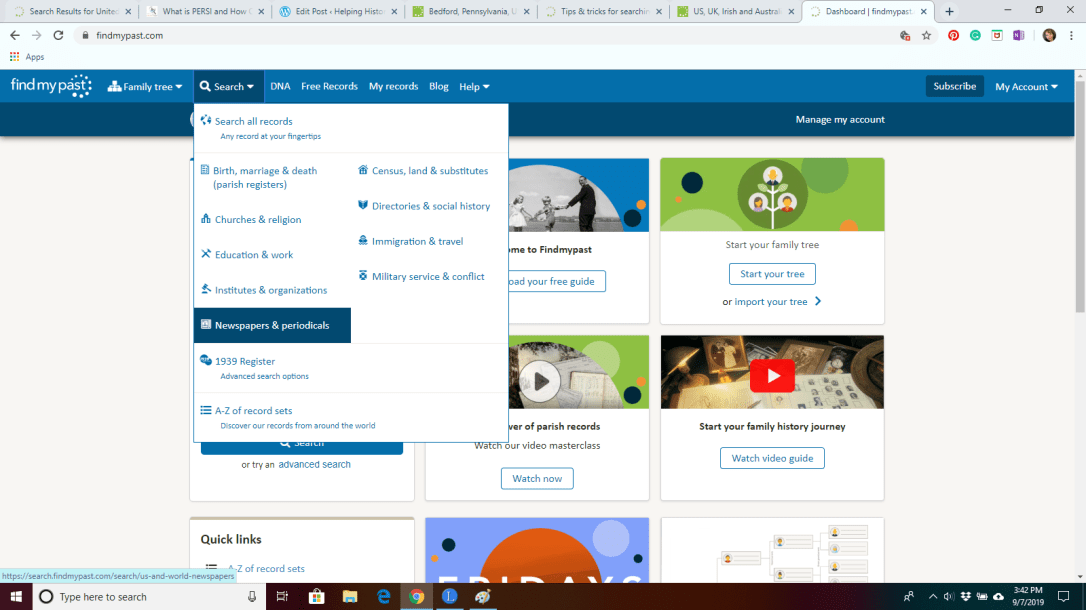
PERSI can be found by going to Find My Past, then using the toolbar at the top of the screen select “Search” and then when the pull-down menu appears select “Newspapers and Periodicals”.

Search for PERSI

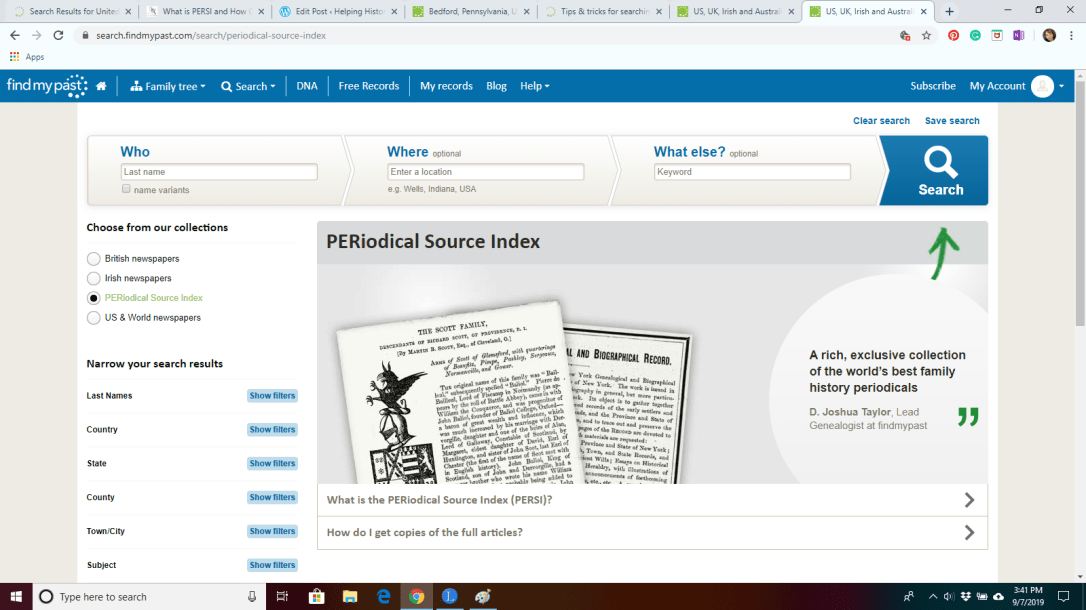
On the left-hand side of the screen near the top you will see a heading “Choose from Our Collections”, fill in the dot next to “PERiodical Source Index” and you’ll be ready to go!

PERSI Screen

PERSI is Subject Based

It does not search the text of articles, it searches the terms or keywords assigned to articles by the people who created PERSI.  For example, you may come across an article that is all about your family, but if the person who indexed the article just assigned it “Bedford County” (where your people may have lived) searching for your family name will give you 0 hits. For best results you are better off to use the “Where” or “What Else” options on the search bar.

PERSI Search

Lots of Filters

PERSI provides you with nine different filters to help narrow the number of results you receive.  These filters include: last names, country, state, county, town/city, subject, keyword, and database title. These are located down the left-hand side of the screen.

Since the world knows I have family in Bedford County, Pennsylvania, I went ahead and did a search on Bedford.  By just putting Bedford County, Pa in the “Where” box (see above), I ended up getting 4,359 hits. This included places in England, Massachusetts, etc., which was amazing as I had Pennsylvania as part of my where.

By filling in the country, state, and county fillers along the left-hand side of the screen, I lessened my hits to 1,350.  Here is a screenshot:

PERSI Screen

Please Note

If you click on an article, it is not going to take you to the page you are seeking.  You will most likely have to read/skim through a book/paper/article to find the information you are seeking.  Try to be optimistic, this may be a good thing as you may find more information than you bargained for which is a big YAY!

Remember, not all articles/books/papers have been digitized so some books you may have to do an interlibrary loan to see.  I know earlier today I found an article from the Bedford County Historical Society that was done on my 5x Great Grandfather, Peter Morgart, in their newsletter.  I am attempting to see if they have past newsletters online, or if I need to pay for a copy of that 1994 newsletter.  I’ll keep you posted, it’s presently a Saturday and they are closed.

Lastly, you are able to search PERSI for free but to view records you do need a subscription to Find My Past.  I know I don’t always have a subscription for all the different sites for genealogy but I know my local library (at least my Main Library) has the library edition of  Find My Past for free where you can view the documents that are digitized. If you find an item that isn’t digitized, you would already be at the library and maybe you can set up an inter-library loan.

I’ll probably update this in the future.  I presently have a simple subscription to Find My Past from when I joined my state genealogical society.  It goes bye-bye in December so I am going to try to focus some of my research endeavors on here so I can utilize it before it’s gone (I say simple as I have learned many documents I need to view for my English ancestors are a higher subscription than the free one I received for signing up with my state society).

Just another valuable tool to maybe help you get the final piece of a puzzle for your ancestors.  Good luck searching!

Genealogy, My Family Tree, Paternal Side

My Research Trip Days 2 & 3

So if you read my previous post, you know that I had quite a day going from one cemetery to the next finding my direct line ancestors on my dad’s side of the family.

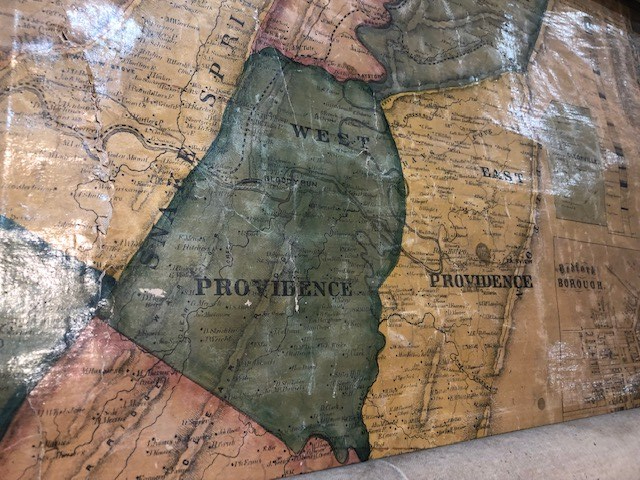
But day two was fun as I spent most of the day at the Bedford County Historical Society.  I went with a plan but the ladies there knew so much more than I did and truly made me feel not so knowledgeable about my family (but in a good way).  Gillian, the director, knew so much about my Morgart side, showing me maps with their names on it from the Bedford area.  Next thing she was giving me the information about Peter Morgart and his part in the Whiskey Rebellion, and it just went on and on.  Huge binders full of family tree information others had done before me of my ancestors and their descendants.  I was in awe and when we left I told my husband I was so unprepared for how much they knew.  All I kept thinking about was all my webinars and how I needed to stay focused and how I did anything but stay focused.  I will definitely go there again and be better prepared when I return.

IMG_9590

Next, we headed to Jean Bonnet’s Tavern for dinner.  The food was delicious, I had crab and shrimp topped salmon with a baked potato and steamed broccoli. I believe my husband had the beef tenderloin.  We left stuffed but so happy we had the experience.  Jean Bonnet’s Tavern was built in the 1760’s so it was just fun to eat where maybe my ancestors did (not all as I’m sure they were in competition with the Morgart Tavern).

After dinner, we drove by the Espy House which is where George Washington had his headquarters when he came to Bedford County in 1794 during the Whiskey Rebellion.  Yes, chills once again as George may have walked where I was now riding (it really doesn’t take much to get me excited about George).

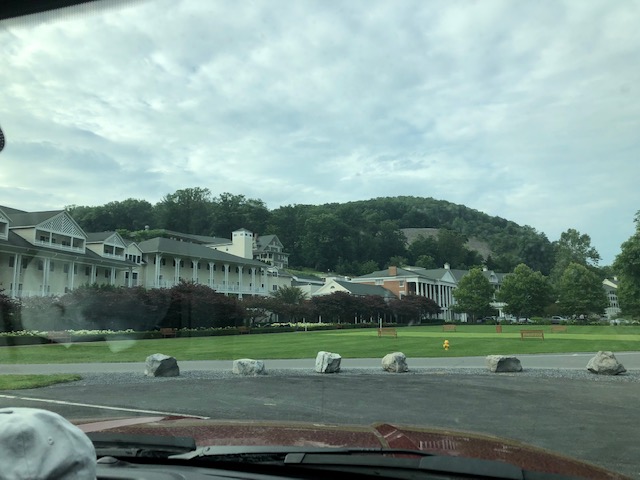
After this, we went out and found the Bedford Springs Hotel as it was one of the places to stay back in the day.  Supposedly the water had (has?) medicinal purposes.  It’s still quite majestic today in its appearance.

IMG_9633

The next day we did a little bit of sightseeing as this area is the home of the Flight 93 Memorial from the happenings of September 11, 2001.  The quiet and the breeze that seemed to be non-stop there was just eerie.  You couldn’t help but feel the specialness of all those aboard who decided to defend freedom.

Next up was the Bedford County Courthouse where I went armed with my checklist of names I wanted to run by with property listings as well as wills/probate records.  I was so impressed as I was able to find something on most of my ancestors that were on my list.  If you have relatives, don’t feel shy about going in, the girls that work in the records department are very nice and were so helpful.

IMG_9649

On our last night there we met with my second cousin Hope and had dinner.  She was also kind enough to show me some spots in St. Michael where my great-grandmother lived as well as the bank where my Grandmother worked (I often remember her telling me she got paid like a nickel to clean the place – I may be off on how much she was paid but I know it wasn’t much).  I guess the bank is now where the residents of St. Michael, Pennsylvania pay their utility bills.  I meant to take a photo of Hope too, but as soon as we got to her house she wished us well and sent us on our way and I was a block or two away when I turned to my husband and said, “I wanted a photo with Hope”.

I thought my first research trip went really well.  I was able to find a lot of information that I was seeking but still had so many more questions when I returned.  I only had three days so I did my best to keep my focus but on future trips I know I’ll do my best to seek information on more than just my direct descendants, and hopefully, I’ll have more time to even visit other relatives that actually live in the area too.