To find a farmer to talk about is about as easy as finding a coal miner in my family, I have many in my tree on both my paternal and maternal sides. With this week’s theme being about life “on the farm” I’ve opted to swing over to my mother’s side of the family and discuss my great-great-grandfather, Arthur James Dunbar.
The Beginning
Arthur James Dunbar was born on 4 August 1869 in Independence, Allegany, New York to Delos Dunbar and Harriett Williams. Delos was also a farmer, both in Independence and in Genesee, Potter County, Pennsylvania which is where the family moved between 1875 and 1880.
According to the official website of Potter County, it’s primary industry in the 1800’s was lumber. Known for it’s white pines, hemlock and other hardwoods, lumber mills were developed near streams where the water could power the saws. In time towns were formed when churches and schools were built in these areas.
While doing searches on Delos Dunbar, Arthur’s father and my 3rd-great-grandfather, there were various small articles on him where he is either cutting wood for someone, or building a home for someone. So I’m guessing though noted as a farmer as well, he may have been more of a lumberman, or had tree farms.
Marriage & Family
On 2 January 1894 Arthur Dunbar married Mazie Lorenia Warner in Wellsville, Allegany, New York. They settled in Hebron Township in Potter County, and began their family on 17 March 1896 when their oldest daughter, Myrtle Iona Dunbar was born. Their next child was Merle Winfield Dunbar, born 10 July 1899 but died on 18 January 1900 of bronchitis. Ina May Dunbar came next being born on 18 April 1901. Their youngest was Mildred Laura Dunbar, born 15 March 1908, my great-grandmother.
Farming
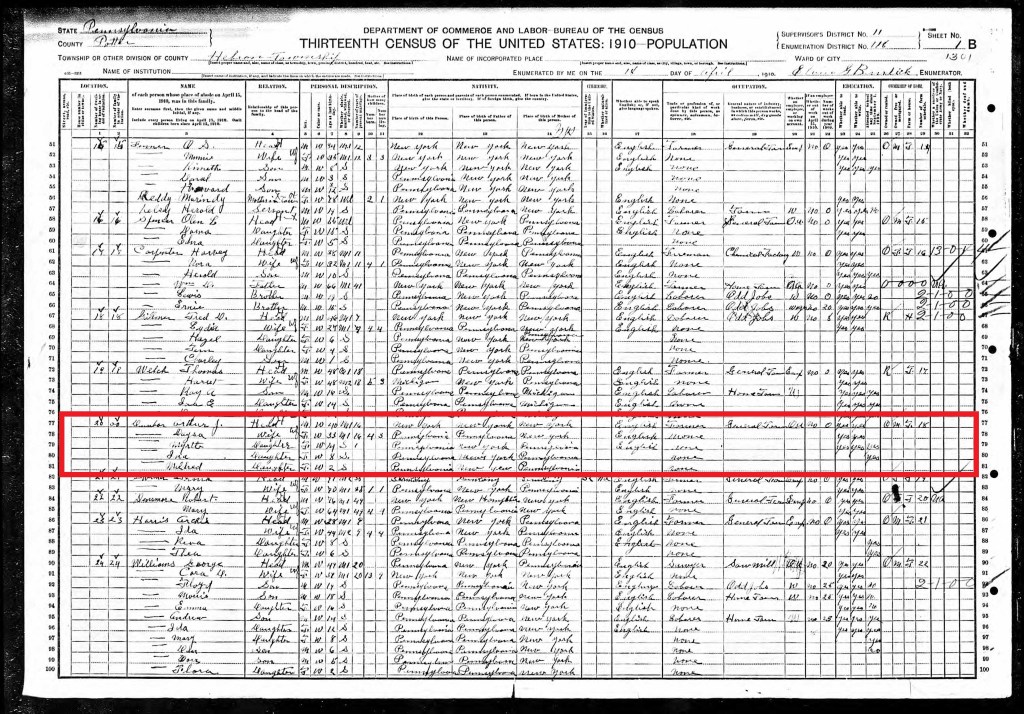
On the 1900 and 1910 Federal Census’ Arthur (A.J.) Dunbar had an occupation of “Farmer”. He owned his property, paying on a mortgage and it lists the agricultural schedule that he was listed on for both population census, Farm Schedule 63 in 1900 and Farm Schedule 18 in 1910. Below is the 1910 Census where it shows that his occupation was “general farm”.
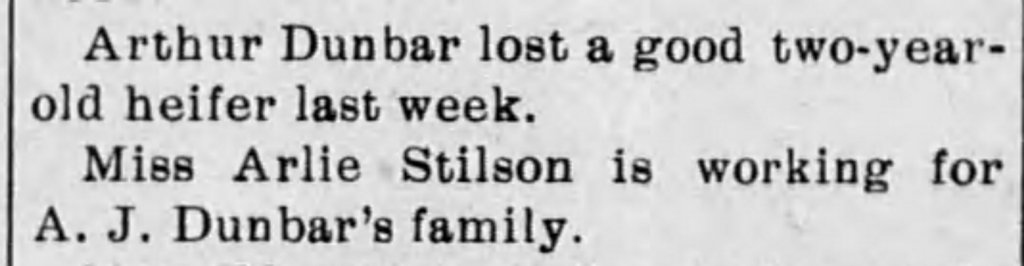
Another clue that he was a farmer was the below newspaper clipping about a young cow he lost. The item below is more than likely is my great-great-grandfather as well as he was known as A.J. Dunbar in many documents.
The Potter Enterprise – 18 April 1901 – found at Newspapers.com
Death
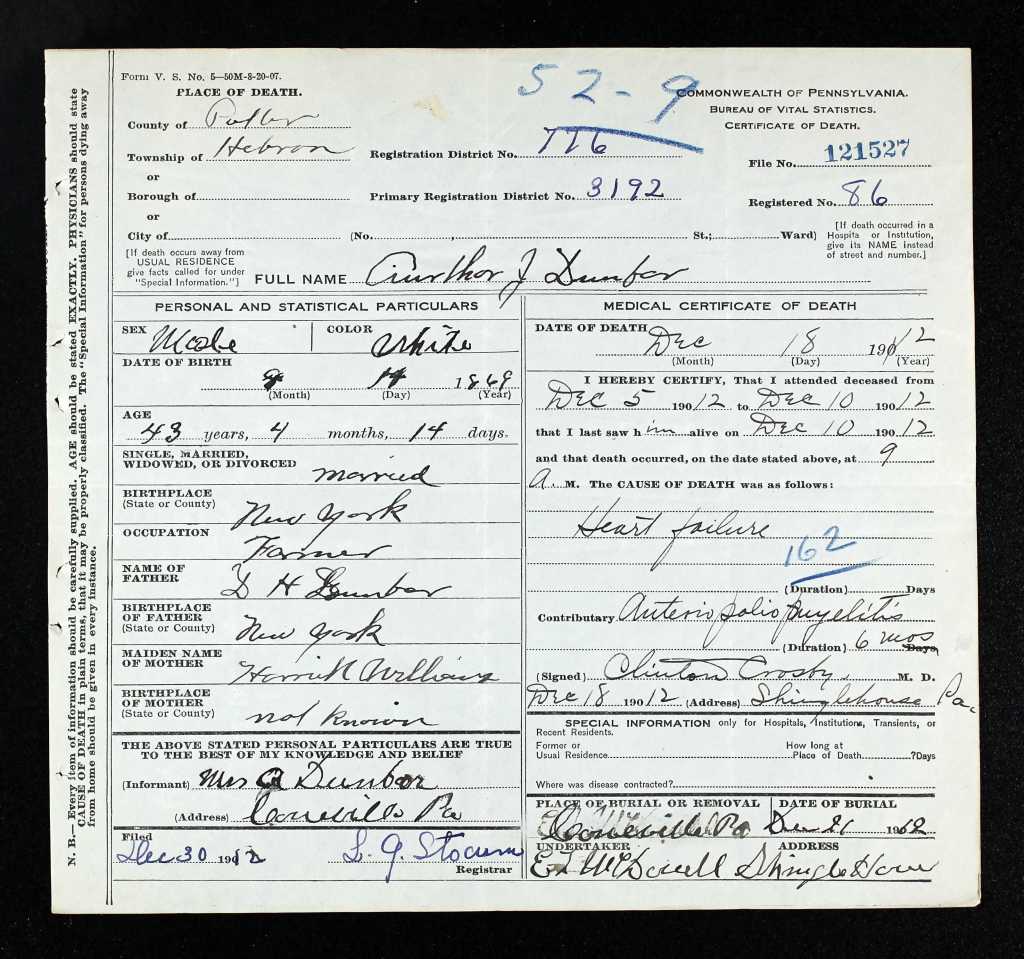
Arthur James Dunbar passed away on 18 December 1912 of a combination of Heart Failure and Anterior Poliomyelitis.
According to the FreeDictionary.com poliomyelitis, commonly known as just polio, is a “disease marked by the inflammation of nerve cells and brain stem and spinal cord”. It was highly contagious and most who caught it were between 6 months and 4 years old but adults did contract the disease. Paralysis in children were 1 in every 1000 cases, paralysis in adults was 1 in every 75 cases.
When adults contracted the disease, it was often white, affluent men. Thankfully this has more or less been done away with by vaccine. I don’t have the tell-tale scar that my mom and sister have (I imagine my dad has it too) because by the time I needed my vaccines for school, it was no longer necessary.
My goal as I continue to do searches about my great-great-grandfather is to find out what kinds of things Arthur farmed, and if there is anything out there that could tell me what kind of person he was, as I am so fond of his wife, Mazie, I always just assume he must be pretty special, too.
Since I spoke of my many coal mining ancestors in Week 30 with the Health topic, I have decided to expand on it with this week’s theme of working. Three of my 4 great-grandfathers worked in the coal mines. Two in Pennsylvania, the third in Ohio.
Andrew Jackson Blair
Born 17 April 1881 in Bedford County, Pennsylvania, Andrew Jackson Blair was born to another Andrew Jackson Blair and Susan Jane Foster. According to the 1900 Census, when Andrew was just 19 years old he was already working in the coal mines (and so was his 13 year old brother, William). His father was also a miner, having it noted as his profession in the 1880 census, as well as his profession in the death register when he passed away in 1899.
I won’t go into details about Andrew too much as I have written about it before (see here). He died when the mine he was in had falling rock and it crushed his chest, killing him instantly. He was 45.
Andrew Jackson Blair
Charles Jackson Morgart
Born 2 August 1873 in East Providence, Bedford County, Pennsylvania, Charles Jackson Morgart was born the oldest child of George Washington Morgart and Mary Ann Ritchey. Charles was originally a farmer but then became a coal miner. It’s odd, I can find him and my great-grandmother, Margaret Dora Wise, twice in the 1910 Census. When they were living in Bedford County he was a farmer, when he was found in Huntingdon County he was a coal miner. His death certificate also listed him as a coal miner. He did not die in the mines, but he committed suicide. It was not the first in his family as his mother had too.
Charles Jackson Morgart
James Fairhurst
Born 8 July 1890 in Leigh, Lancashire, England, James Fairhurst was already working in the coal mines in England in the 1911 census when he was still living at home with his parents, Thomas Fairhurst and Rachel Topping. He came to the United States in 1913 leaving behind his wife, Phoebe Boone (pregnant with their son, Wilfred) and his daughter, Elsie, to work with his brothers at Wolf Run, Jefferson County, Ohio. Phoebe came over with Elsie and Wilfred in January 1915. By June 1917 he had filed his declaration of intention to become a citizen of the United States, and by 14 May 1920 he was a naturalized citizen.
James occupation took a turn for the better. He opted to move to the rubber capital of the world in Akron, Ohio and began working for the various rubber companies, a much safer occupation compared to the work one did working in the coal mines.
Life in the Coal Mines
Working in the coal mines was a dangerous occupation. Most began working at a young age of 10 to 12 years old where you started out sorting out the coal from other rocks (sometimes elderly coal miners would do this too).
Underwood & Underwood. (ca. 1913) Boys picking slate in a great coal breaker, anthracite mines, Pa. Pennsylvania, ca. 1913. New York: Underwood & Underwood, publishers. [Photograph] Retrieved from the Library of Congress, https://www.loc.gov/item/2007681337/.
As you got older, responsibility increased. The next position for a teen would be keeping the the tunnels lit at key spots in the mine. Miners did wear hats with lanterns attached to help them see what they were doing and where they were going, but there were still people sometimes positioned in key places so that danger could be avoided.
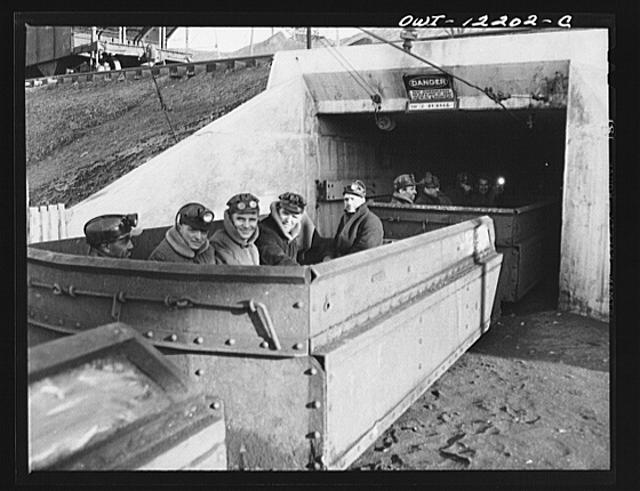
Other jobs within the mine would be pushing and pulling the carts throughout the very narrow tunnels and the actual mining of the coal. They spent 12 hours a day underground in the dark hunched over.
Collier, J., photographer. (1942) Pittsburgh, Pennsylvania vicinity. Westland coal mine. “Mantrip” going into a “drift mine”. Pittsburgh Pennsylvania Allegheny County United States, 1942. Nov. [Photograph] Retrieved from the Library of Congress, https://www.loc.gov/item/2017841040/.
Company Towns
Those working in the coal mines were often paid in company money, renting company housing, and the stores you were able to shop in were also owned by the coal mining company as it was the only store that took the company money. It was very difficult to be able to move onto another company to make more because the coal companies more or less owned you.
Wolcott, M. P., photographer. (1938) Company houses, coal mining town, Caples, West Virginia . United States Caples West Virginia, 1938. Sept. [Photograph] Retrieved from the Library of Congress, https://www.loc.gov/item/2017752393/.
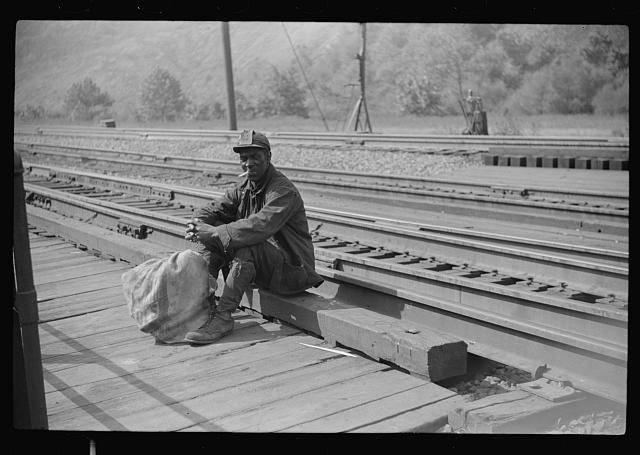
Working in the coal mines was a difficult job but was just one of many sacrifices the coal miner made to provide for their families. It was a hard job that had many health risks, but it was taken with the hope that the next generation would do better.
Wolcott, M. P., photographer. (1938) Coal miner waiting to go home, Caples, West Virginia. United States Caples West Virginia, 1938. Sept. [Photograph] Retrieved from the Library of Congress, https://www.loc.gov/item/2017752675/.
This week’s topic is “school” for 52 Ancestors in 52 Weeks and I am going to discuss my high school. Counting my own children, there have been 4 generations to attend Cuyahoga Falls High School beginning with my maternal grandmother, Alberta Lou Metzger. Her children attended, including my mother, my sister, myself and cousins, and now my kids.
Cuyahoga Falls High School
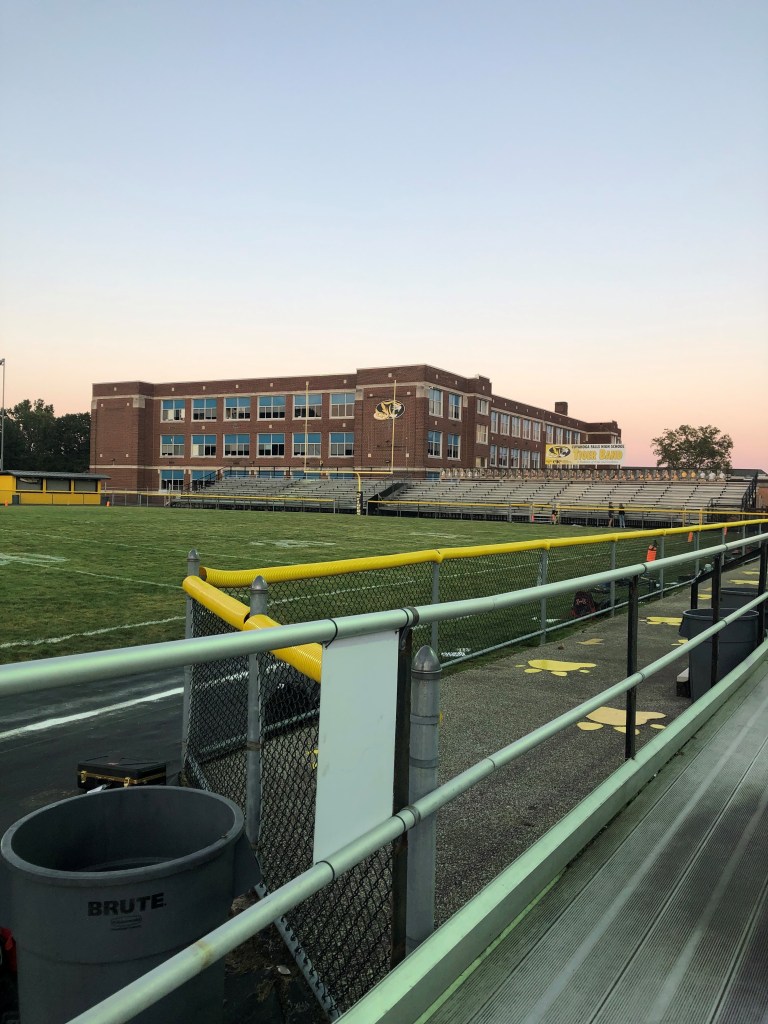
Cuyahoga Falls High School was built in 1922. The original building is still a part of the functioning school, often referred to as the old building (at least that’s what it was called when I was there). This part of the building is where your 100’s, 200’s, and 300’s are for classrooms. Back when I went it was foreign language, English Department and Math. Mix in the Old Gym and the Little Theater and this was the original building used for probably 30-plus years.
It’s a view of the Old Building from the football stands taken 2 September 2021 while my son had band practice, I thought the sky extra pretty.
Little Theater
The Little Theater was often where multiple classes went to view movies and such when I attended in the late-80’s, early-90’s. It was also where the Fall Play took place each year.
The primary highlight I remember from my mother was that is where she was when John F. Kennedy was assassinated. It was a moment she would never forget.
A cookie a classmate of mine made for our reunion. This was the logo that was on our gym clothes for years. Since the football team was going over footage I wasn’t able to take a photo of the Little Theater so this seemed a good spot for the cookie.
Old Gym
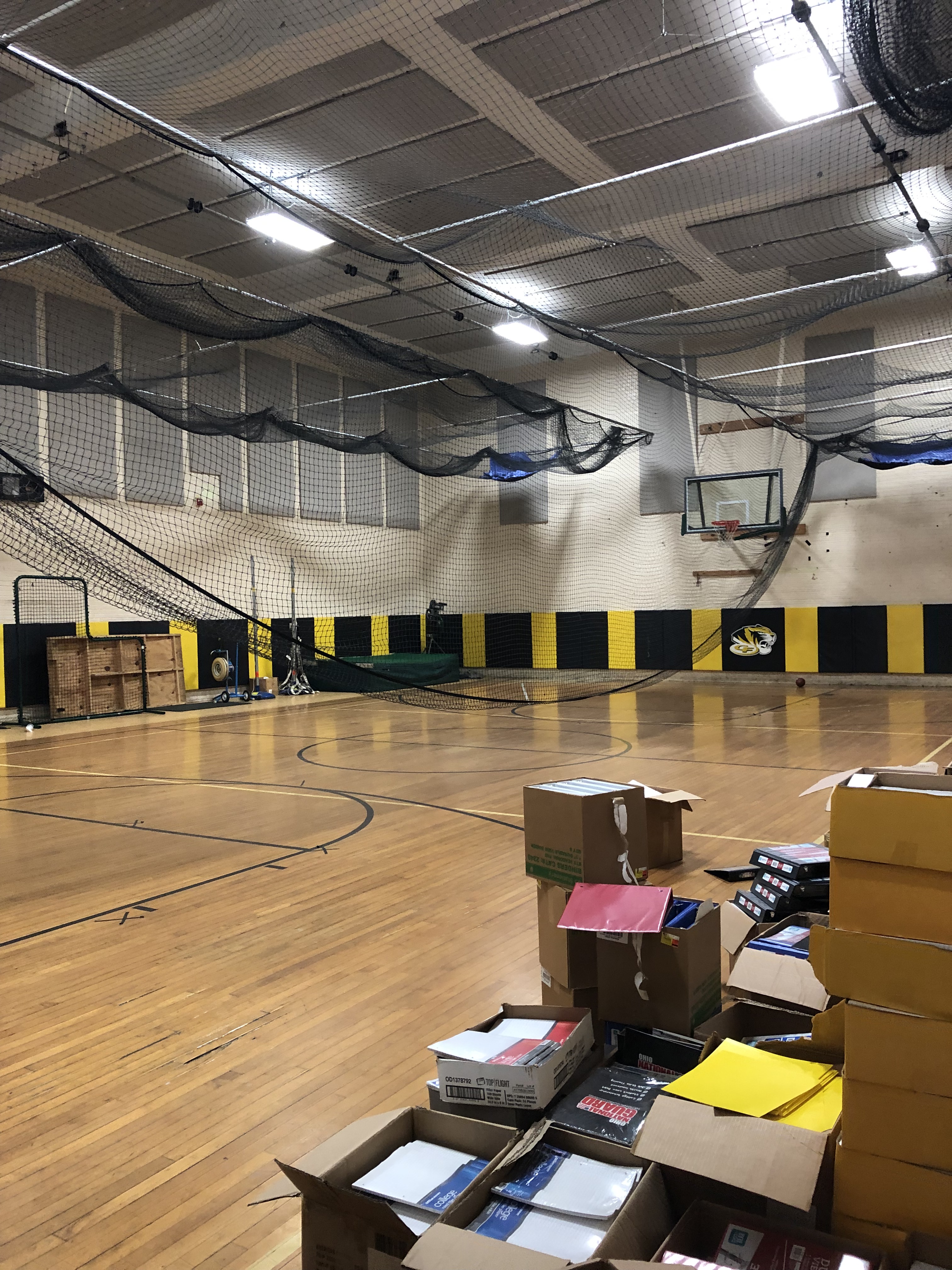
The Old Gym is where we would go when you were doing sports where 4-classes in the regular gym got to be too much (though it was common when I was in 10th grade to the mat room used for wrestling where my all girl gym class because of choir would play crab soccer – it’s amazing how that huge ball used for it would not mess up the big bangs that were essential for hairstyles during this time).
Recently I went on a tour of the high school for my 30th class reunion. The Little Gym was set up for batting practice for the baseball players. I found it a good use for this the space.
The New Building(s)
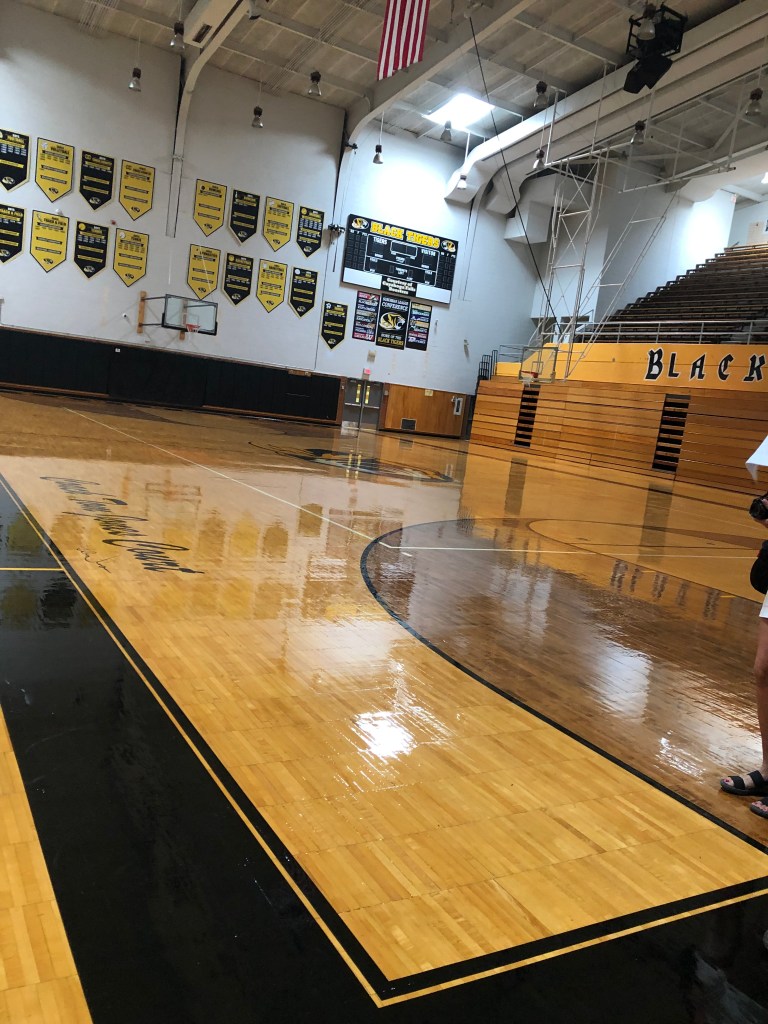
The new building was already a functioning part but still very new when my mom attended the high school in the 1960’s. It consists of the 400’s, 500’s, and 600’s. It included a bigger gymnasium (hence the “Old Gym”) and a state of the art auditorium, along with a music wing. It also houses a cafeteria, library, and the offices. Science classes are basically based in the 400’s, more history and classes like typing were held in the 500’s (I doubt they even have typing classes today). The 600’s is where the instrumental and vocal music programs are.
The present gymOne of my favorite spots in 10th grade. The end of the hallway in the 400’s, I always got to school early and a fellow classmate and I sat here and discussed “Days of Our Lives” and all sorts of things. I remember discussing Ted Bundy the day he was executed by the state of Florida with her too. She is one of the people I miss from school and she isn’t on social media.
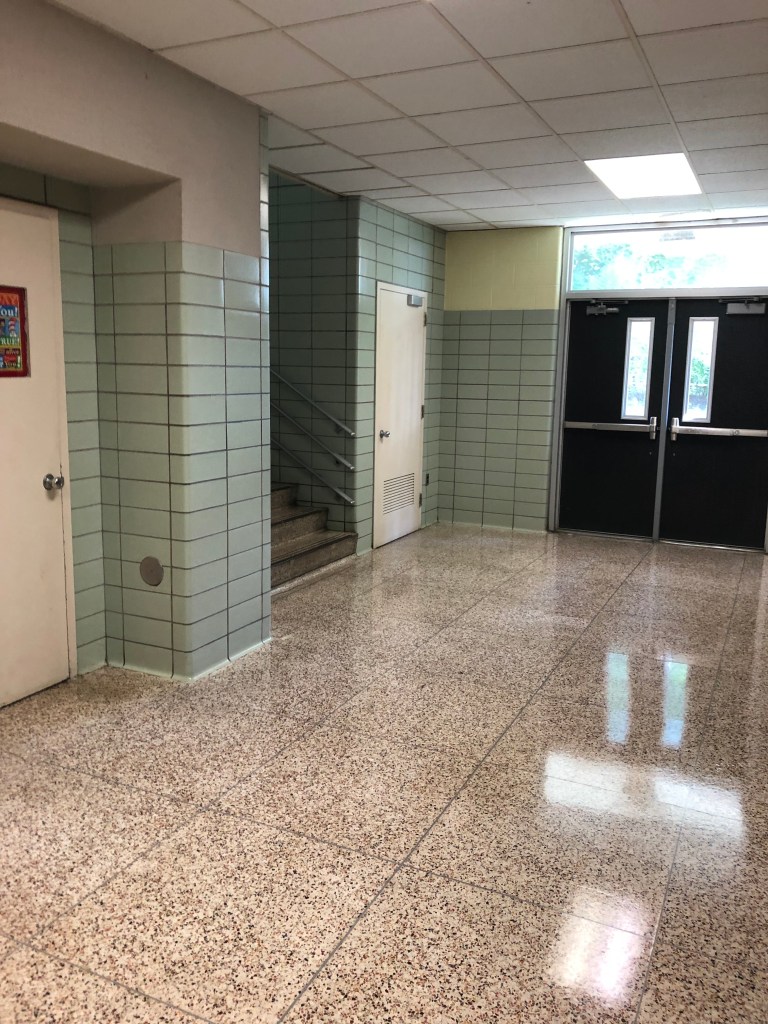
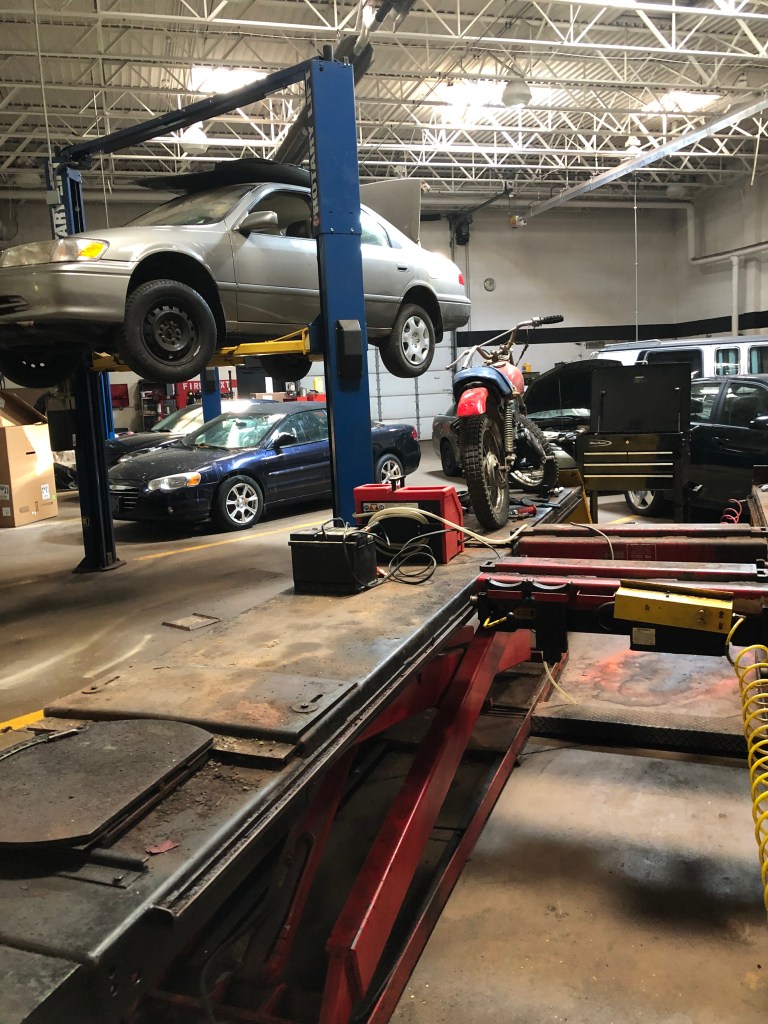
I believe at sometime between the above buildings and 1980 is when the vocational wing was built. This homes the cosmetology, auto tech, and marketing career programs for junior and seniors. Kids from other schools participate as well as part of a six district program.
I enjoyed checking out this part of the vocational wing as my daughter is enrolled in the Auto Tech program
Class Legacies
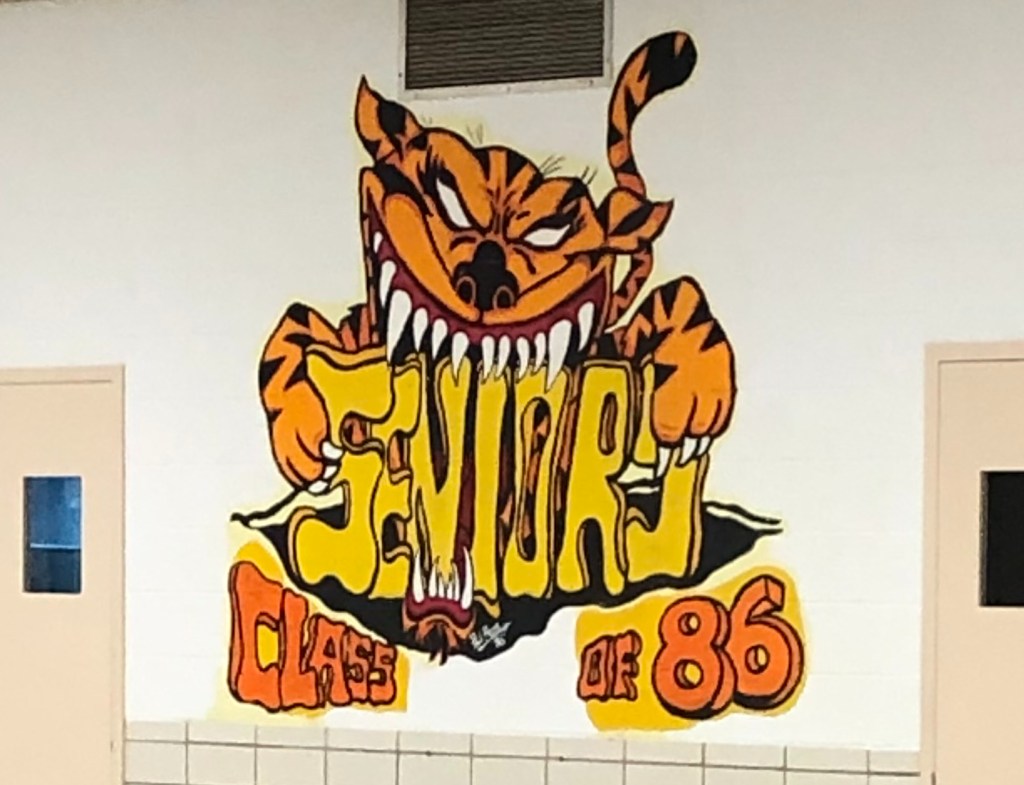
Each graduating class from probably the 1980’s on leaves their mark by creating a piece of art that is displayed in the cafeteria. My sister’s class is below. I tried to find my class but after the horrible experience of Columbine in 1999 they covered my classes art up. The student who won the art contest wore a trench coat (that was his style) and had that as part of the tiger in our 1991 artwork, but that was considered a negative after Columbine. I found it sad when I found out after our tour that was why we couldn’t find it. I feel they could have asked said student to come in and try to fix it up a bit instead of painting over it.
The Future
So many memories at this school and soon it will be no more. The citizens of Cuyahoga Falls voted to build a new high school and middle school complex which means soon the school that I figured would stand forever will be torn down. I doubt my middle school will go, it was the newest of the buildings but would probably be turned into something else.
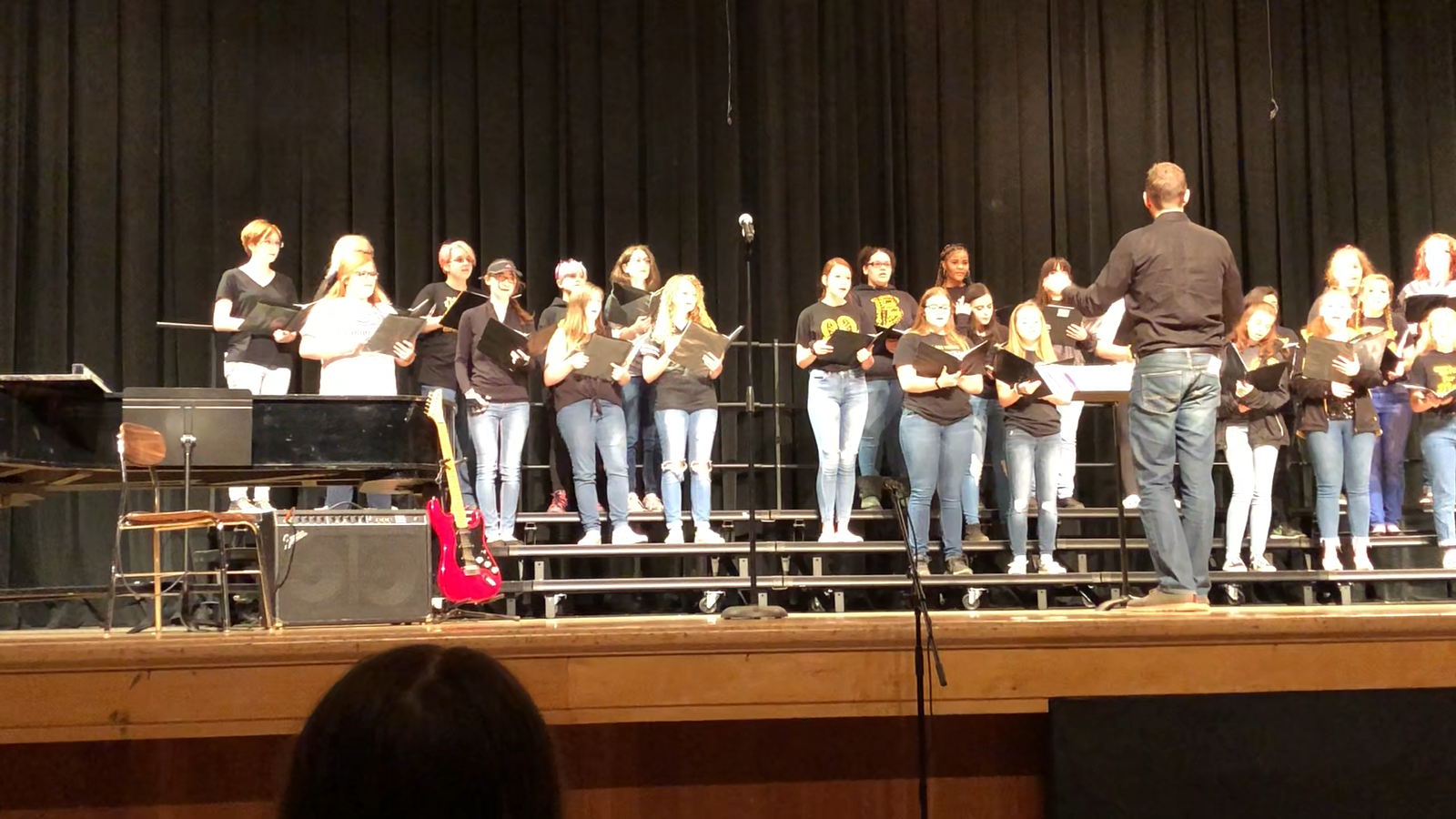
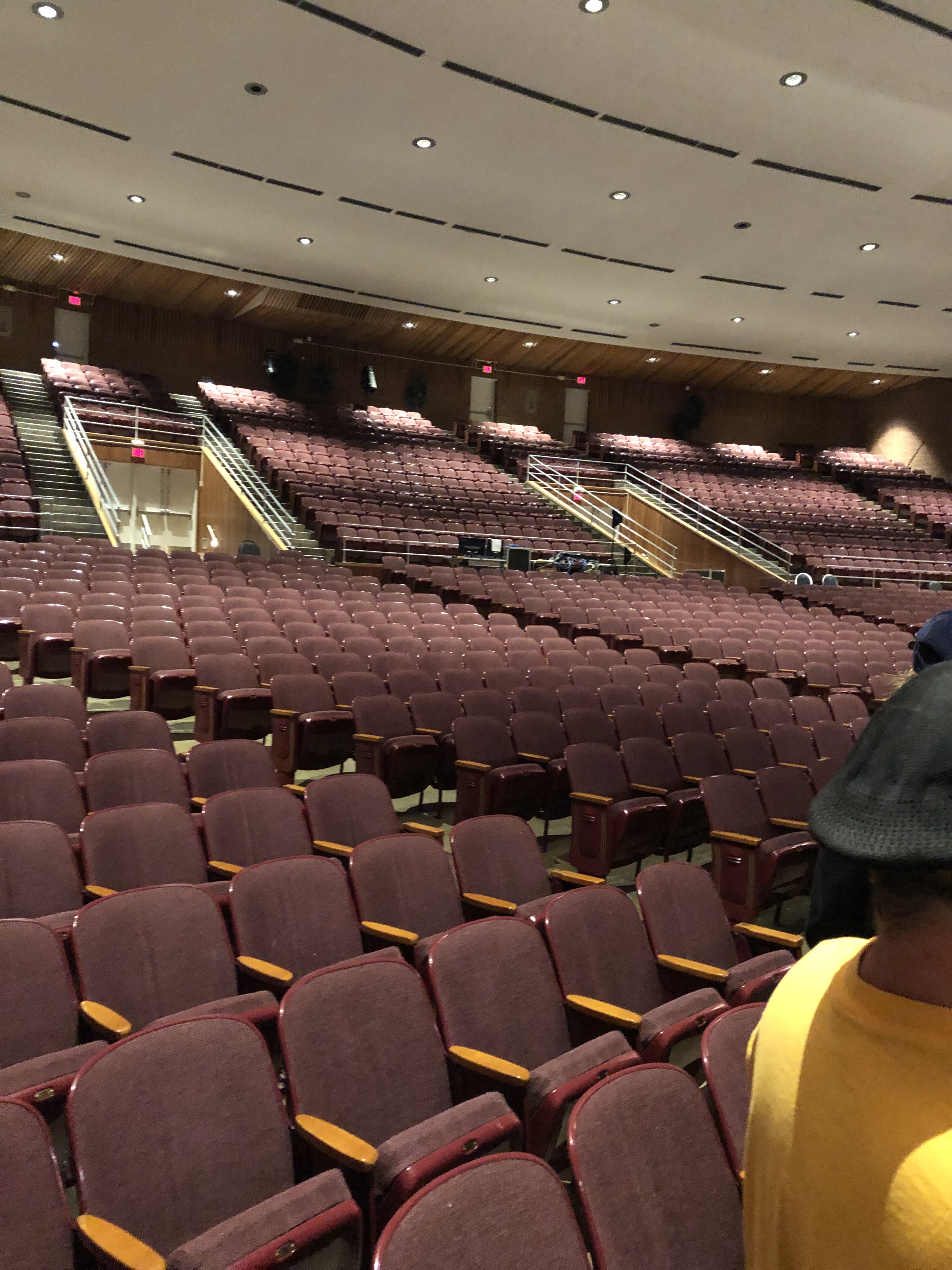
But the auditorium is what brings me so many tears. My choir concerts, my daughter’s choir concerts, my son’s band concerts. I know they need newer, and better to attract families with kids, but there is something to be said for the past.
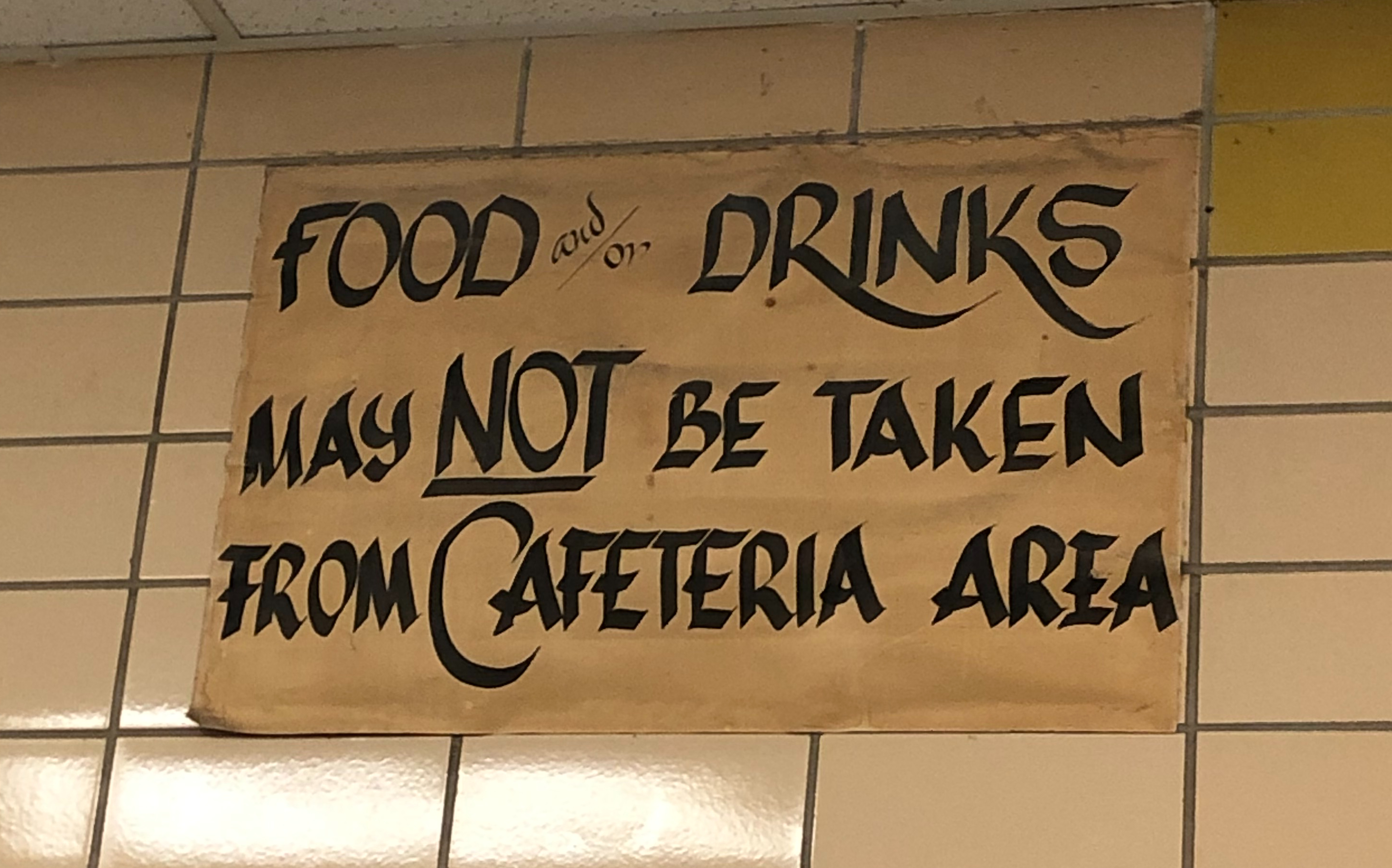
I can say this much – I don’t know what all will be taken from the old building to the new building, but I do hope this cafeteria sign goes. It was hanging in the lunchroom when I went to school and we noticed it still hanging there on my 30th reunion tour. I just feel it should be moved to the next. And not a new copy, this same sign.
The Marching Band
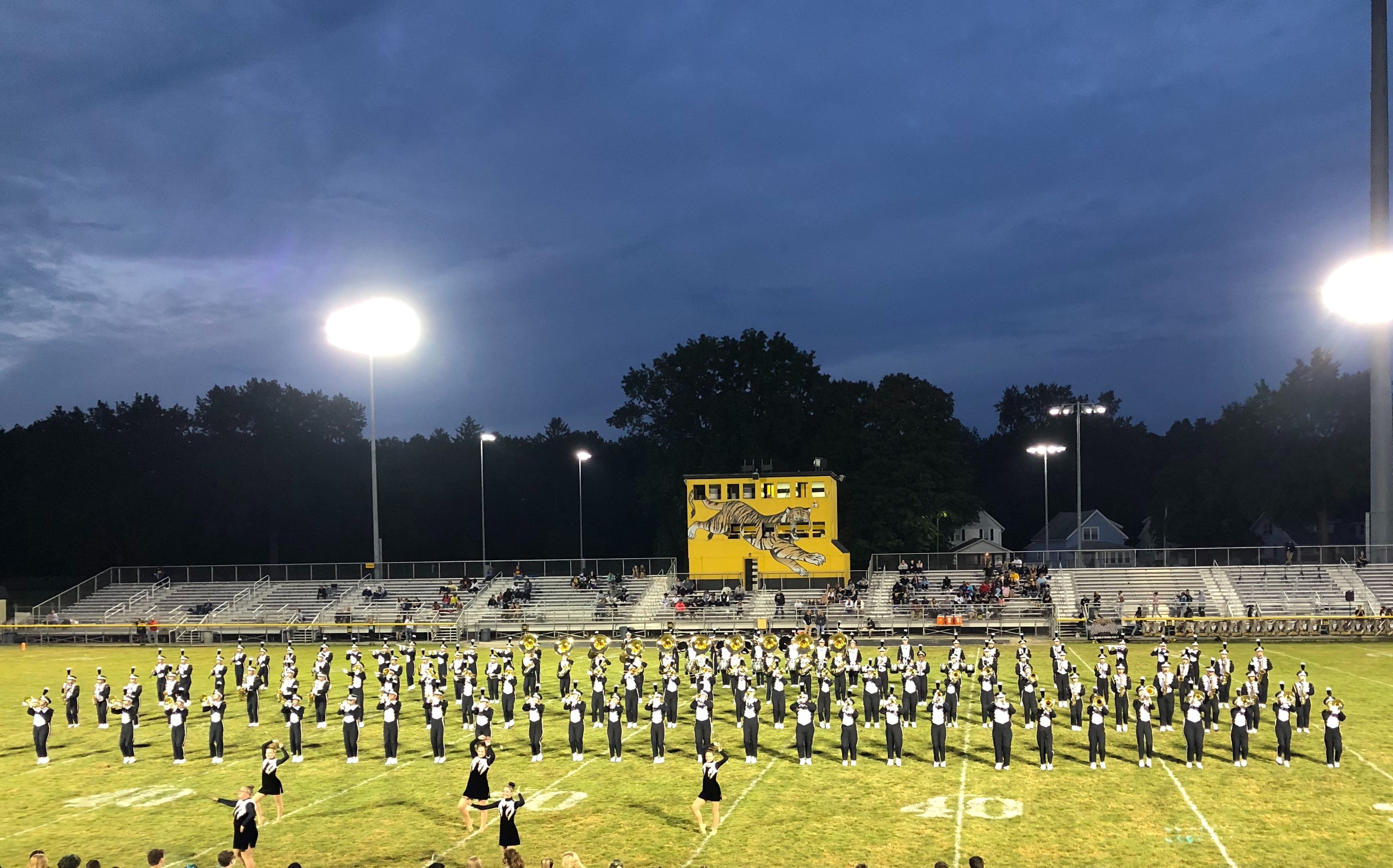
Along with the school being 100 years old, the Marching Band is also celebrating it’s 100th anniversary this year as well. I am beyond proud that my son has become a part of this legacy. I never learned to play an instrument (though I’m teaching myself the piano presently). but he plays the trumpet.
So impressed with their talent and dedication through good times and bad (which would have been last year and coping with Covid challenges).
This photo was taken on 3 September 2021, the band was awesome and the football team won too!
I’ve really had a hard time coming up with someone for this week’s theme for 52 Ancestors in 52 Weeks. I contemplated writing about my third great-grandfather who was a deeply religious man, but I haven’t done much with him yet, other than figure out all his kids (there were 16 – and thankfully someone wrote a book to assist with finding them all).
The person who kept popping in my head was a man who is not blood-related to me, but he was family, and the only man I can remember being a grandfather to me. My dad’s dad passed away when I was 2, so I didn’t really get to know him. My mom’s dad was just mean and I didn’t like him so there’s that. But my mom’s mom remarried (twice) and her third and final husband was James Edward Metzger, whom she married the month after I was born. He was a lively sort and for a very long time I thought he was just one of the greatest people ever.
So for this week’s post I’m going to write about my Grandpa Jim, and hopefully he will make you smile as he use to make me.
James Edward Metzger
James Edward Metzger was born on 12 May 1930 to Howard J. Metzger and Gertrude Mary Rule in Columbus, Ohio. In a few years time he was joined by a sister. I’ll admit I haven’t done a great deal of research on him just because I get so caught up in blood lines, but I believe Howard and Gertrude must have divorced and she remarried Marty Roush, but I’m not sure when.
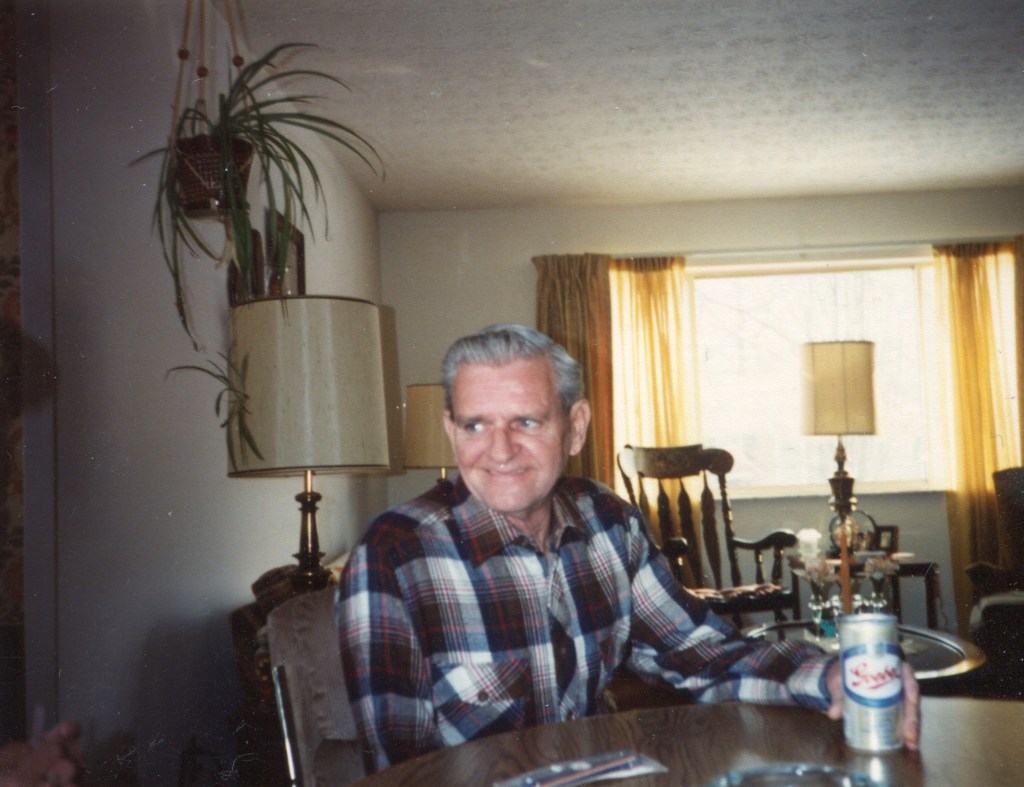
James Edward Metzger, sitting at the dining room table at my parents house (aka my first home) sometime in the 1980’s (the sofa and curtains were the originals)
Marriages
On 2 September 1950 Jim married Mary Jo Williams, with whom he had two sons. He divorced Mary Jo in 1956 and remarried a woman named Florence and they had a daughter. Their marriage also ended in divorce in 1962. His third marriage would be his last, to my maternal grandmother, Alberta Lou Fleming. He always made sure that he told everyone that he paid for her second divorce (as it was final 16 March 1973 and James and Alberta got married on 24 March 1973 (1 month and 2 days after I was born).
He Was A Character
Not that my grandparents ever had much, but they would do what they could to help you. My Grandpa Jim was a drinker, but he wasn’t the type to get mean and violent, the more he drank, the louder he became, and the funnier he thought he was (it was hit or miss to those around him).
But my Grandpa Jim always took the time to be involved in what mattered to me, as well as my other cousins. When I was into swimming, he was my biggest supporter. I remember him taking the time to cheer me on when I visited with him and my Grandma in the summer of 1986, it was my sister’s graduation present but I ended up tagging along too. For the 6 weeks we spent in Florida with them, except for the days we went to Disney and to Busch Gardens Tampa, all my time was spent with me swimming in the pool. I’d get up and swim, take a lunch break between 12-1 to watch my favorite soap at the time, Loving on ABC, then I’d swim in the pool until 4 when it was adult swim time – at that point I’d head to the Gulf of Mexico for an hour and then I’d eat dinner, only to return to the pool again from 6-10, my Grandpa calling me in when he went to close the pool for the night, I went inside and be it a chair, recliner or sofa, that’s where I fell asleep and I’d get up in the morning and do it all again, which was easy as I was still in my bathing suit.
Grandpa Jim was different from anyone I knew. His passion was singing, and he sang so beautifully, so much so that he joined the local Barbershop Quartet (or choir as it was sometimes) in Florida. He would burst into song (not like a musical, but if a song fit the moment, he’d sing it).
Everything he did was a bit larger than life. And though I know life wasn’t a bowl of cherries, he always tried to make it seem that way when all of us younger grandchildren were around.
He was a die-hard Ohio State Buckeye fan and would brag at no end about how his step-dad, Marty, would caddie for Jack Nicklaus (this seems to be true).
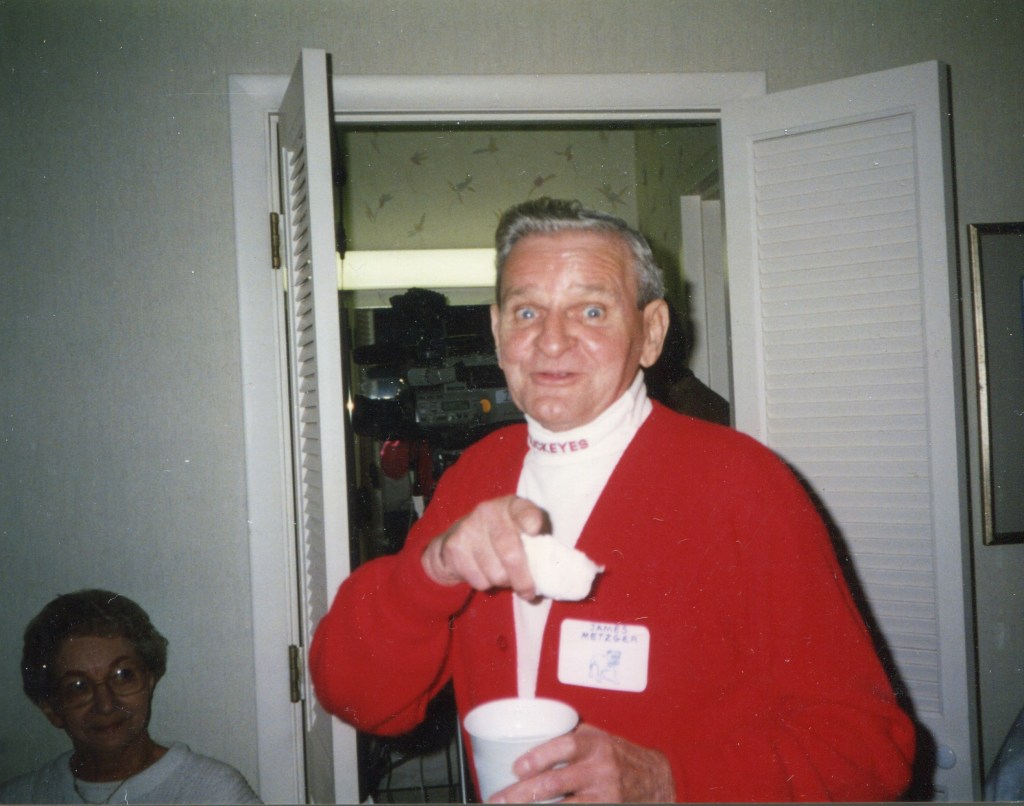
Jim Metzger in his red sweater & Buckeyes mock turtle neck (my grandma, Alberta Lou Fleming, is to the left)
His Occupation
At some point in his life I heard that Jim Metzger sold dental equipment before he began managing condominiums and apartments with my Grandmother. Alberta was the manager while Jim fixed things. It was a good set up.
A Funny Story
I consulted with my mom’s sister for this next story as it was one that always made my mom cry she would laugh so hard. So here is what my Aunt told me, the story includes my Grandpa Jim, my Uncle Jim, and an outhouse.
“A death occurred on Howard Fleming’s side of the family in Corsica, Pennsylvania. The house they were staying in belonged to an Aunt Margaret (possibly Martha). She was apparently a hoarder by frustration as she got tired of picking up after everyone, so she began stacking stuff and eventually everything became full except a little path from the bedrooms to the kitchen.When she got up in the morning the boys had gone outside to use the outhouse (there was no indoor bathroom). As they were standing there, taking a leak, the floor gave away. Somehow they were lucky enough to have both feet land on a pole that was ran underground under the outhouse, but they were still waist-high in poop.
My Aunt doesn’t remember what they did for clothing but they had no shoes for the funeral. My Aunt could only wonder what Jim Metzger was thinking.”
I don’t think he was married to my Grandmother yet.
My Grudge
I’ve been told by both sides of my family that I am as stubborn as the other side. My mom telling me I’m as stubborn as the Blair’s while my dad says I’m all Fairhurst. I have learned that deep down I’m probably a combination of them all.
One such time of my showing how stubborn I could be was when I’d hold a grudge against someone, and I had such a grudge towards my Grandpa Jim. He embarrassed me one day when he was drinking really heavy in front of my best friend. doing a really bad imitation of Jerry Lewis, it was never good, but this day had him doing it repetitively trying to get people to laugh, and it wasn’t working. Top it off with the fact that I was in 10th grade, so you know how that age can already be, but he was slurring his words and just going a little too much over the top. Even my mom would admit that was a bad day. He ended up getting in his car and driving to Columbus after an altercation with someone (that part escapes me now but I remember my mom being horribly worried something really bad would happen, to our knowledge nothing did).
After that day I never was the same around him, giving him the silent treatment and the like (well, he and my grandma forgetting my 18th birthday a year or so later didn’t help, but maybe I brought it on myself).
Where I ended up making my peace with my Grandma Metzger, I never had the chance to really do that with my Grandpa. I was young and stupid. And then I was in my twenties. They had moved back down to Columbus so I didn’t see them all the time. I’d like to think he would forgive me, he was the first person who drank a lot that I was around. I have/had all kinds of addictive personalities in my extended family, but he was the first person who I truly “saw”. And he was one of my heroes, they aren’t suppose to fall off their pedestals.
How Scanning Photos Changed My Mind
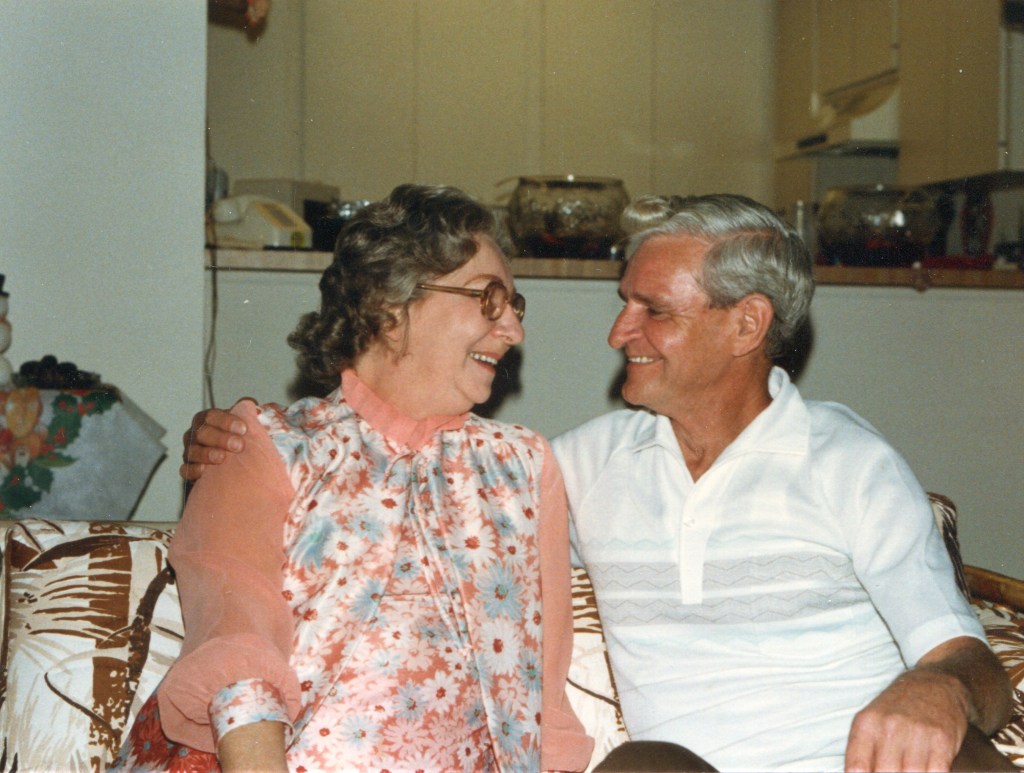
I also think my opinion really changed last year during Covid when I began scanning my Grandma Metzger’s pictures that my dad gave me and I found the one below of my Grandparents. Look at them looking at each other. And I can tell this was when they lived in Florida which was a good 13 years into their marriage. So much love. I can just hear him calling her “Dear Heart” (well, he called everyone that). He may have had his flaws, but you can tell he loved my Grandma.
Alberta Lou Fleming and James Edward Metzger circa 1983-1985
James Edward Metzger died 21 July 2001 from lung cancer in Columbus, Ohio. He was far from perfect, but he was full of personality, and considered everyone he came in contact with a friend.
The theme for 52 Ancestors in 52 Weeks is “tragedy”. I’ll admit I did a search in my genealogy software trying to find a relative who was a logger and died under tragic circumstances (I could not find them) or I contemplated about a distant cousin who died young under horrible circumstances (leaving that for another year?).
But then I decided to be different.
All week long when I began attempting to compose this post the Bee Gees song began going through my head. Why? Well “Tragedy” is the name of the song, it’s also quite catchy, as most songs by the Brothers Gibb are.
But for me the Bee Gees songs have a greater meaning, in the last 20 years of my mom’s life she loved the Bee Gees and would often ride her recumbent bike listening to them, or when taking a walk around the block or at the local gym. She would often comment that their music would allow her to bee bop through the house (she had a specific term for this bee bopping but I shall not say it, because though Cynthia Anne Fairhurst meant it as a HUGE compliment, it may not be seen that way in today’s climate).
The Bee Gees Greatest Hits were one of my mom’s favorite albums, and my sister often has moments that she feels my mom is with her when a Bee Gees song comes on. Sadly, I don’t listen to the correct radio stations to be blessed with this – but that’s okay. I get cardinals in my lilac bush on her birthday which is just as nice.
This week’s theme for 52 Ancestors in 52 Weeks is “In the City”. I’ll admit this one was hard, because most of the relatives I have focused my research on were born and died in Pennsylvania, in one of the following counties: Bedford, Blair, Cambria, Fulton, Huntingdon, or Somerset. Granted on my mom’s side they either came from England and settled in Ohio or they were born in Massachusetts and moved to Potter County, Pennsylvania. But finding someone who was born in a small town and moved to a big city was not anything my ancestors did.
But then I remembered my 5th-great-grandfather, Ebenezer Oakman, who was born in Lynn, Essex, Massachusetts and moved to Philadelphia, Pennsylvania.
Lynn, Essex, Massachusetts
With land purchased from the Indians, Lynn, was founded in 1629, specializing in the manufacture of leather shoes, eventually becoming the ladies shoe center of the world, even getting Congress to place a protective tariff on the shoes.
In 1850 Lynn officially became a city and they had another claim to fame as the General Electric Company was born in 1892 by the merging of Edison Electric and Thomson-Houston Electric.
Today, Lynn is the 9th largest city in the state of Massachusetts and is close to 4 miles north of Boston located on the Atlantic Ocean.
Ebenezer Oakman
Ebenezer Oakman was born 8 August 1775 in Lynn, Essex, Massachusetts when it was still a part of British Colonial America, to Isaac Oakman and Elizabeth Lathe. He married Hannah Stocker on 13 October 1796 and they went on to have six children: Rebeca, Hannah, Elizabeth, Ebenezer Phillip, Sally, and Squires, all born between 1797 and 1805 (this was found using a document I found at AmericanAncestors).
In 1802 Ebenezer began a shoe factory in East Saugus with large expansions in 1807 and 1810, where he then had the largest shoe factory in the area. He would make the shoes in Massachusetts and then take them to be sold in Philadelphia, however in 1818 he moved the entire business to Philly.
One of the reasons for the move was that Ebenezer’s wife, Hannah, died on 27 March 1812. He then met and married Anna Bruce Ansley in approximately 1814 where they then had seven children between 1815 and 1832: Joseph, Robert, Agnes, Jane, Isaac, John, and William.
It appears around 1850 Ebenezer and Anna separated and he moved to and died in Lynn, Essex, Massachusetts at the age of 78 on 6 September 1854 (she moved to Illinois with Isaac).
My Lineage
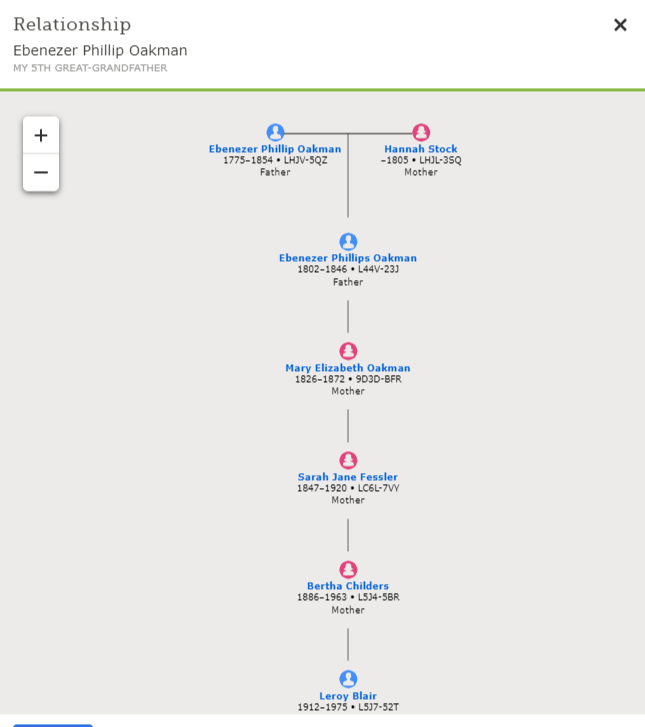
I am related to Ebenezer Oakman through his oldest son, Ebenezer, through his daughter, Mary Elizabeth who was born in Philadelphia to his wife, Mary Catherine White. Mary married George Henry Fesler and their oldest daughter is my 2nd-great-grandmother, Sara Jane Fesler. She married Randall Childers and had Bertha Childers, who married the younger Andrew Jackson Blair and their son Leroy was my grandfather.
Here is the direct relationship from my grandfather, Leroy Blair, to my 5th-great-grandfather, Ebenezer Oakman using FamilySearch
As a girl who was quite fond of trendy shoes back in my college days (well, we can just sum it up as the 1990’s in general) I was really excited when I learned of my ancestors owning a leather shoe store. I’ve not yet uncovered what happened with the shoe store (one of the online blurbs I read stated they traded the store for land in Bedford County but at this time I have nothing to back this up), but I would love to know if maybe this company turned into a brand that I myself wore.
This week’s topic for Amy Johnson Crow’s 52 Ancestors in 52 Weeks is Health. It was proving to be a struggle for me as I went through various people, illnesses, and how my mom was a nurse, but since I had discussed her not so long ago I wanted something that was different and not so obvious, and then it hit me – I have so many relatives who were coal miners, I decided to discuss the unhealthy conditions of working in a coal mine.
Coal Miners in My Family
I started making a list of all the men that were coal miners in my family and had not gotten too far on just my dad’s side and I already had over 20. My mom’s side could easily have just as many with her Fairhurst and Boone relatives as they all came over from England in the early 1900’s and settled in Jefferson County, Ohio where they were also miners (my great-grandmother, Phoebe Boone even ran a boarding house for miners).
My coal miners were not just limited to those who were here in the United States like my Blair’s, or the Fairhurst’s and Boone’s who immigrated from England, but my great-great-great-grandfather, James Boone was a coal miner in England. I do know that Isaiah Boone, mentioned later, moved to Utah and mined there and then returned to Ohio.
An Unhealthy Industry
Coal was one of the main resources that ran engines (stationary and locomotive) when the world began going through the Industrial Revolution. Though in the United States coal mining was done in smaller, rural towns, the mines were sometimes owned by railroads, which would obviously make sure the coal got where it needed to go.
Coal mining was not easy work. You were in the darkness all day, hunched over because most of the time the cavities within had low ceilings and you were constantly inhaling coal dust. Many illnesses were caused by lung issues.
Coal Workers Pneumoconiosis
Coal Workers Pneumoconiosis is a lung disease caused by the inhalation of dust and the lungs become inflamed or scarred which eventually made the person have a difficult time breathing. Another common name for this is black lung.
The stages of the disease often began with a cough, which leads to shortness of breath, then chest tightness. There is no cure, only prevention.
Though technology was not available hundreds of years ago, today’s miners can wear a personal dust monitor that measures the dust exposure, knowing at the end of each shift what the amount of dust was.
Another similar ailment is Silicosis.
Lung Cancer
Lung cancer in coal mining is primarily caused by exposure to the diesel exhaust daily for five-plus years. This is focused primarily on miners since the 1940’s and is normally combined with pneumoconiosis.
Chronic Obstructive Pulmonary Disease
Chronic Obstructive Pulmonary Disease (COPD) is a common ailment among many people in today’s world, even outside of being a coal miner (your common habit of smoking is enough to contribute to COPD, my mother and maternal grandmother were both diagnosed). Like pneumoconiosis, COPD cannot be cured. Examples of COPD are bronchitis and emphysema, and along with coal worker pneumoconiosis, it has been classified as an occupational disease.
Skin Conditions
Coal miners suffered various skin ailments along with the lung diseases. Eczema and contact dermatitis were issues that came about since the 1950’s due to chemicals, “communal bathing, prolonged and profuse sweating, friction and dirty clothing” causing bacterial and fungal infections (and was the reason for the most days missed).
Though not deemed harmful, “coal tattoos” also were a sign of the coal miner as the miner would get cut and coal dust would get in it before it healed.
Disasters
Along with suffocation, gas poisoning, another unhealthy part of coal mining are explosions and mine collapse. I know in my own lifetime I’ve witnessed on television in differing areas of the world tragic outcomes where a group of men were trapped underground due to an explosion or a cave-in and it was unknown if the area where the men were trapped had enough air to sustain the 22 miners in China (11 survived), or the 33 miners in Chile (all survived for a period of 69 days), or the 13 miners in West Virginia (only 1 miner survived this explosion).
Explosions in mines are nothing new. I have both direct and collateral ancestors in my tree who died from such mining accidents.
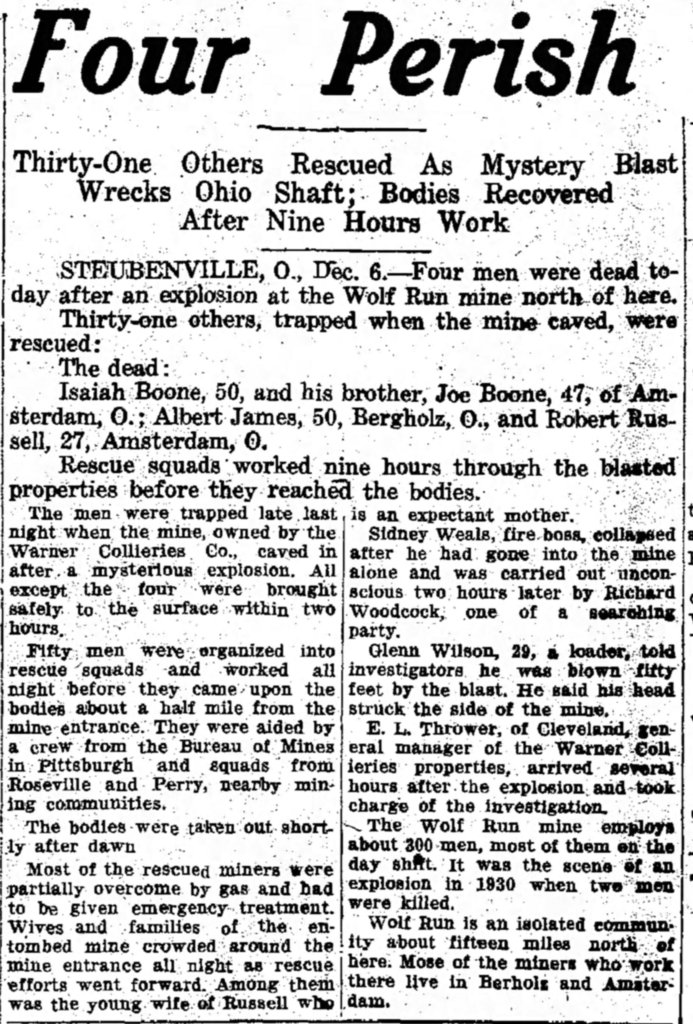
“Mine Explosion Kills Four Men At Wolf Run” – Carroll Journal, 12 December 1935
“Four men lost their lives and 31 had a narrow escape in an explosion early last Thursday night in the Warner Collieries Mine at Wolf Run near Bergholz. Those killed were Isaiah Boone, 50, his half brother, Joseph Boon, 47, and Robert Russell, 25, all of Amsterdam, and Albert James, 50, of Bergholz.”
Isaiah and Joseph Boone were the older and younger brother of my great-grandmother, Phoebe Boone, she was sandwiched between them in chronological order of children of Enoch Boone and Susannah Rigby’s children. Both came to the United States from Leigh, England – Isaiah in 1923 and Joseph in late 1920.
Isaiah Boone, photo permission granted from RWissler Collection
Using Newspapers.com to find articles of the paper, the blast was reported from as far East as Connecticut and as far west as Idaho, and I also found where it was reported in Canada.
Article taken from the 6 Dec 1935 Xenia Daily Gazette found on Newspapers.com
Andrew Jackson Blair
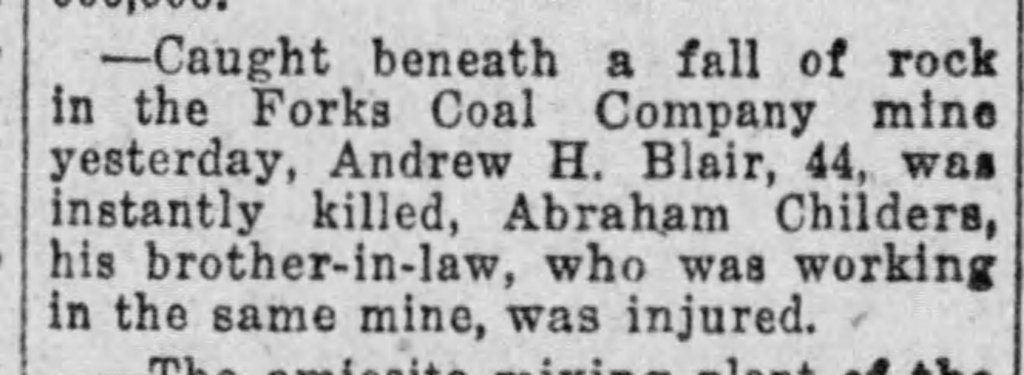
“Blair, Andrew J. aged about 44, of B Court was instantly killed about one o’clock this afternoon when caught beneath a fall of rock while at work in the Forks Coal Mining Company mine. The victim was badly crushed. Mr. Blair’s brother-in-law, Abraham Childers, was injured in the same mine yesterday, having the ligaments torn in his leg”. – Johnstown Tribune, Wednesday, 17 November 1926, Page 26 (This article was found on Find A Grave where it was transcribed for his memorial, I was unable to find the original to include).
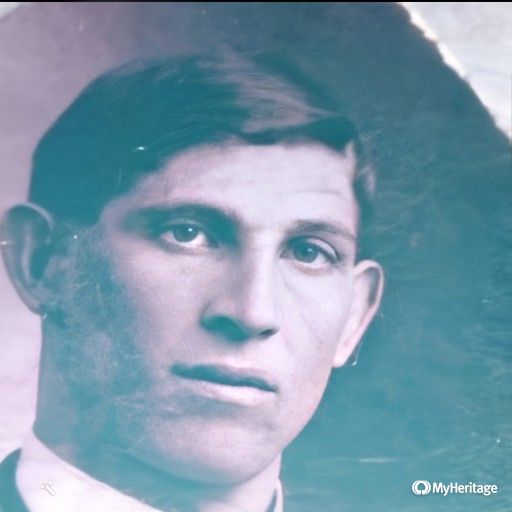
My great-grandfather was born in 1881 and on the 1900 census was already working in the coal mines. My dad told me that his dad, Leroy, Andrew’s oldest surviving son, also briefly worked in coal mining but had an accident in the same area his father died and that is when he found a different vocation.
Andrew Jackson Blair, sadly he was cut out of a group photo it is believed to have been from a church. I enhanced it at MyHeritage (hence their watermark in the corner)
I was able to find a newspaper article from Harrisburg, Pennsylvania newspaper, The Evening News, with a snippet of his death:
The Evening News from 17 November 1926 found on Newspapers.com
Other Interesting Facts
Coal mining was an institution unlike any other that I know of. Workers worked for a company who not only paid them in company cash or script, the housing was crude and also owned by the mines, the stores that took the script were owned by the company and priced everything high, but they could, because these stores were the only ones that would take the company cash. You were in a never-ending cycle and it really didn’t give you an “out”.
Young boys began working at the mines by the time they were 12 to 14 years old. They were not allowed to work in the mines but they would stay outside sorting the coal. To work within the mines they had to be 18 years old.
The social systems surrounding the mines were ethnicity based. Those with the highest prestige were the Welsh and English (this would have been where Isaiah and Joseph Boone fit in); then the Irish, Italians, Eastern Europeans and finally those that were from Appalachia. I am not quite sure where my great-grandfathers would have fit in being born in Bedford County, Pennsylvania, they weren’t foreign but also too far north for Appalachia.
It had to take a person of strong mind and spirit to work in the coal mines day in and day out. My other paternal great-grandfather, Charles Jackson Morgart worked in the coal mines the last handful of years before he took his own life. I’ve sat and contemplated his death numerous times trying to wrap my head around why he killed himself but I’m sure it’s a mystery I’ll never know for sure. Was it a bit of depression from working in the dark after being a farmer? I’ll never know.
I am sure there are hundreds of other illnesses that can coincide with working in a coal mine that I haven’t listed, but this is what I found in just a day or two researching for this blog of mine. Coal mining was a dangerous occupation that until I saw how many of my ancestors did this for a living, I never gave much thought too (well, until you hear about a grave situation on the news). I look at it so much differently these past few years, so many risks, both health and otherwise, that these men took to provide for their family.
* I found the information for the above article and provided links throughout leading to Wikipedia, American Lung Association, NCBI, NIOSH, and the Nursing Times
Thank goodness for fashion, otherwise we would never be able to figure out what era our family pictures came from. Fashion is also the theme for this week’s 52 Ancestors in 52 Weeks, and though there is not much for me to say, more or less to show, I am going to showcase my 2 fashionable aunts on my maternal side of the family.
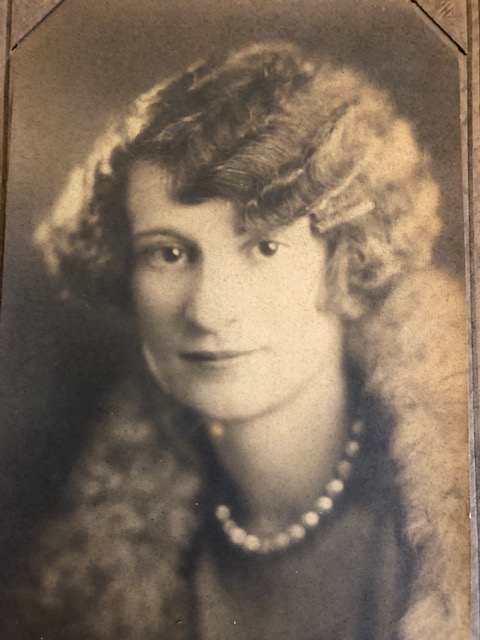
Ina May Dunbar
I remember a few weeks ago when I was binge-watching Downton Abbey, when I saw Edith’s ‘do in season 3 as we entered into the 1920’s I smiled at how much her hairstyle reminded me of my Great-Grand-Aunt, Ina May Dunbar, older sister to my Great-Grandmother, Mildred Laura Dunbar.
Ina May Dunbar, circa 1920’s
She is so beautiful and stylish, between the fur top of her coat and the pearls. I always have wondered how they got those beautiful waves in their hair, I’m sure I would utterly fail if I ever tried to attempt it myself.
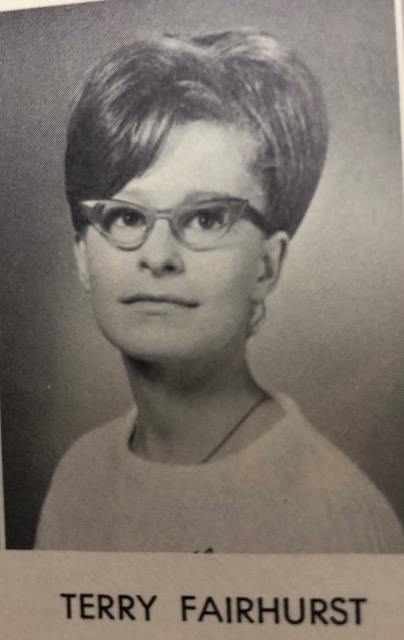
Terry Mildred Fairhurst
My Aunt Terry was such a wonderful lady. She had a hard life, mostly because she made poor choices, but she always did her best to make lemonade out of lemons. Or at least that is how it seemed to me when I would talk to her. No matter how bad life seemed to get, she was a fighter and found a way to land on her feet (probably because she had family who loved her).
But my Mom always loved how stylish her younger sister was. My Aunt loved to dance and just have a good time. I loved her laugh.
Terry Mildred Fairhurst, 1965
I have so many other photos of beautiful ladies but these are the two I have that just really exemplify the decade of fashion they were taken in. The 1920’s and the 1960’s had such unique style, so much that they are often imitated even today.
Today I am not writing about a direct line ancestor, but a man who seems to have been a very special person. His name is Samuel J. Randol and he was the second husband of my maternal great-great-grandmother, Mazie Lorena Warner.
Samuel Joseph Randol holding Alberta Lou Fleming, early 1930’s (again, no date but my Grandma was born in October 1929)
I will tell the tale of Samuel as he at one point worked for the railroad when they lived in Potter County, Pennsylvania. Then, after moving and settling in Akron, Summit County, Ohio, he worked as a truck driver. He was actually making a delivery to Decatur, Macon County, Illinois, when he became ill and died.
Samuel Joseph Randol
Samuel Joseph Randol was born 5 October 1874 in Independence, Warren County, Indiana to Alonzo Randol and the former Laura Altman. Upon doing my homework for this post I came to the conclusion that Samuel had been married three times. He was divorced from a Rosa Cox (born in 1876 and passed away in 1924), and his second wife, Emily, died of a cerebral hemorrhage a month before he married Mazie (I tried to keep an open mind hoping that Samuel and Emily had only been married a short time, but it was 14 years, but this was over a century ago, they did things different then, right?)
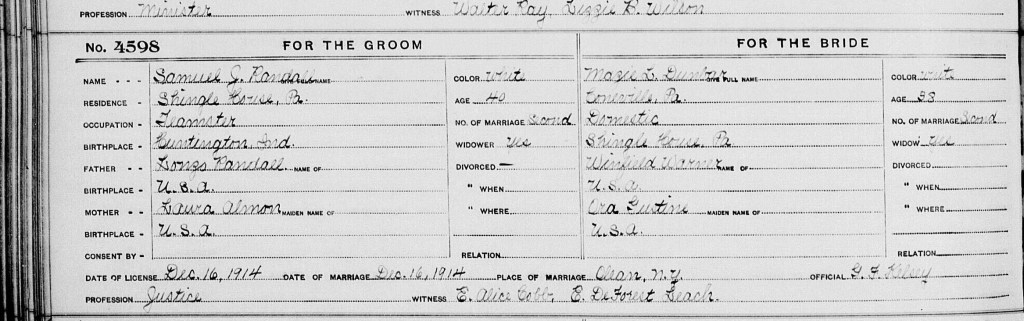
Portion of the page from the New York Marriage License of Samuel Randol & Mazie (Warner) Dunbar – this Record of Marriage was found on FamilySearch
His Occupations
According to the 1900 Federal Census, Samuel was listed as a teamster. For those who do not know what a teamster is, it is a truck driver or a person who drives teams of draft animals.
In the 1910 Federal Census he was listed as working for the railroad. This was not his only stint with the railroad, he was employed with the Pennsylvania Railroad once he settled in Akron from 1917 through about1922. When he initially moved to Akron he worked for the Swinehart Rubber Company, which was not far from where he lived.
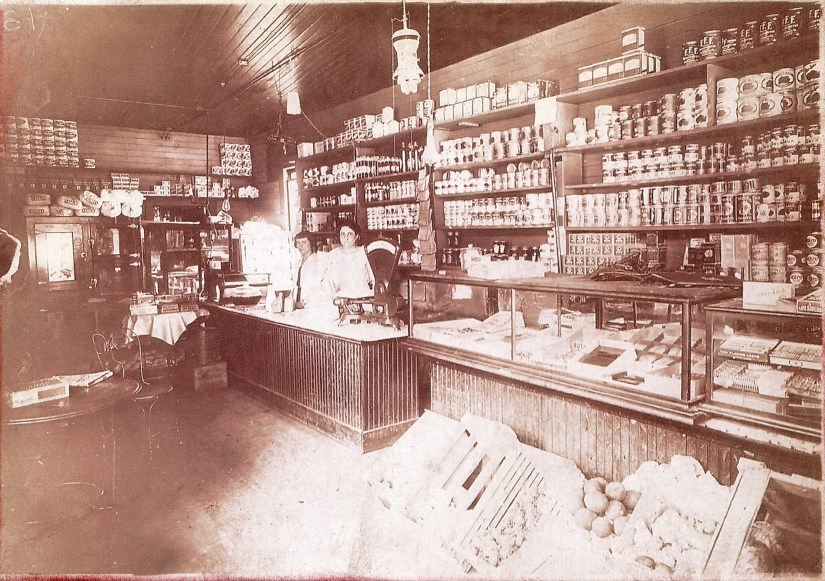
Around 1923 he opened his own grocery store entitled “SJ Randols” located on Howard Street in North Akron. This entrepreneurial endeavor did not last long as he was once again a truck driver by 1925 (I tracked his occupations once he arrived in Akron using the digitized City Directories that are located online by the Akron-Summit County Public Library, from years 1859-1969).
S.J. Randols Grocery Store – this was amongst my great-grandmother’s items, no date, no names. Circa 1923
Life With Mazie
Seeing as his first 3 marriages did not last long, that Samuel was married to my great-great-grandmother for 23 years, it must have been love (or at least I hope it was).
Samuel and Mazie were married in Olean, Cattaraugus County, New York on 16 December 1914. By this point in time my great-great-grandfather, Arthur Dunbar, had been dead for 2 years (he passed away of heart failure, most likely a complication from his having polio).
When Samuel married Mazie he got a full package, her and 3 daughters, who he took on and cared for as his own. Myrtle had already married William Harvey of Elmira, Chemung County, New York, but Mazie was still raising a teenage Ina May Dunbar and my 6-year-old great-grandmother, Mildred Laura Dunbar.
Just before moving to Akron, Samuel and Mazie had a son, Richard LeHoty Randol 8 March 1916. Five months later on 7 August 1916 he died of intestinal intoxication, which is a severe dietary deficiency. It’s so sad when you see dehydration and malnutrition as causes of infant deaths just a century ago as IV’s and formula now do so much.
Richard LeHoty Randol, only child of Samuel & Mazie, 1916
Samuel and Mazie had no more children but had their hands full with Ina and Mildred.
Ina married John Slater, had a daughter, but when the marriage didn’t last it was Samuel and Mazie who took them (Ina and daughter) in. The same could be said for Mildred twice over as she got married, then divorced, got remarried, had a daughter, then another divorce and when she married for the last time they lived with Samuel and Mazie for a couple of years before finding a home (I like to think they were saving up for a down payment?).
Ina did re-marry Ralph Stone in 1928 and I remember attending their 50th Anniversary Party. I was 5 and my Daddy was getting me punch, not realizing it was spiked. All I remember is laughing a lot and saying “Oh Johnny” as I thought my older teenage cousin was really cute (Johnny descends from my Aunt Myrtle, and I have yet to find him in my genealogy search).
Anyhow, I digress. In 1938 Samuel was still a truck driver, often going to Decatur, Macon County, Illinois. He apparently got sick while there, was taken to the hospital and after a week “with a complication of diseases” he died.
The Decatur Daily Review, Monday, October 17, 1938 – found on Newspapers.com
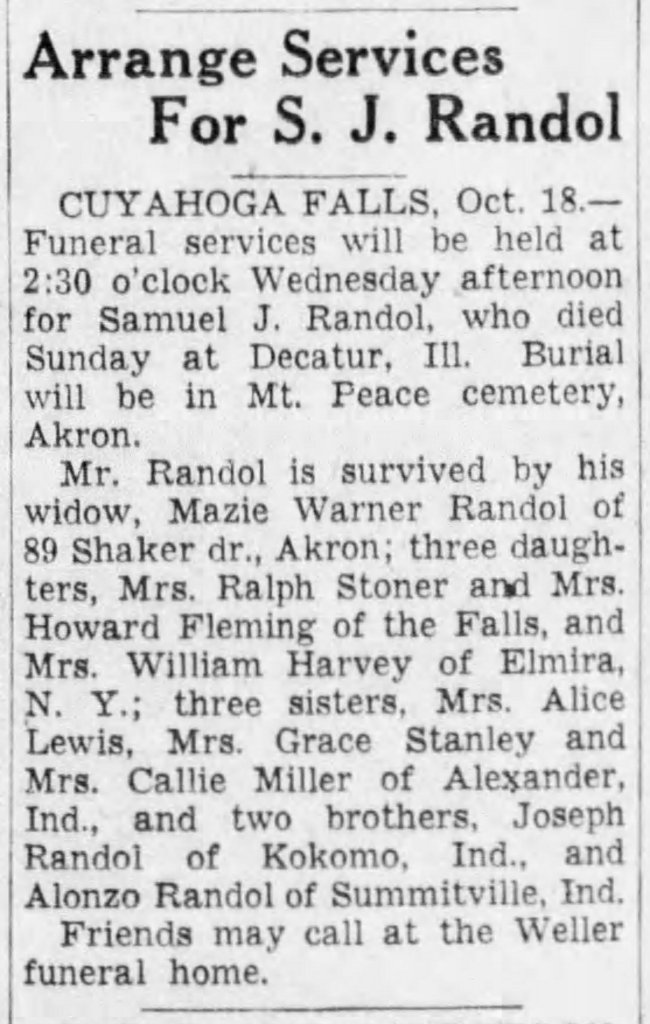
They shipped his body back to Ohio, and his funeral had quite the turnout. Along with the photos and such my dad gave me that were my great-grandmother’s, Samuel’s funeral book is among the items. I was amazed at all the names of all the people, at least 10 full pages, who either attended calling hours or the funeral (or both). Among them, one of his first Ohio friends, Clyde Geer (and most likely my great-great-grandfather). Clyde worked at Swinehart Rubber Company when Samuel did when he first moved to Akron in 1916.
The Akron Beacon Journal, Tuesday, October 18, 1938 – found on Newspapers.com
But working in transportation – be it by train or automobile (maybe even heading up a team of animals???) is how Samuel supported himself and his family. That he changed with the times was quite trendy of him.
Though I never met Samuel (he died about 35 years before I was born), he seemed like a loving man and I couldn’t have asked for a better person to care for Mazie.
Transportation was the theme for week 28 of Amy Johnson Crow’s 52 Ancestors in 52 Weeks family history writing challenge. It’s a fun way to stop and write about your family each week. If you would like to sign up, please do so here.
Free is the prompt for this weeks 52 Ancestors in 52 Weeks, and who better than to write about than my 5th-great-grandfather, Solomon Sparks, who fought in both the Revolutionary War and the War of 1812.
Solomon Sparks was born 13 June 1758 to Joseph Sparks and the former Mary McDaniel in Frederick, Maryland. Overall he was the fifth of at least nine children, and the third boy. (As a side note, Solomon’s younger sister Sarah is also my 5th-great-grandmother, making Joseph and Mary my 6th-great-grandparents two times over).
Solomon’s family moved from Maryland to Bedford County, Pennsylvania in 1778 and in 1782 Solomon joined the militia as a private, mustering out when the war was over in 1783. He was a part of Captain Boyd’s Company of Rangers, their job was “to scout the forests and guard the settlements against surprise attacks from hostile Indians” (Taken from the History of Bedford, Fulton, & Somerset Counties).
Upon the war ending Solomon returned to Frederick, Maryland to live for a short time. This is where Rachel Weimer also lived, and they very well could have known each other or met at this point in time. They married in Pennsylvania in 1786 and had 11 children, settling in Providence Township in Bedford County, where he became a successful farmer.
When the War of 1812 began Captain Solomon Sparks and his Regiment of Rifleman “marched through the wilderness to the Canadian frontier and there performed efficient service” (Taken from the History of Bedford, Fulton & Somerset Counties).
Solomon passed away on 8 April 1838 but I wonder if he had been ill for a while. His will is dated 10 January 1821 with the beginning wording as “being for time very unwell but sound in mind, memory and understanding” (will was found in records not yet transcribed on FamilySearch). He gave $200 to each of his daughters, and money and homes to each of his sons. His wife, Rachel, was Executrix and his oldest son, Abraham, Executor.
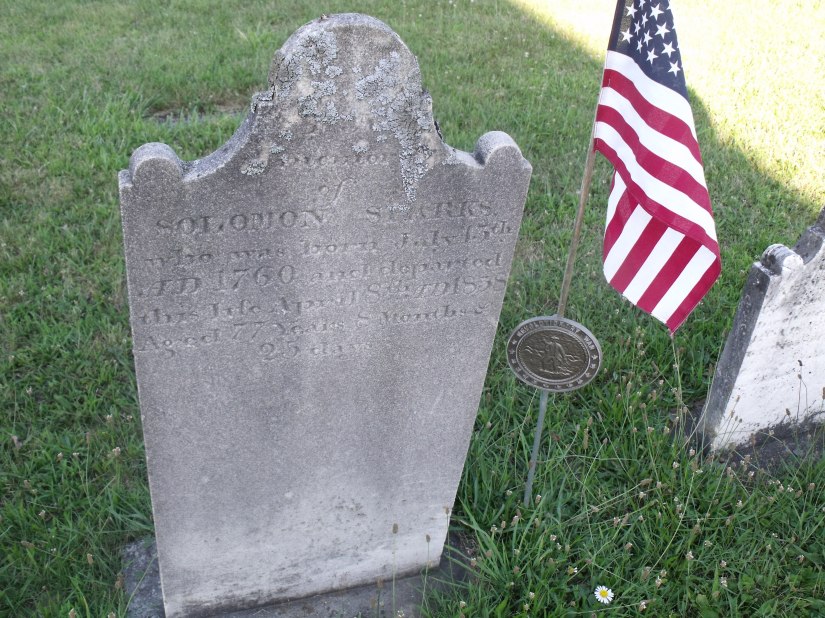
Grave of Solomon Sparks, he is buried at the Providence Union Church in Everett, Bedford, Pennsylvania









 Helping History Come Alive