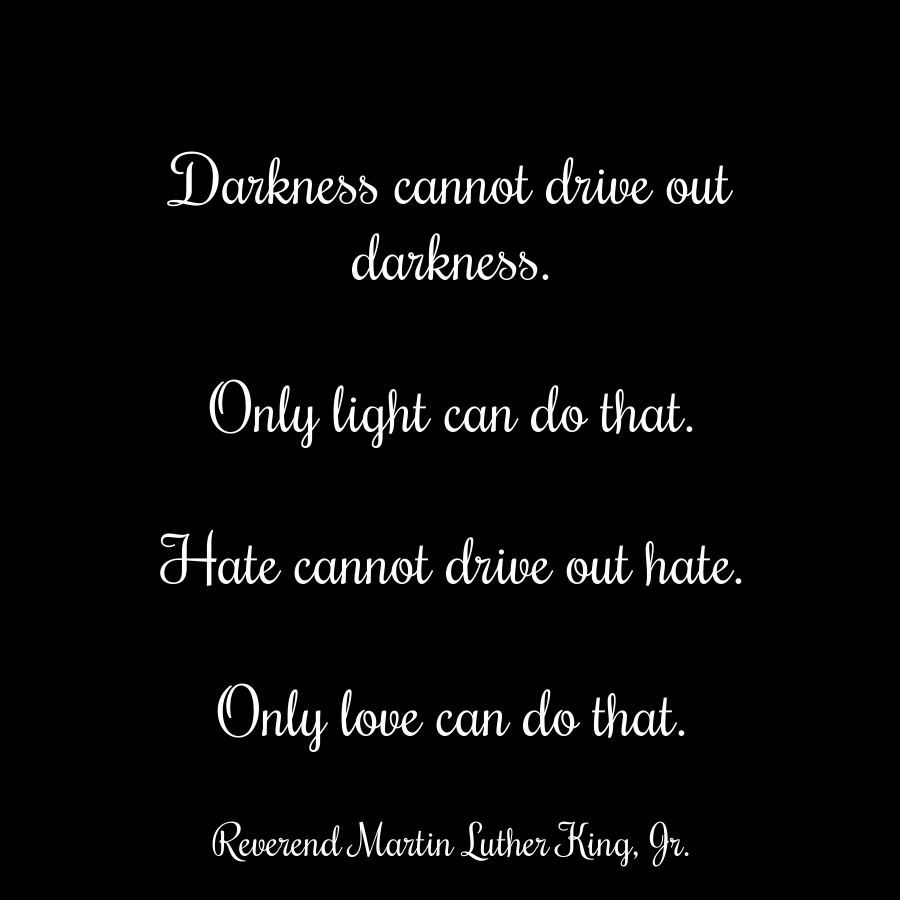
Martin Luther King, Jr. Quote

Family History Enthusiast – Overall History Geek
Have you joined a genealogical society? A few years ago I joined three different societies, beginning with my local county chapter of the Ohio Genealogical Society (also known as OGS), OGS, and the National Genealogical Society. Later I joined a fourth, an online only society in an area of the United States that pertains to my ancestral journey.
I love genealogical societies, because they are a great resource for your research. At the various levels, whether it’s county, state, or national, each has something that stands out to make it unique.
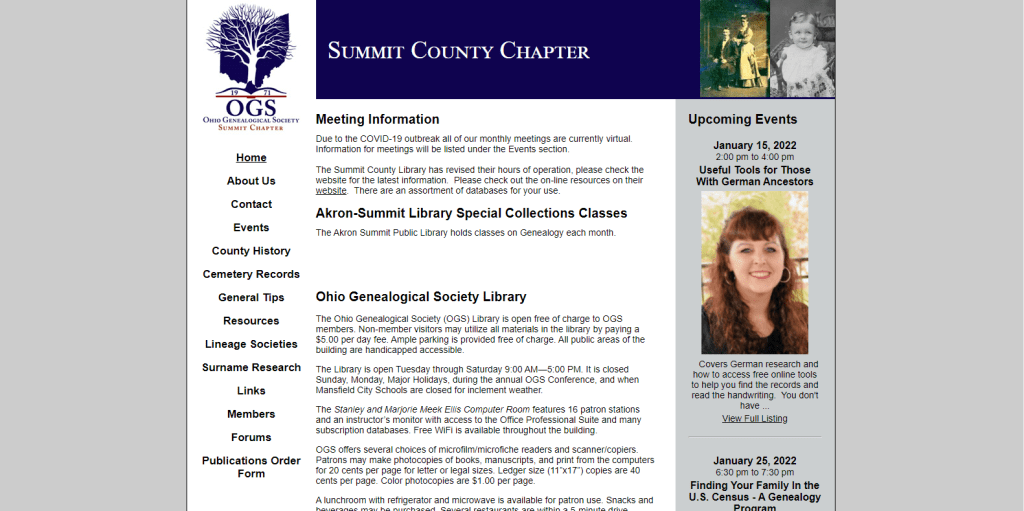
My local Summit County Chapter of the Ohio Genealogical Society is a wonderful resource because it meets monthly (except in August and December). At these meetings, which are the third Saturday of the month, we have speakers pertaining to different topics. As I type this tomorrow is our meeting, and our program is “Useful Tools for Those with German Ancestors” by Dana Palmer. She is one of my favorite presenters, discovering her at a Family History Day at the Summit County Family History Center in October 2018.
This past year we attempted to have a research day at the Akron-Summit County Public Library in the Special Collections department, which has several computers available for access to online databases (Ancestry, FamilySearch, MyHeritage, FindMyPast, AmericanAncestors, and more, you just need a library card). They also have books on local history and genealogy from all over the country (possibly all 50 states, if not, it’s close) to aid in sources not online. We ended up doing mostly solo research, but it was nice to know others were there in case we needed to float ideas.
Presently our meetings are hybrid, meaning we meet in person at a conference room at the main library but members can also be a part of the meeting from their homes via Zoom.
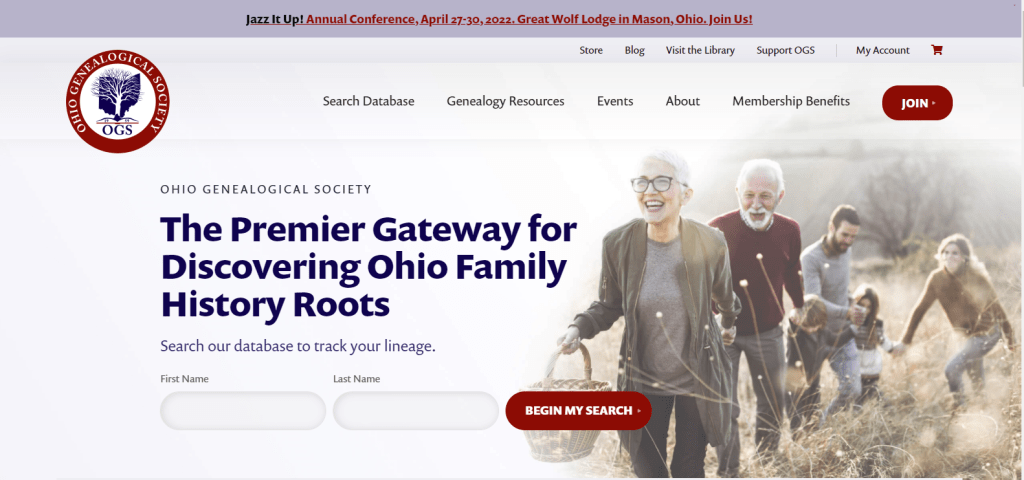
The Ohio Genealogical Society is the largest genealogical society in the United States and has a wonderful 4-day conference each spring that moves between three locations: Cincinnati, Columbus, and Sandusky (I wish they would do one in my area, not that the drive has prevented me from attending).
They also do a weekend retreat in the Fall at a rustic getaway (picture cabins in the woods) with high profile speakers discussing topics of interest. I looked at their event page and not much was listed, but their recently updated website has a number of genealogical resources available, but you must be a member to view.
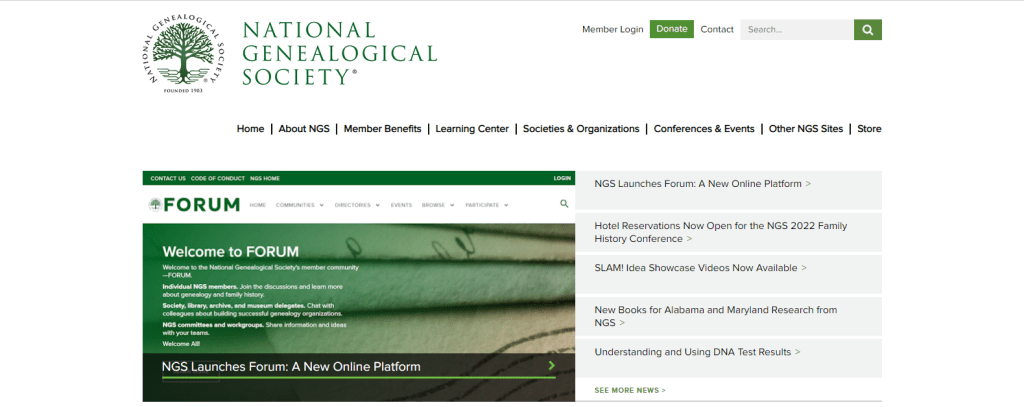
There is a higher price tag to become a member for the National Genealogical Society but I find it to be worth it. Along with free classes there are classes you can purchase in order to be a better family historian.
Like OGS, NGS has a yearly conference that takes place in a different location every year. Since I’ve been a member they have been in St. Louis, Salt Lake City, Richmond, and this years is to take place in Sacramento. They have both in person, virtual, and on-demand options for attending.
A little over a year ago NGS merged with the Federation of Genealogical Societies and now have these societies as a focus in the NGS Magazine. By combining both organizations they can focus on caring for the needs of all areas of family historians.
This past week (or maybe it was last week), NGS launched Forum, a member community where members can discuss family history with each other, but societies, libraries, archives, and museums associates can “discuss building successful genealogy organizations”. This sounds like a great way for ideas to be bounced around and for you to communicate with others, possibly where you are researching.
NGS also has two wonderful magazines, one with a hodge podge of information, the NGS Magazine, and one that is filled with case studies, National Genealogical Society Quarterly. Both are valuable tools for the family historian.
The NGS website also lists a number of events on their website for their own sponsored events as well as other genealogical societies across the United States. They are all quite helpful for those who want to continue to learn.
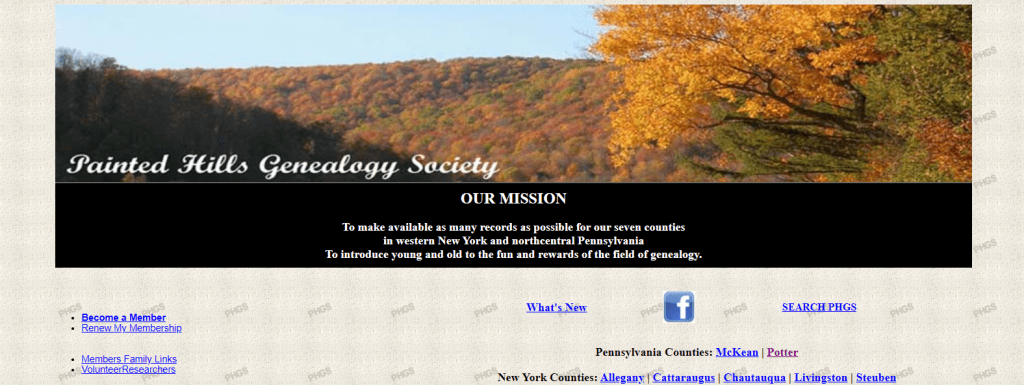
Painted Hills Genealogy Society is a website I stumbled upon and that I value so much. It has so much information on the website, and your dues allow you access to an exclusive Facebook group. The website pertains to southwestern New York counties (Allegany, Cattaraugus, Chatauqua, Livingston, and Steuben) and two northwestern Pennsylvania counties (Potter and McKean). These are the counties (both New York and Pennsylvania) where my Dunbar, Williams, and Gustin families all hail from on my maternal side of the family. Joining a society that is all about the area you are researching is simply invaluable.
So, whether you join just locally or want to broaden your horizons, there is so much to gain by becoming a member of a genealogical society. Each society has something to offer, and you can normally learn a lot about them by visiting their website (I’ve included links above to all the ones I’ve talked about today).
Take some time from your researching to check out these valuable resources. If your budget is limited choose only one to sign up for but make sure it’s one you know you will get the most bang for your buck. Sometimes it’s worth signing up for society in the area of the country that will most benefit your researching (as I have the Painted Hills Genealogy).
I know my local society allows visitors to check them out, or even if they have a program that you are interested in. Everyone is always welcome, so take a chance and become involved! You’re only going to find people with the same hobby as you!
The final week of 52 Ancestors in 52 Week’s has a heavier topic than normal (I type as I laugh as some of the themes have really made me think hard). This week’s is no exception with the prompt of “Future”.
I’m going to seize the moment and really focus on 2 lines from each side of my family. The Warner’s and Gustin’s on my Mom’s side and the Blair’s and Aker’s on my Dad’s side. I’m sure others may pop up with interest (for example, my Dunbar’s married a Warner so I could stray a bit that way), or maybe I’ll have a moment when I want to research my maternal grandfather’s side of the family, and since they are all in England, you utilize that mood when it strikes.
My genealogy future will be me going into a little more detail on my mom’s side of the family, the Warner’s to be precise. While attempting to look up some information on Thankful Chapin, who I believe to be my fifth-great-grandmother on my maternal side of the family, I realized not only do I not have the paperwork to back this up (though her years of being alive do) but I don’t have confirmation that her supposed son, Oliver Charles Warner, is a son of Joel Warner. By exploring this portion of my tree, it will help me explore other areas of this side, and since my great-great-grandmother, Mazie, was a Warner, they are extra special (because for some reason she is extra special to me, I truly feel she would have liked me).
If I am going to write more about the Warner’s I may as well learn more about Mazie’s mother, Orienta Gustin and her parents, Benjamin Gustin and Nancy Return Gault. I remember being so tickled upon finding Orienta’s photo that I want to know more about this amazing lady and her lineage as well.
Oh, it wouldn’t be a year of genealogy if I didn’t try to work on my Blair brick wall, now would it? Observing in the past weeks of various DNA matches I saw that a person who was placed in the middle of my Blair’s on FamilySearch’s one big tree is on a DNA matches tree. Though there is a possibility that the person has the wrong fellow in his tree, just in case that I am somehow related to the infamous Andrew Sloan Blair I am investigating him by putting him on an experimental, private tree. I will never know if there is some sort of distant connection until I build a tree and flesh it out. The worse thing I do is waste my time. (And honestly, I have no idea how this will all pan out).
And it’s not fair to write about the Blair’s and not bring in Susanna Akers. I so wish to know more about my third-great-grandmother on my paternal side. Just how they appear and disappear from thin air has me especially intrigued. I hope to find her. Or whatever Susanna’s last name is. I still feel the key is with their second youngest son, George Washington Blair.
This year I plan on doing something I have never done before. Going to specific places to research, and try to utilize knowledge from groups I already belong too.
I am going to get the courage to go into my local Family History Center and ask for help on how to use their facility (assuming they are open – with the different Covid variants running around, this may be another pipe dream). I know that there are files for Oliver Charles Warner that I can hopefully view in the Family History Center, so this is one of the reasons why I am planning on using this wonderful place to find out what I need.
I signed up for the AmericanAncestors.org website to utilize as my mother’s family is from New England (you may recognize these names, the Warner’s, the Chapin’s – all from Massachusetts). This appears to have so much great information that I plan on utilizing it more for my research so I can better understand this area of the world and hopefully learn so much more about my relatives. As a person who absolutely loves the history involving the beginning of our country, this should be a wonderful treat me for me.
Since I live within four hours of Fort Wayne, Indiana, I hope that I can go and visit the Genealogy Center in the Allen County Public Library over a weekend. I know I need to be ready to research what I need to find out if I go there, but it just seems like a great resource for me to go since I just live in the state next door.
My other goal is to continue with my blog. I know I was able to increase those who follow me this past year and that is great. I like to think that means people are enjoying what I’m writing. I hope to add more history book reviews in the mix, and more how to articles, as well as the occasional prompt for 52 Ancestors in 52 Weeks (I’ve still signed up for it – just may not do it every week – I’ll write when the feeling strikes or the theme is too enticing that I can’t say no).
I enjoy sharing what I know that if maybe it helps someone else with their research, all the better. And I’ve actually chatted via email/Facebook messenger with distant cousins because of my blog and that had made it that more exciting!
I love to read books about genealogy. I have various books on finding church records, the Genealogical Proof Standard, books detailing women’s lives (The Hidden Half of the Family), researching newspapers, and the like. I’m also trying to get more out of the genealogical memberships that I belong to from my local county chapter to my state and even NHS as they have all kinds of learning opportunities for free and some classes you can purchase. All of them will allow me to be the best researcher I can be.
I also want to be a better participant in the Facebook groups and on Twitter. If you aren’t a part of the Twitter genealogy scene, you are missing out. So many wonderful people in the social media world.
So that is what my genealogical future holds. All in all it’s about learning. You can never learn too much!
I should have looked ahead to see that my favorite name was also a theme for 52 Ancestors in 52 Weeks! But alas I will talk about the unsung hero of genealogy for all of us who have gotten started in the past 20 years – technology! So many things have changed for family historians since the inception of home computers and the internet (especially the internet). It literally is the single most important item that has revolutionized our fast-growing hobby.
I am so incredibly thankful that I live in a time where I am able to do so much research here in the privacy of my own home. Computers, well, and in turn the internet, have changed how one can do their family tree. I can only imagine the long, drawn-out process writing and re-writing a tree when you found out more information about something. Now with the click of a mouse we can fix our tree if we had a wrong person, add an entire document we either downloaded or scanned from real-world finds and include with our people or insert a story we were told by another family member without losing any sleep.

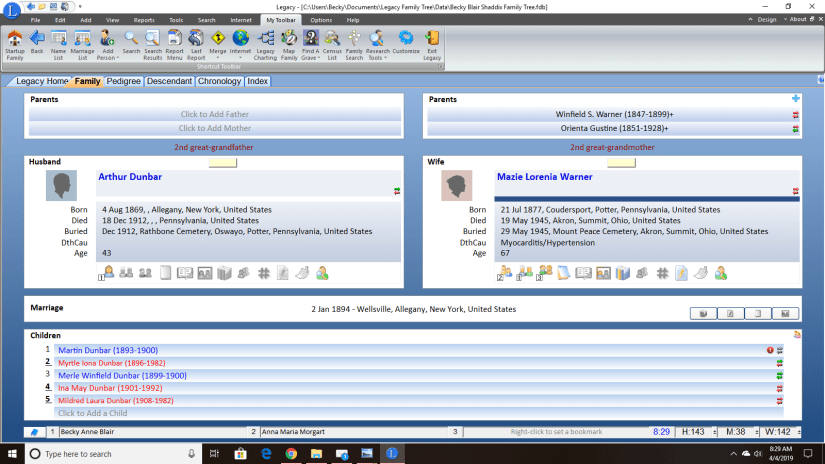
Another advantage of computers is having personal software that will track your family with both pedigree charts, family group charts, and give you statistics within moments of your inquiry. No matter who you choose to use: Family Treemaker, Legacy Family Tree, or Rootsmagic, (or any of the many others, but I believe those are the big 3) it’s nice to have your own copy of your tree and not just one tied to Ancestry or MyHeritage (which have private trees) or FamilySearch (which is just the 1 big tree that millions of people can change at any minute). Each has their perks, with Family Treemaker and Rootsmagic both syncing with Ancestry so that makes it nice if you use Ancestry on a regular basis.
I chose to get my software as someone on FamilySearch placed someone in my tree that didn’t belong and it was a year or more before I realized that I could change it. I asked the lady who plopped Andrew Sloan Blair in my area of the tree to remove him, and she did not. But for a year he looked at me from my home page (it was a huge picture that stared at me every day).
The lasting perk of my software was that it was my last birthday present from my Mom. She ended up passing away unexpectedly 3 months later and so every day I use it I think of her (well, she asked me what I wanted and told me to just get it and so I did after reading the reviews about which one was the best at the moment – I think they all trade places each year).
In conjunction with the internet is social media, which is a great way to ask for help with your genealogy or share what you have learned. Each venue of social media offers a different way of appealing to your fellow family historians that go from learning tools, to asking questions, to sharing your finds.
I am so incredibly grateful for the number of educational videos that are out there on YouTube for the average person to once again view from their computers, or tablets, or heck, televisions that allow us to learn about the who, what, where, why, and how of our ancestors. Between free videos such as Elevenses with Lisa (by Lisa Louise Cooke of Genealogy Gems), the world of New England Research (American Ancestors), this year’s RootsTech Connect that has been letting us watching videos for free all year (you just need a FamilySearch login to view, which is also free!). I know I am missing so many – and the genealogy giants: Ancestry, FamilySearch, Find My Past, and MyHeritage (typed in alphabetical order), all have video tutorials and such as well.
I know a few of my podcasts I listen to also have YouTube alternatives if you would rather view the talk instead of listening on your phone or tablet.
Another nice option of YouTube is you can go to the subscription tab on the menu and follow along with all the latest uploads of videos from your favorite people or groups.
I am thankful for Facebook Groups where you can ask a question and get responses from warm, caring people. I have done this several times and do my best to help others in return (though I will admit I need to do the helping more often than I do, random acts of kindness can truly help someone break down that brick wall).
If you want to find genealogy groups on Facebook, just search “genealogy” and then narrow down your selections by groups, I am sure you will find one that fits your tastes. You can find general groups, DNA groups (and I’ll state this here, only ask DNA questions in a DNA group because your general groups might delete or close the question and tell you to go to a DNA group).
You can also join groups for a specific area of the country or world that your ancestors are from. My favorite group is one based on Old Bedford County Pennsylvania where I have gotten some great assistance and advice on where to find things on my people (and what’s nice is it lends itself to all surrounding counties that were once a part of “Mother Bedford”).
You do need a Facebook account to participate, but it’s free, and if you just want to create a profile for user groups, you don’t have to friend others and post anything about yourself (well, other than what you might type about yourself or your family history in a genealogy group).
Twitter is another great arena for genealogists. I have met so many inspiring bloggers who share their expertise as I attempt to do. Again, just like those in group forums on Facebook, family historians sharing their finds through tweets are again so helpful. There is an entire community that meets up on Tuesdays for #AncestryHour, sadly it’s based in England so I am always working as their 7pm meet time is 2pm my time. One day I’ll be able to participate. (If you are ever interested you can search #ancestryhour and all the posts will show up, not sure if it will be in the correct order though).
Again, you do need a Twitter account to participate and you will have to post in order to get something out of the experience but it’s not as personal as Facebook. Also, tweets (your post on Twitter) can only be about 180 characters, but you can always add message 1 of however many you think you will need. Infographics, meme’s, or photos are not counted as part of your words so that can help get your message across in 1 post as well.

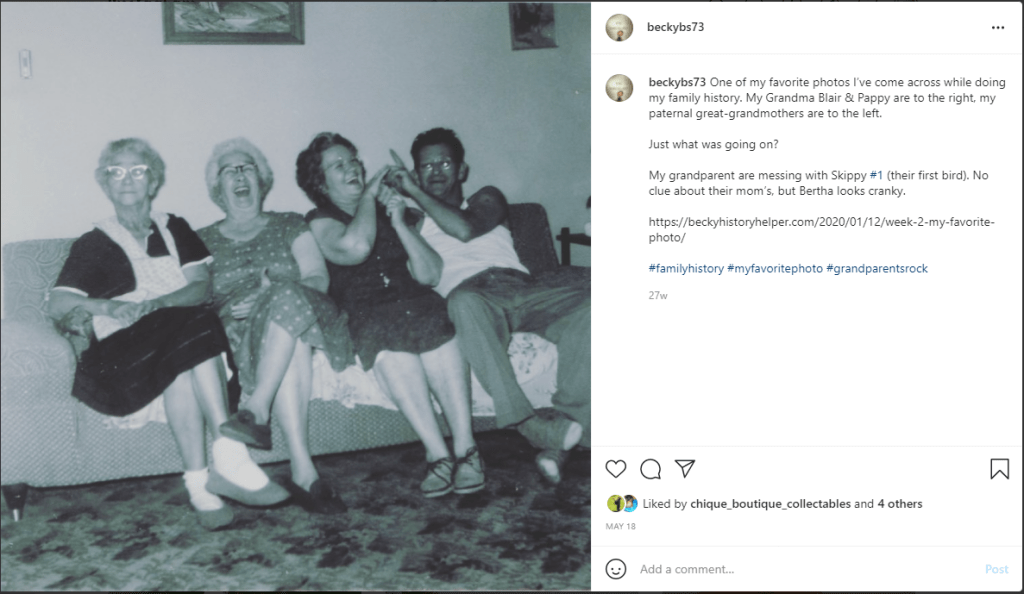
If you love pictures then Instagram is for you. Instagram is a visual social media platform that doesn’t restrict you in characters but allows you to share a photo and link to your blog to share your family history.
I have been a subscriber of Family Tree Webinars since 2018. It is a wonderful resource that has top notch genealogists providing programs via a PowerPoint presentation (or something similar) where they give you all kinds of great information on a specific topic. Most webinars are an hour in length and will often have a q & a segment at the end where the presenter answers questions asked by the moderator (which they get the questions from the live viewers in a chat).
Topics can include the introductory programs on how to start doing your family tree, to busting down brick walls, to teaching someone how to find information in Eastern Europe, to how to use Excel spreadsheets in your genealogy research, to what is autosomal DNA (and a 1000 more webinars that will pique your interest).
They do provide a webinar that is free for a week for everyone to view, however being a member gives you access to the syllabus that goes along with each presentation. You can purchase a subscription with a discounted rate, but renewing at such is no longer an option. Though I enjoyed getting the discount every year, I can admit it is still worth the $50 fee to join (which is why I’m guessing that they took the discount away).
Last, but not least, are the subscription sites that you can sign up for in order to create a tree and obtain documents of your people. Alphabetically here are a few I have used: American Ancestors, Ancestry, GenealogyBank, FamilySearch, Find My Past, Fold3, Heritage Quest, MyHeritage, Newspapers.com, and Newspaper Archives, just to name a few (I know there are many more out there, but these are even the ones that are touched on my local library, which has a lot of great information about genealogy and local history).
These subscription sites (you must sign up for all of them, but FamilySearch is free) are so incredibly helpful for finding information about your family. Most have library editions so even if you unable to afford all the subscriptions you can use them for free at your library (some are letting you use the library editions for free from your home since Covid-19 has been a part of our lives, you normally need a library card, definitely worth checking into).
Along with subscription sites, there are great websites you can use to help you with your genealogy.
Some county government websites will have links or emails that you can send an inquiry right to the department where you seek your information that can aid in your finding documents about your ancestors. Sometimes you can even access the records yourself by paying a small fee for the time you spend online (just make quick haste in downloading your documents, just look later).
City websites often have a history of the town on the website which may give key background information about the time when your ancestor lived there.
There are a ton of blogs out there that can provide help with your genealogy. Everyone has a different take on how they word things, and sometimes you just come across someone that explains a technique just the right way and it clicks (a great example of this for me is Amy Johnson Crow, the founder for the 52 Ancestors in 52 Weeks, she has a WANDER Method for working on genealogical problems and is more or less a simplified version of the Genealogical Proof Standard).
Another great website to help you in Cyndi’s List, which is a wonderful source of links to whatever it is you are looking for in your genealogical search. I know I need to use it more often.
It is great that technology can allow you to find so much information while you are dressed in your pajamas into the wee hours of the morning but one must remember that you don’t have access to everything, and that there is so much that you need to go find in person where your people lived.
Every day more and more records are digitized and put online but there is still so much more that is out there, just waiting for you to find it, and knock all those walls down.
Being on a break from researching the past few weeks, when I finally looked to see what the theme for week 44 for 52 Ancestors in 52 Weeks was I shouldn’t have been surprised it was voting (as it was election week).

And I’ll confess, I’ve never looked into finding my ancestor’s voting records, so this week’s post gave me the opportunity to do just that.
Rather than make life difficult I did what came naturally, I Googled it and the first link I clicked on was the FamilySearch Wiki and “United States Voting Records“.
I had an idea in mind which was to see if my great-great-grandmother, Mazie Warner, ever voted as she would have been a 40-year-old woman when women were given the right to vote in the state of Ohio in 1917.
However, it didn’t take me long to realize that FamilySearch did not have the voting records of Summit County. Or Pennsylvania. Or Massachusetts (all the main states where I know I have ancestors, as I quickly broadened my search when I wasn’t finding the records for Summit County).
My next step was doing a search on Google for Summit County, Ohio voting records. This led me to the Summit County Board of Elections website and I began reading what their policy was on public records and voting as it appeared I could contact them for information (so much for this becoming a blog post I could do on the fly). My first question was how far back their records go, if they did not have the voting records of 100 years ago (I’m still focused on Mazie for this exercise) then they would not be able to help me.
After reading through their 14-page document I discovered it does not include how far back one can go to research the voting records. So I opted to inquire to them about what years they have. Luckily I didn’t have to wait long, I emailed them in the morning and by 5pm I had an answer – their records only go back to 2011.
So, I found myself starting over.
I tried to find other ways to find voter records in genealogical research. The first article I read was from Family Tree Magazine with “How to Trace Your Ancestors in Voter Records” by Diane Haddad where it explained that voter records were good resources to follow where your ancestor lived, the key was finding county lists of registered voters or discovering who paid poll taxes.
I lucked out as the author specifically highlighted Ohio, which listed years that I wasn’t needing right now, 1803-1911, but detailed that “Ohio counted men age 21 and older in various counties to determine voting districts” and can be located on Family History Library microfilm and in local genealogical society collections.
The next website I checked out was new to me entitled The Ancestor Hunt, their article explained why it’s important to find your people in voter records: helps with the gaps between censuses, naturalization, middle names, you can find a spouse, nativity, physical characteristics, political party/affiliation, and migration (I just re-stated their headlines).
They also have a link for each state for free online voter records. So naturally I selected Ohio, not every county had their records online, and once again Summit County was missing.
Sigh.
Next came a link that led to an entire section of Ohio history research using Ancestry.com. But again, these records led to city directories, and oddly enough, files related to Florida (yes, that’s me you hear scratching my head).
Next up was the Family History Daily website who had a blog entry “Voting Created Some Fascinating Genealogy Records! Here’s Where to Find Them“. This article title has me elated. It provided a nice synopsis of voting registers and how they are found alphabetically. It also noted that these records are often available after the mid-1800s, with better luck to be had in the 1900’s and these records are very limited, or not included due to many groups of people being excluded from voting.
But the most important tidbit this article offered was that these records cannot be found online for free. (This explains why I have never stumbled upon these records).
Thank you Family History Daily.
So now where can I search in Summit County to find my ancestors voting records (I am more or less curious to see which of my relatives took their civil duty seriously? I do my best to be a good citizen and get out and vote each year.
Since I have not found anything online and have not had any luck at the Summit County Board of Elections, my next place to look is the Summit County Historical Society. Many of their documents are located at the Akron-Summit County Library in the Special Collections Division. So I will see if I can find anything there first.
By looking through the local history section of the Special Collections page, I found an Archival Collection page that has the collections of the Summit County Historical Society.
My first search I I used the keyword “vote” which gave me 46 results, most being articles on specific levies and whether they passed or failed and by how much.
One headline that made me smile was “Akron Public Library Booms During Depression: More Persons Registered for Books Than Are Eligible to Vote Here”.
Other headlines were for businesses and board votes and mergers between companies. But nothing for voter registrations.
An even bigger sigh.
I continued to look through records that were listed in pdf form that stated what files the library had on microfilm to see if voter registrations were there. Despite them having birth, estate, and other records, there were no voting records amongst the files.
I then turned to the Summit County, Ohio website to see if any files were there. If so I was looking in the wrong place. What gave me the idea was that the naturalization records are there with the Clerk of Courts section. I get that the voter registrations aren’t online, but I had hoped that one of these places would have it mentioned if they have these records within their facilities.
I will have to pick this up at another time. I may find the voter registrations by next November when this is the topic once again. I will continue to research this topic as I am very curious if any of my female relatives voted in the 1920 elections when they earned the right to vote with the 19th Amendment.
Having one-word prompts for 52 Ancestors in 52 Weeks is proving to be quite challenging for me. I know in some ways it gives the writer a little more “scope for the imagination” but sometimes it’s too broad. So much so it takes me to the next week to figure out what to say. And I even went on a 2-mile hike and constantly mulled over what I could write about… and then it hit me, I have changed as a family historian.
When I began this journey 5 years ago, I was a “plop the name in the search box and see what information came up” type. I felt a little advanced from the get-go as I broadened my searches with initials, seldom using cities to find what I was looking for and using states instead, and using both maiden and married names when looking for my female ancestors. But now I know that’s just common sense.
It did not take me long to begin saving copies of the documents I found and setting up an online folder system that works for me and I know where everything is.

Then I began taking classes, first at my local library over topics such as immigration, how to use Ancestry or Fold3, how to use historical newspapers, and how to identify photographs (just to name a few).
But then I went to my first Family History Day at my local Family History Center that my dad saw advertised in our local newspaper. An entire day of classes on various topics dealing with genealogy? I had no idea such bliss existed. And it was free!!!
My world changed that day. I discovered lecturers that I could listen to all day. They are the hands on type of speakers showing how to do case studies in a step by step manner. Or they give you an abundance of ways to search for records and where to search for records that you end up going home and discovering that you yourself are implementing what you have learned on a daily basis.
I then found myself joining my local, state and national genealogical societies to continue to learn. The Spring of 2019 I went to my first conference (and attended my second this past Spring as 2020 was cancelled due to Covid). With every class I learn a little more, and as Peggy Clemens Lauritzen said in her key note speech to open the 2021 Ohio Genealogical Society Conference, you are never the same family historian because each day you learn something that you carry over to the next day.
Now I’ve gone on a research trip to where a bulk of my paternal ancestors lived, 2 conferences, 3 Family History Days, on my 4th year of being a member of Family Tree Webinars all so I can hope to successfully continue finding my people. I also have become pretty good and looking up other online information that has been digitized using the Card Catalog on Ancestry, using image searches on FamilySearch and no one loves those gossip sections that give all sorts of details about your relatives than me in Newspapers.com.
So if you are just beginning your family research, or you have been doing it for decades, every day you change, so continue to bloom!
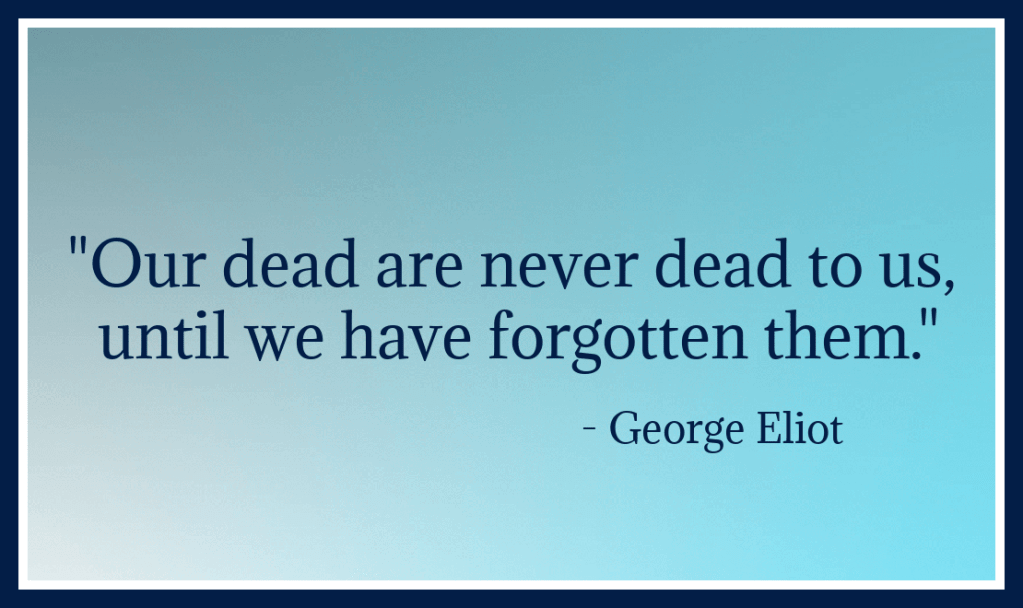
This quote exemplifies why I work on my family tree. I do my best to preserve each and every member of a family in order to have a correct family tree, but most importantly so that each person is remembered. Because for me, it is when a person is forgotten is when they no longer live.
This is my quest as the family historian. I try to find everyone, especially the babies who never had a chance to make much of an impact in the world. All of these people who make up my tree, without them I wouldn’t be here. In some way they all have impacted my life, whether it was someone I knew or someone I learned of doing research. All of them deserve to be remembered.
Preservation was the theme for this week’s 52 Ancestors in 52 Weeks, a weekly writing challenge offered by Amy Johnson Crow.
October is one of the greatest months of the year because it means we all have an excuse to work on our genealogy!
Not that we ever have to have a reason to continue to work on our family trees, but it is a month filled with educational webinar’s, podcasts, and articles that will further our knowledge to find our ancestors.
So I hope you are all able to enjoy the month and get the most out of all the opportunities that are out there. May you break down your brick wall and move on to new ones!
I literally went through a list of my ancestors names to determine my “favorite name”. It was tough but like most everything else, she popped out and despite my looking at other names that caught my eye (one was a first cousin twice removed, Chester Charles Childers because who doesn’t like a good cha-cha-cha) I couldn’t stop thinking of a name I saw before his, and that is Thankful Chapin, my fifth-great-grandmother.
Or is she?
I think she is though many do not have her listed as my fourth-great-grandfather’s mother. He was born in 1809, she died in 1812, seems like he should fall into her realm. But who knows? But here is what I do know about Thankful Chapin Warner.
Thankful Chapin was born 11 November 1774 in Bernardston, Franklin, Massachusetts to Lt. Joel Chapin (he fought in the French & Indian War and the Revolutionary War) and Sarah Burke, the sixth of seven children born to this couple. Her siblings names are Joel Chapin, Jr., Eddy Burke Chapin, Israel Chapin, Solomon Chapin, Sarah Chapin, and Oliver. Depending on the book you read it claims she had another sister, Gratia, who was also married to Joel, but this book seems to be the only book I can find that lists her.
On 27 April 1799 she married Joel Warner and in their almost 13 years of marriage, they had three children: Sarah Burke Warner born 8 February 1800; Anson Warner born 27 November 1805; and lastly Oliver Charles Warner who was born in 1809. She died on 3 April 1812 and is buried with many other Chapin’s in Old Cemetery, Bernardston, Franklin, Massachusetts.
I have never been able to find a whole lot of information on Thankful, and honestly nothing concrete if she is really Oliver’s mother (though since her younger brother was an Oliver, it really helps to think that she may be).
So over the course of the next few months, as I discuss research logs I plan on using Thankful as my example, to prove that she is the mother of Oliver Charles Warner.
I chose Thankful Chapin as my favorite name as it always brings a smile to my face. We all have so much to be thankful for and to have a direct line ancestor named such, and you wonder why her parents, my sixth-great-grandparents, would name their daughter such a name. Did they have a reason to be extra grateful at that time? 1774 had the British Colonial America gearing up for a war with Great Britain, Massachusetts especially. Did they have a good crop that changed their world? So many things go through my mind.
Do you have an ancestor whose name is your favorite? Feel free to share!
This is my 100th post on my blog. I was surprised a few weeks ago when I saw I was at 95 posts and couldn’t believe I was reaching a milestone (or at least it is for tv shows).
The one thing I have not done is add more book reviews and actual history tidbits – I actually named my blog “becky history helper” for a reason – because I wanted to bring history to life. I was fortunate to have fun history teachers that made learning fun and I hope to do the same going forward with my blog.
In the meantime I will re-start posts on the important things you should do when completing your family history (if nothing else as a reminder to me) as well as continuing Amy Johnson Crow’s writing challenge of 52 Ancestors in 52 Weeks.
Thank you for reading and subscribing to my blog and I hope to share more knowledge and make it even more exciting in the future.

 Helping History Come Alive