12 Ancestors in 12 Months, My Family Tree, Paternal Side

Month #8: Helper

Today I am going to share with you my helper in my genealogy search. She was my first cousin once removed who I only think I ever met in person once when I was in second grade and long before I ever became enchanted with my family history. At that time, I was a girl who loved the Muppets and I showed her a really cool science experiment (that I sometimes still do to this day to be honest). In November 1980 when I had my tonsils taken out Darlene Reese Prosser got me “The Muppet Book” for me to peruse while recuperating. I did and then some. I’m fairly certain that book is up in my attic struggling to keep it together as the binding came completely apart. But I loved that book as it had so many of my favorite sketches in type and colored photos for me to remember (I was always fond of Veterinarians Hospital and Pigs in Space).

But it was Darlene I turned to when I was in college and began a slight interest in working on my family history. She had sent me copies of family group sheets she had on our shared ancestors of the Blair’s to help me get started. I held onto that envelope of merchandise and scanned them into my own records that I have a few years ago (she also sent me a hat of my dad’s she had taken and finally returned to him, it’s still in the same envelope, she apparently took said hat when they were kids. Darlene was 5 years older than my dad and they were both born in Gary, Indiana.

It was also Darlene I have turned to off and on from 2016-2020 while I became obsessed with researching my family tree. She had begun working on our tree back in the 1980’s when everything was done with letters or in person, talking to her was always the perfect food for thought for my own research as we would discuss people and it would really click sometimes and send me on a new adventure of trying to find Andrew and Suzanna (yes, she was stuck there, too). When her daughter sent me the gedcom of Darlene’s research I was so excited and was amazed we had almost all the same information at least people-wise.

But today I am going to share with you the story of what I know of Darlene Reese Prosser, my genealogy helper, who I wish was still here to guide me.

Darlene Reese

Darlene Reese was born 9 May 1937 at St. Mary’s Mercy Hospital in Gary, Lake, Indiana to Charles Randall Reese and Vada Blair (Vada was the oldest sister of my grandfather, Leroy Blair) at 2:07 am.
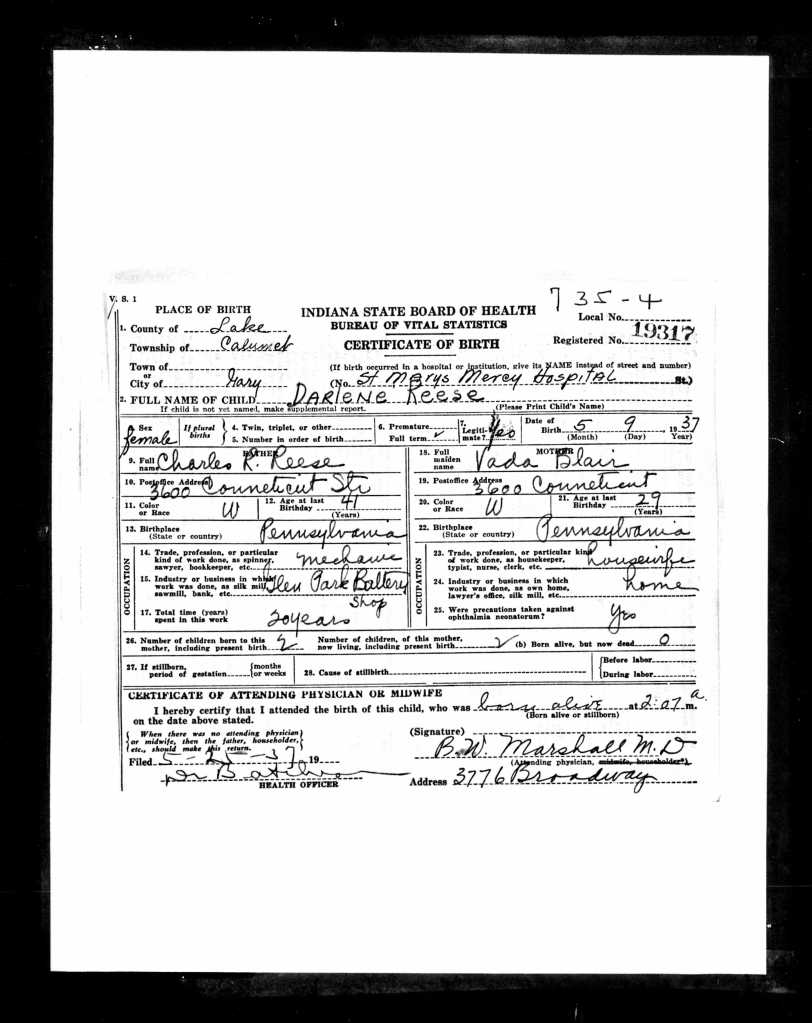
Copy of Darlene Reese’s birth certificate found on Ancestry.com

Darlene was the youngest child of her parents, following the birth of her older brother, Charles Blair Reese (more commonly known as Buddy) in 1929.

As my Grandma’s caption states, Darlene (baby) and her older brother, Buddy in 1937 (from the personal collection of Anna Maria Morgart Blair)

In the 1940 census, the Reese family was still living in Gary, Indiana where Charles was a mechanic and Vada a housewife.
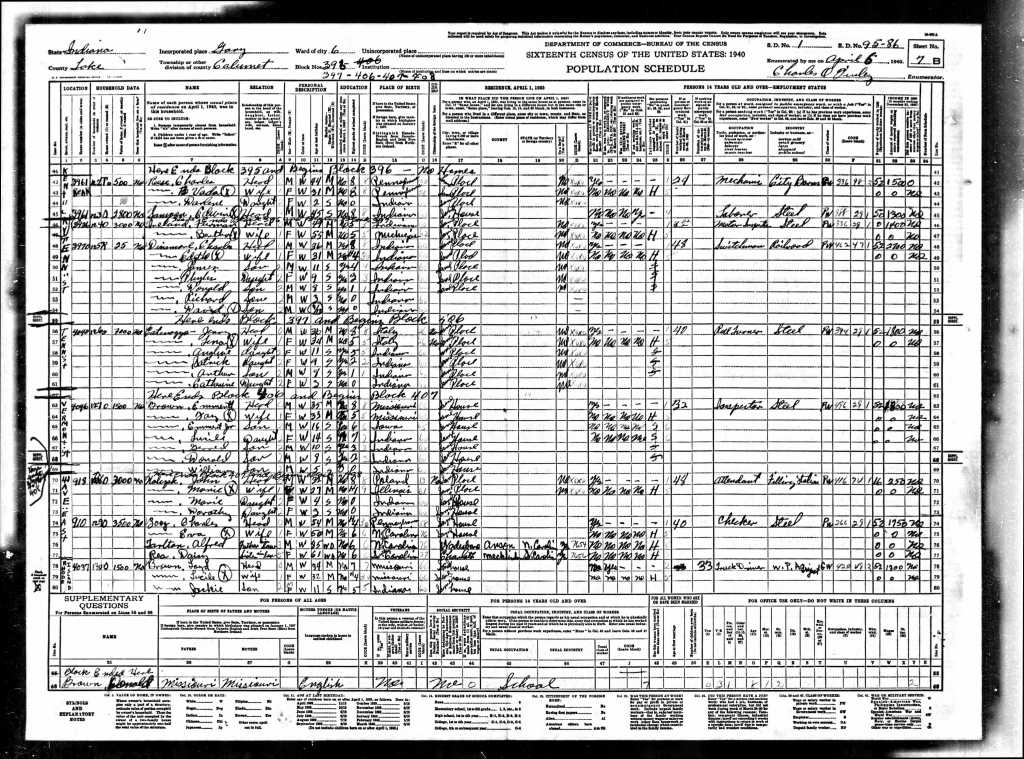
Copy of the 1940 Census found at Ancestry.com, they are the first family listed at the top of the page
Darlene Reese with her dad, Charles Reese. Photo from the Anna Maria Morgart Blair private collection

I find it interesting that one of the photos my Grandma had of Darlene was from 1943 and I liked it so much that I put it in the header of my blog. I think she is so cute and just stands out amongst all the faces in my collage.

Darlene Reese in 1943 from the photo collection of Anna Maria Morgart Blair

At some point in time between 1940 and 1950, Charles, Vada, and Darlene moved to Arizona where they ran a hotel on Buckeye Road in Phoenix. I asked Darlene’s daughter if she knew why they left Indiana and moved to Arizona and her reply was “Charles got disgusted with it raining for X days straight in Indiana and decided to move west. They intended to go to California but stopped in Phoenix and stayed. Maybe he figured it would never rain in a desert as opposed to living on the West coast”.

Her daughter also elaborated, “They gave her (Darlene) total freedom to be a kid. This included riding the bus alone to go downtown to movie theaters when she was young. She’d sit behind the driver, so no weirdo would bother her. If they followed her, she’d cross the street. If they were in the theater she’d move. I swear she must have had a guardian angel”.
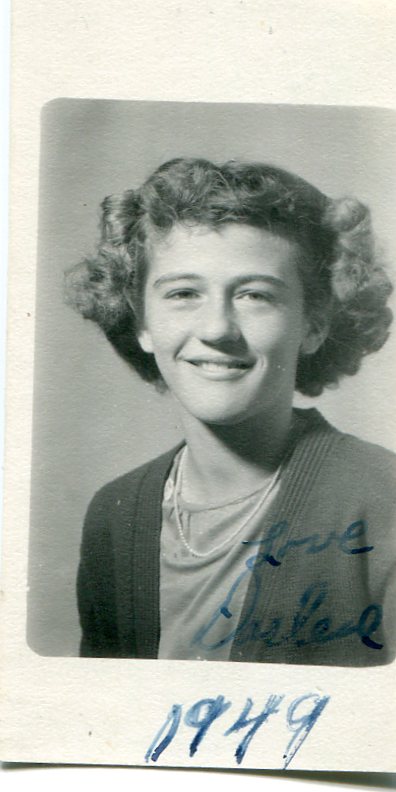
From the Anna Maria Morgart Blair photo collection

More from her daughter: “Throughout her life, she got her way most of the time. She’d done exactly as she wished as a child, and she carried on doing exactly that until the end of her life. She also tried to make sure those she loved also got their way.

She was endlessly loving, but she also had a temper – and she let you know when you made her mad. She had no problem putting the words together to say exactly what you’d done wrong, what she thought of it, and why you should never so much as think about doing it again in the future”.
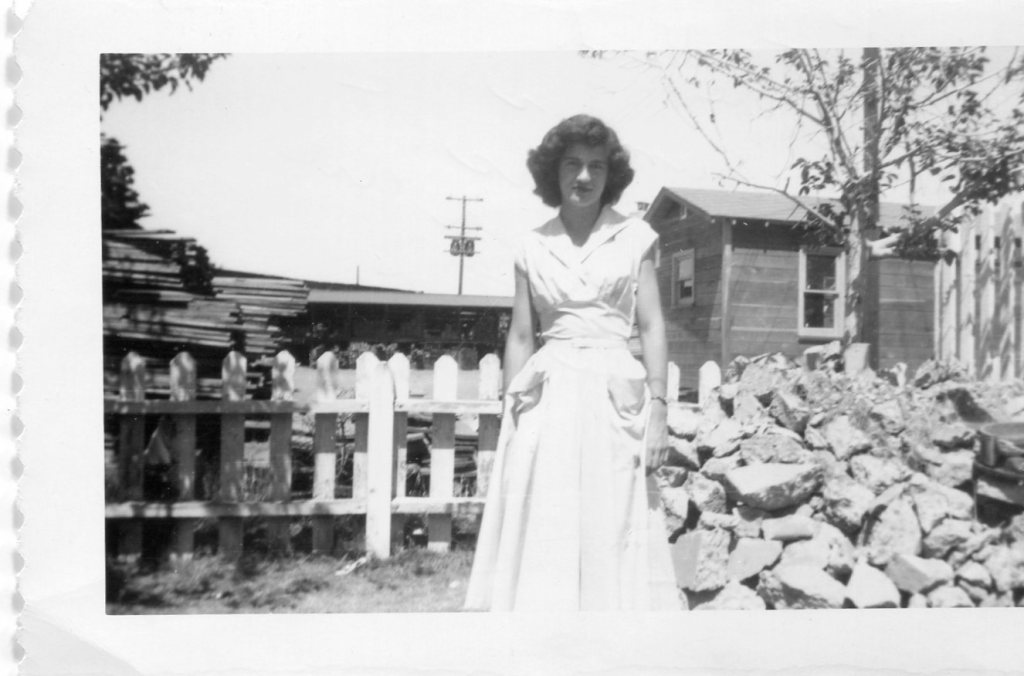
Darlene Reese circa 1953 (from the Anna Maria Morgart Blair photo collection)

Meeting Robert Lee Prosser

One of the specific questions I’d asked her daughter was how her parents met, as Darlene got married to Robert Lee Prosser on 18 March 1956. “My parents both went to West High in Phoenix. He was a senior when she was a freshman, and she knew of him only because: 1) he played drums for the band at the school dances; 2) he was cute. The year after he graduated, he broke up with his girlfriend (a redhead, as my mother liked to point out) and then asked a mutual friend if he know of any “petite girls”. The friend thought of my mother because she was 5’2″ and maybe weighed 100 pounds.

The friend introduced the graduate to the sophomore, and that was that. They dated until she graduated and for months after that. My father spent a lot of time at my mother’s house, sleeping on their sofa, until my grandfather told her to marry the guy because he wanted his sofa back”.

Darlene’s daughter was not sure when they got engaged, “but I think it was after she’d graduated. She often went to Pennsylvania to her cousins in the summers. She told me she didn’t want to come back the last year she went because she knew she’d get married.

They never set a date for the wedding, Mom was still living at home and Dad at his mother’s when they were out on a double date one evening, and the other couple asked when Bob and Darlene were getting married. No time like the present? So, Mom went home to get a dress and told her mother she was getting married. My grandmother didn’t believe her. They went to a justice of the peace (no idea how they reached him that night) and were married by him. I don’t know whether it was at his home or at a city hall. Don’t know where they went afterward.

They rented an apartment but a few weeks later Dad got drafted into the army. Spent 2 years away, most of it stationed in France. Mom said they likely would have gotten a divorce if he hadn’t been drafted because she wasn’t mature enough to be married. She moved back home and could have gone to France with him after his basic training was done but she refused. She got a job at AT&T tracking payments/accounting and said she spent her salary on phone calls from France.”
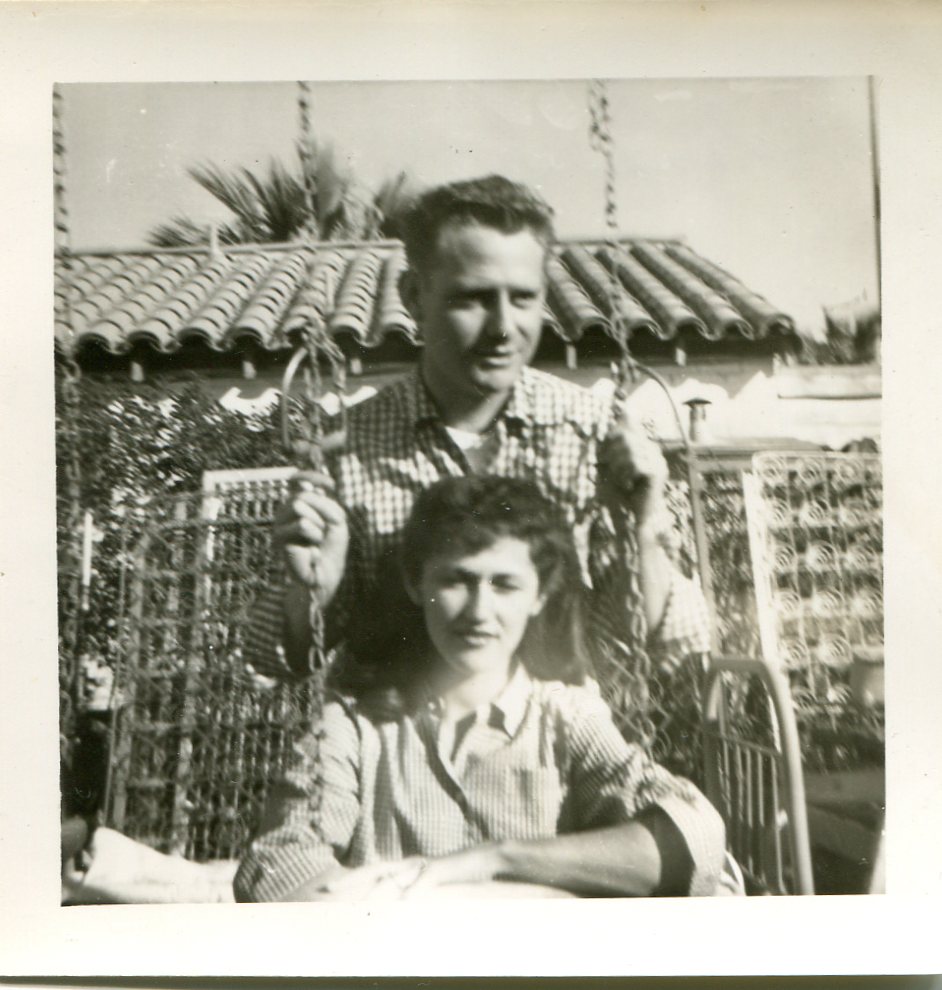
Robert Prosser & Darlene Reese around Christmas 1957-58 (from Anna Maria Morgart Blair photo collection

And Baby Makes 3

“From the time she was a teenager, she wanted a daughter, and she wanted to name her what she named me. When she was expecting me, her doctor told her she was having a boy (no idea how he knew). She cried for days.” Their daughter was born in December 1959.

I came on schedule, and she had me on a rainy Monday (rare for Phoenix) at 4:58 am.
She didn’t have labor pains until the final stage – go figure. She walked the hospital
corridors out of impatience, to move things along. Which likely didn’t work.

Dad couldn’t deny I was his: I had a cowlick in the same place and looked like he had as a baby. Mom had thick black hair. Dad had curly auburn hair. So did I when I was born. Then it fell out and came in blond. She never held it against me. She just made me grow it long and loved playing with it when I was a child and permed it for me when I was a teenager because it was dead straight.
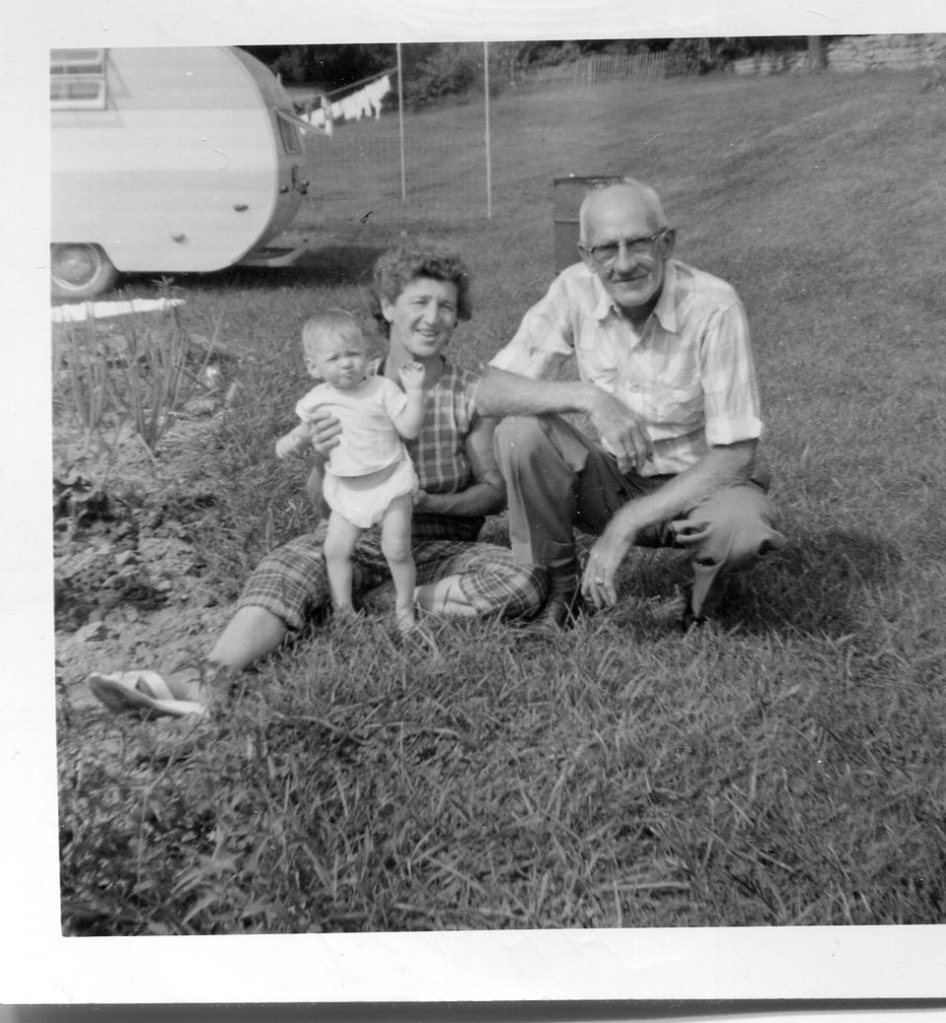
Vada Blair, Charles Reese, and their granddaughter September 1960 (from the photo collection of Anna Maria Morgart Blair)

Her Daughter’s Memories

I was fortunate enough to get 7 pages of memories from Darlene’s daughter with stories about her mother. I’m including everything for the simple fact that I enjoyed each and every word.

“I gave her a strawberry cake once, and she told me her mother nicknamed her Strawberry because she looked like one when she was born.

She always had a short-haired black cat while I was growing up because she loved them, though she loved all cats, black was the one that most fascinated her. Dad and she had a running joke that she was a witch because of this. She collected black cats throughout her life – knick-knacks, elegant Egyptian-like statues that book-ended our living room window, pictures, books. People would give them to her, and she’d prowl thrift stores for them.

She loved second-hand stores, junk stores, as she called them. Goodwill, Salvation Army, St Vincent de Paul’s, any used store. Their prices were terribly cheap in those years, and she bought a lot of clothing, books, decorative items for every room, Christmas and birthday presents for everyone. She traveled a lot for years with my Dad (who sold John Deere industrial machinery, and whose territory was all of Arizona north of Phoenix) and always had to check out those stores.

We all had a lot of used clothes. Her reasoning was once a new piece of clothing was washed, it was used, so no shame in wearing used.

She sewed a lot of clothes for me while I was in high school. My inseam is 33”, so it was impossible to buy pants long enough for me, so she’d make them. Occasionally she’d find used pants that were long enough or buy men’s Levis on sale from western-wear stores, then take in the waist.

I grew up in the 70s, when maxi-dresses were popular, and wore them to church and
dances. She’d take me to a fabric store and have me choose wedding-dress patterns I
liked. She’d then have me choose the fabric and would make me a dress.

She let me be a kid because she’d gotten to be a kid. She was having me hang my Christmas stocking at the fireplace, and giving me Easter baskets, well into my 20s. I didn’t say a word; I knew I had it good.

There was a bath every Saturday night. Afterward, she’d roll up my wet hair on fat pink rubber rollers and make me sleep in them so I’d have curled hair for church. Dressed me in pretty dresses with scratchy net slips, and colored leotards that never fit right because my legs were too long. Put me in a red coat, patent-leather shoes, scratchy hats, and made me carry a muff! One of her favorite child movie stars was Margaret O’Brien. I wasn’t a Shirley Temple, so I think Mom turned to Margaret for inspiration.

She never forgot anything that happened, or anything someone told her. Woe betide you if you lied; she couldn’t stand being lied to or being betrayed. The flip side to this was that if she knew you liked something – a book, a movie, a performer, whatever the thing was – she’d keep an eye out for it/them in her travels and get it for you. All you had to do was mention it, and at Christmas or birthday or out of the blue, she’d present it to you. She loved hunting for treasures that way, and she always thought of others – that they’d like, what would make them happy.

Throughout her life, she got her way most of the time. She’d done exactly as she wished as a child, and she carried on doing exactly that until the end of her life. She also tried to make sure those she loved also got their way.

She was endlessly loving, but she also had a temper – and she let you know when you made her mad. She had no problem putting the words together to say exactly what you’d done wrong, what she thought of it, and why you should never so much as think about doing it again in the future.

When I was four or five, and she was on the phone, I took a bottle of blue India ink out of her secretary and carried it around the corner, into the living room. I then opened it on the coffee table and promptly spilled it on myself…and on the carpet. Not on a rug, on the CARPET. She was furious – not only with me for touching her things, but also for herself for being on the phone. She covered up the stain (no getting that out) with a rug and couldn’t afford to replace the living-room carpet for the next five years or so. She never stopped mentioning to anyone who’d listen how I’d ruined her carpet. She was still mentioning it the year she passed away.

She had used a fountain pen while taking shorthand in high school, and she used the pen while keeping a diary for years – hence the reason she had India ink. When I was 12, she gave me a Sheaffer school fountain pen which took ink cartridges or bottled ink. This started my lifelong interest in fountain pens, so she got her revenge. I also learned my lesson: I’ve never spilled another bottle of ink on any surface (knock wood).

When I was 11, Kurt Weinsinger moved to Flagstaff and went to our church. He was a music professor at Northern Arizona University who also directed our church choir. Through his influence, Mom began singing the opera / musical theatre choir at NAU, and I got to watch. She sang in Carmen, Die Fledermaus, Faust, and Camelot. I fell in love with Camelot / King Arthur, she had the Broadway soundtrack, and I decided I wanted to learn to sing like Julie Andrews. I didn’t tell her. Whenever I was home alone, I snuck-sang with her musical LPs, and told Weinsinger I wanted to sing. The first time she knew of it, I got up in church to do a solo, and she thought, “Where did that come from?” I wasn’t shy, I was introverted, but no one understood that, then. I was also terrified of piano recitals yet had no problem singing in public.

She encouraged me to keep singing. In addition to piano lessons, she supported me to the point I was able to sing in the top high-school choir, madrigals, perform in drama, and make it to regional and state choir. The audition for the state choir took place at West High – which I think was then a community college and no longer a high school. Years later, I also ended up singing with the same musical-theater director she’d had for Camelot and the operas. And Weinsinger gave me voice lessons for years at NAU. So that’s what you get for dragging your kid to The Sound of Music, Camelot, Funny Girl, and the like. She was always too shy to do anything in public, whether it was teaching Sunday School or singing a solo, but she seemed to be proud of what I was doing. No matter what I became interested in, she supported it. Except for wanting a horse. She and Dad didn’t want me getting hurt, so there was never a horse in my life.

When I was ten or so, she decided she wanted to take a trip back east to visit relatives and do genealogical research. This was pre-internet, so any seeking of birth/death certificates, civil records, etc. had to be done in person or through the mail. She and Dad owned a 1965 Chevy truck with a camper shell and foam-rubber mattresses in the back. The plan was for Mom, Grandma, and me to stay in KOAs along the way for this 6000+ round trip. Dad later said he expected her to turn around after 200 miles or so and come back home. Didn’t happen.

Did I mention she could be stubborn? (Before I forget to tell you, her method of dealing with anything she didn’t want to entertain or discuss was to meet your query or comment with silence. She could ignore things into oblivion.)

I spent the trip reading books in the back, and I have sporadic memories of the entire trip. But it does involve memories of your grandparents because it was the first of two times I visited them in Akron and went to the farm. One of the trips was the year a PBS special on Leonardo da Vinci was airing, and it was important to me that I saw it every week we were on the road. Your grandfather was amused I was interested in da Vinci.

I didn’t meet your Dad because he was in the military at the time, but I slept in his bedroom. He had a ticking alarm clock that I put under the bed and covered up because the ticking bothered me.”

She went into more details about my grandfather that I did cut just because this is about her mom, not Pappy. But she did say my Grandma had great pies, and she did.

“I remember my mother was given an antique round table in Pennsylvania on that trip. Into the back of the camper it went, and we climbed over its top and pedestal for the rest of the trip. I also remember visiting an old, old graveyard whose headstones were weathered to the point of being unreadable – at least to me. One had even been taken over by a tree growing next to it. Maybe Mom told you about this trip.

She loved antiques. My grandfather and she would go to auctions, and she’d buy boxes full of piano sheet music for cheap at the last auctions of the day, when most everyone else would have gone home. No one wanted 19th-century furniture in the 50s. Grandpa had a store – mainly a shed and a yard on Buckeye Road – where he’d sell appliances and furniture. (This was after giving up on the motel).
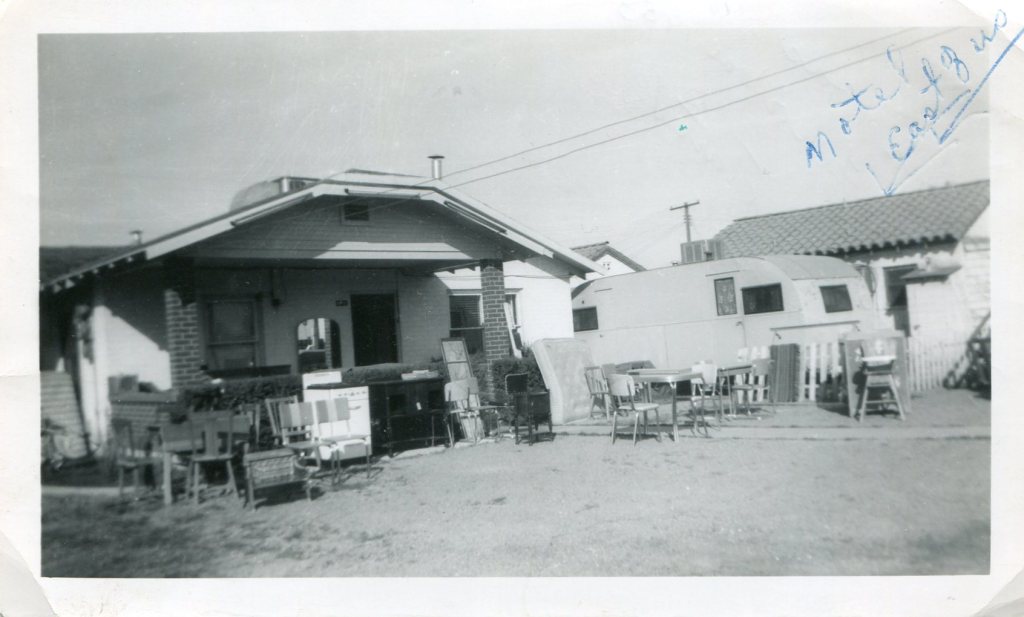
Photo of Vada & Charles home/shop, you can see where the hotel was as well (from the Anna Maria Morgart Blair photo collection)

Mom had her pick of the antiques. Among other things, she chose an upright piano (that was later taken to Flagstaff, and I learned on it), a secretary, a cedar chest, a tapestry featuring Spanish galleons in port, two brass incense burners, and an assortment of big and small tables (but not the kind you eat on).

She didn’t like domestic chores or cooking. She wanted her freedom, to explore her corner of the world and see what there was to see. She loved Christmas and would take far too long traipsing through the woods in search of the perfect tree for Dad to cut… to the point of exasperating him. She’d wander off – not only in the woods (after he’d told her not to), but in Costco as well, leaving my Dad and me to fulfill the shopping list and wait for her in the commissary section. She’d get her own goodies…she did love a good treasure hunt, after all.

She was a beautiful woman, inside and out, who loved with fierce loyalty, compassion, and caring. I couldn’t have asked for a better mother, or Dad for a better wife. He always commented that she took good care of him, and she did it for years. She took good care of her mother and me as well. She didn’t really let others take care of her, except for Dad. He’d get her a box of dark-chocolate nougats every Christmas. She loved those, and black licorice.

Bob Prosser and Darlene Reese 1959 (from Anna Maria Morgart Blair personal photo collection)

I remember taking her to see Ladyhawke. The theatre was empty except for a few other people. Matthew Broderick / Mouse’s lines made her laugh out loud.

She loved Barry Manilow long after he was a pop music icon and inherited the LPs of him that I’d collected in the 70s and lost interest in. She took me to one of his concerts because she liked him, but she also took me to one of Michael Crawford’s in the 90s because I liked him. My best friend loves Kermit / Jim Henson, and Mom got tickets to an exhibition on Henson in Phoenix more than a decade ago… and bought Jim Henson videos for her whenever Mom ran across them. My friend was also into dressage and Arabians and Anglo-Arabian horses, so Mom was always on the lookout for things she’d like.

I hope she’s off in the Afterworld exploring everything and anything that interests her, spending time with Weinsinger and other friends who have moved on. I hope she and Dad are travelling together, and that she’s getting to do all of the things she didn’t have time to do.

I miss hunting treasures in second-hand shops with her and talking with her for hours on the phone. I miss hearing her laugh, and her endless questions about my life. I miss her”.

Her Next Chapter

Darlene passed away on 6 March 2020 after having a fall. For a woman I had only met in person once when I was 7, her death really affected me. Until reading her daughter’s memories I learned I had more in common with her than even family history, I love Barry Manilow, too, and always get lost in stores because I’ll just stop to look at something and not care what whomever I’m with is doing. And I like to think she has met Andrew and Suzanna in the afterworld and is somehow trying to get me to next level up in our family tree. Or at least I can hope she is.

Rest in Peace, Darlene. You were one in a million and are missed.

Genealogy

Genealogy Scavenger Hunt

So last month an advertisement came across my Facebook page for the Genealogy Scavenger Hunt. I had heard about it in the past while listening to Julie Cahill Tarr talk to Denys Allen of PA Ancestors (click here to view the podcast on the PA Ancestors YouTube page).

What Is It?

The Genealogy Scavenger Hunt is a challenge every month where you explore records you may not necessarily use every day in your genealogical pursuits. When I signed up, I was able to get the previous 5 months challenges, so for February you were analyzing documents associated with the enslaved, for March it was a female homesteader, and for August it is coroner’s reports.

Why It’s Awesome!

Why am I enjoying the Scavenger Hunt? Because I’m using records I wouldn’t necessarily use. All of my people have been in Ohio, Pennsylvania, New York, or Massachusetts, I’ve not had any reasons to look up resources for the enslaved. It has been refreshing to get out of my comfort zone (and that is the perfect phrase as I haven’t always been excited about the findings, especially in February’s use of the documents for the enslaved individuals). But searching through the Homesteaders information on the Bureau of Land Management’s site was fun to utilize as well, I’ve not had a whole lot of success on the website with my own ancestors but feel better prepared now whenever I am fortunate enough to get lucky!

The Badge

I’ve yet to get a 100% on everything (though with the August one I apparently mis-read the month of when something happened), I had the date and year correct. Still with each month’s completion you earn a badge.

If you are interested in a great genealogy challenge that will allow you to expand your knowledge of different types of records and actually put them to use for an exercise, go and check out the Genealogy Scavenger Hunt on Julie Cahill Tarr’s website Genealogy in Action.

Please note, Julie Cahill Tarr is not aware of my writing about her challenge, though I am hoping she does not mind. I am simply writing about my own experience about how these challenges are helping me be a better researcher. I am not getting compensated in any way for this review.

12 Ancestors in 12 Months, Maternal Side, My Family Tree

Month #7: Identity

Three years ago, I learned the identity of my great-grandfather, Paul Harrison Geer (or at least who I am pretty sure is my great-grandfather). Today I am going to do the best I can to outline his life as I never got the chance to meet him in the 11 years that our lives overlapped.

Paul Harrison Geer

Paul Harrison Geer was born on 21 September 1905 in Akron, Summit, Ohio. He was born at home to Clyde Ellsworth Geer and Gertrude Van Buskirk.

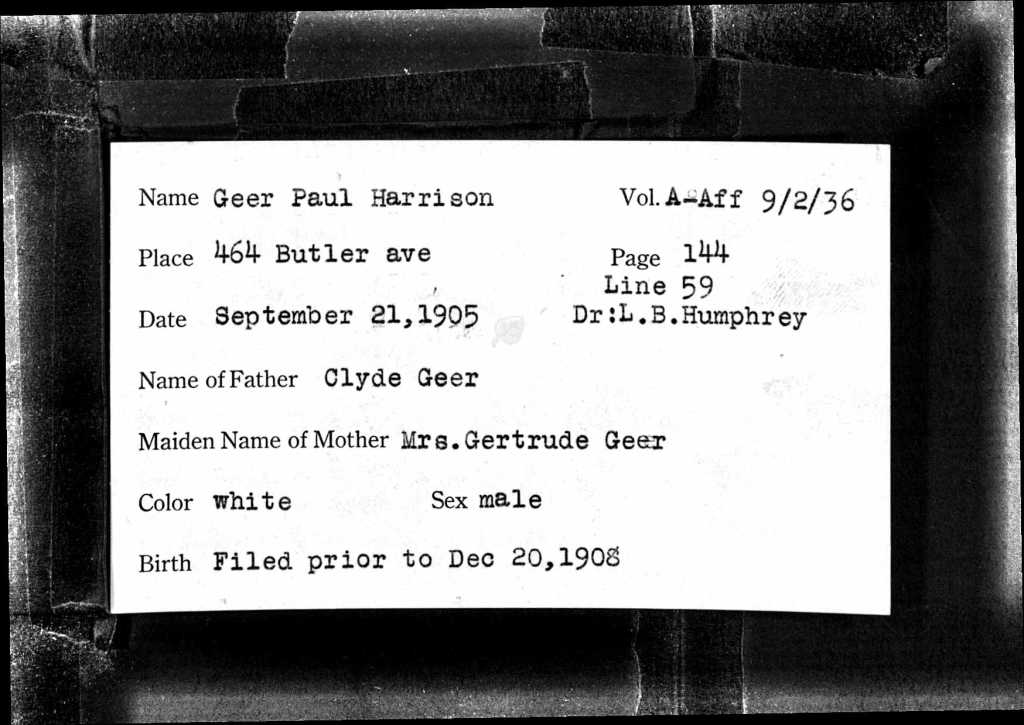
This was found on Ancestry.com in the Birth Card Index for the state of Ohio. Standard birth and death certificates did not begin in Ohio until 1908. Another index lists the home as 102 E York St, which is where the Akron City Directory for 1906 has Clyde and Gertrude living as well. These places were just around the block from each other.

Paul was only 3 years old when his mother died on 26 October 1908 of acute pneumonia. From there he was raised by his maternal grandparents, George Van Buskirk and Lydia Cunningham. Though Paul was not listed in the 1910 census in his grandparents’ home, he is not listed with his dad, Clyde, either. (It appears Clyde lived with his brother, Fred, and his family after Gertrude passed away). Paul’s older brother, George Ellsworth Geer, and his younger sister, Ruth Cloe Geer, were both accounted for on the 1910 census, my guess is that Paul may have just been missed. At this time the Van Buskirk’s lived in Akron at 745 Elma Street (this house no longer stands).

The photo that allowed me to figure out my DNA puzzle, was the headstone of George VanBuskirk, Lydia Cunningham VanBuskirk, Fred VanBuskirk, and Gertrude VanBuskirk Geer. This photo was taken by William A. Davies III and was found on FindAGrave. It was also selecting George VanBuskirk that lived a few blocks from where I presently live to research that helped to point me in the right direction.

Being an adolescent between 1910 and 1920 there is not a paper trail of documents to be found for Paul. In the 1920 census, he is listed as living with his grandparents still. They have moved to Lake Township in Stark County, Ohio, and live on Akron Canton Road.

By the 1925 Akron City Directory, Paul and his siblings began living with his dad, Clyde, and his second wife, Helen (they got married on 23 April 1921) at 71 Rosalind Court in Akron. He was a driver at this time, an occupation he would have later in life as well.

Paul Meets Mildred

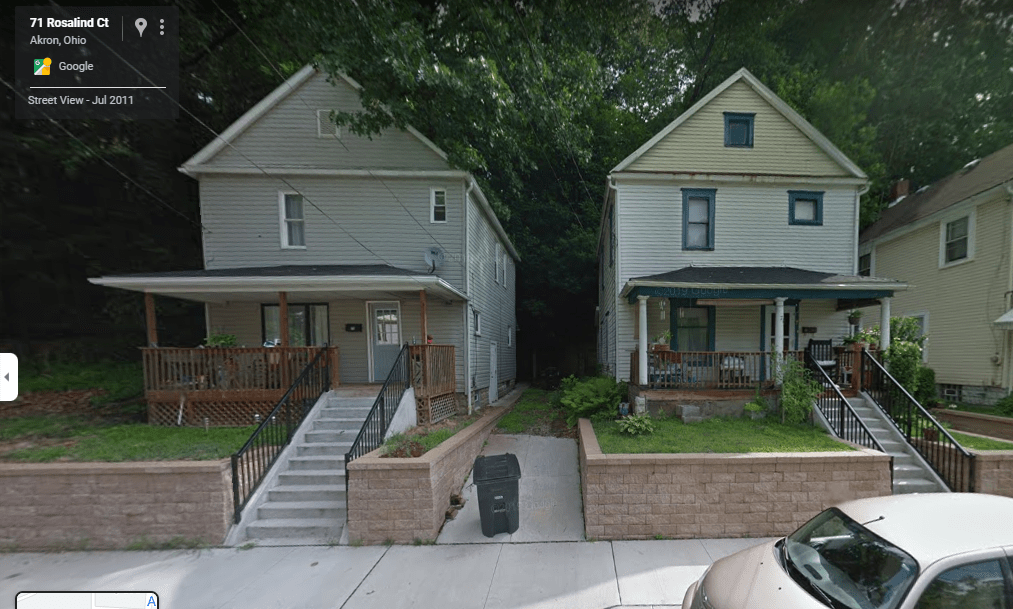
But by living at 71 Rosalind Court I know Paul has now met my great-grandmother, Mildred Laura Dunbar as my 2nd-great-grandmother, Mazie Lorenia Warner, and her second husband, Samuel Randol, had lived at 75 Rosalind Court since moving to Akron in 1916.

This photo was taken from Google maps (as it would be a tad odd to get out of my car on a dead-end street to take photos of these homes, or maybe that’s just me). Both are still standing and according to the Summit County Auditor’s real estate tax website, these were the homes that both families lived in. 75 Rosalind is on the left, and 71 Rosalind is on the right.

I am not certain how long Paul and Mildred knew each other as it may have been prior to 1924 when Clyde and Helen are known to have moved into 71 Rosalind Court. I believe that Clyde Geer worked at Swinehart Rubber Company for an overlapping year with Samuel Randol, Mildred’s stepfather. I think the two men may have become friends, which may explain Clyde moving next door to the Randol/Dunbar household.

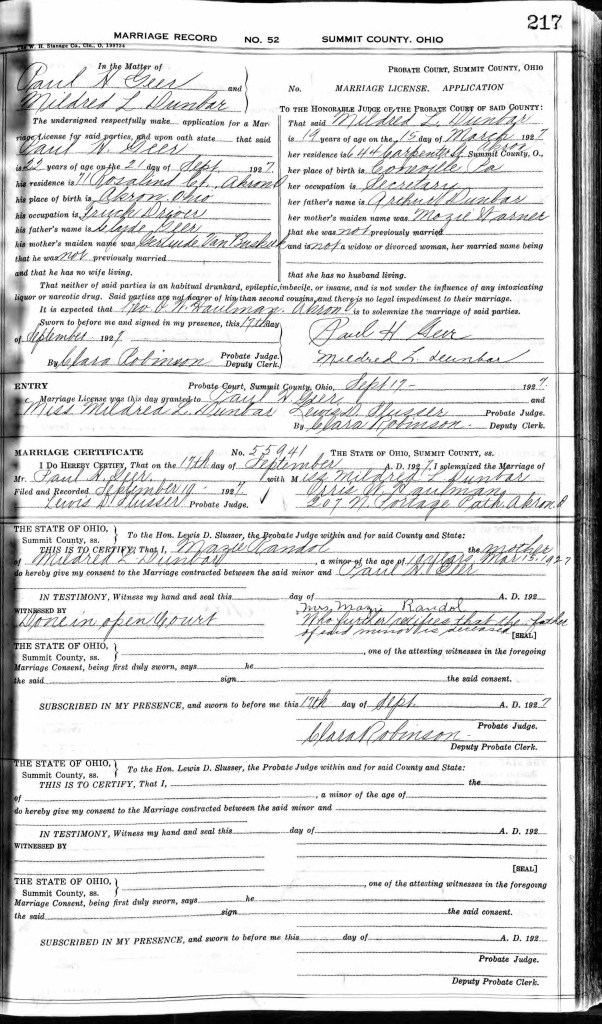
But even if it was by just sheer coincidence, Paul and Mildred became neighbors in 1924, and with my great-grandmother being sweet sixteen, I imagine that Paul was her first love. Fast forward a few years to 17 September 1927 and the happy couple gets married by Reverend Orris W. Haulman (a popular local minister) at the Grace Reformed Church when it was still located at 207 North Portage Path.

Found a copy of Paul Harrison Geer’s and Mildred Laura Dunbar’s marriage license using FamilySearch

After they married the Geers settled at the Randol’s former residence of 75 Rosalind Court (with Mazie and Samuel moving to 622 Carpenter Street, not far away). Their happiness was short-lived as Mildred filed for divorce on 15 January 1929.

Before I took my DNA test which is how I learned Paul was most likely my biological great-grandfather, I thought him to be this horrible person, that my great-grandmother was lucky to be rid of him. Now I hope my great-grandmother exaggerated as she just didn’t want to be married to him anymore. On the chance that what she stated was true, well, I like to think that Paul changed for the better over the years, and maybe he was just young and stupid.

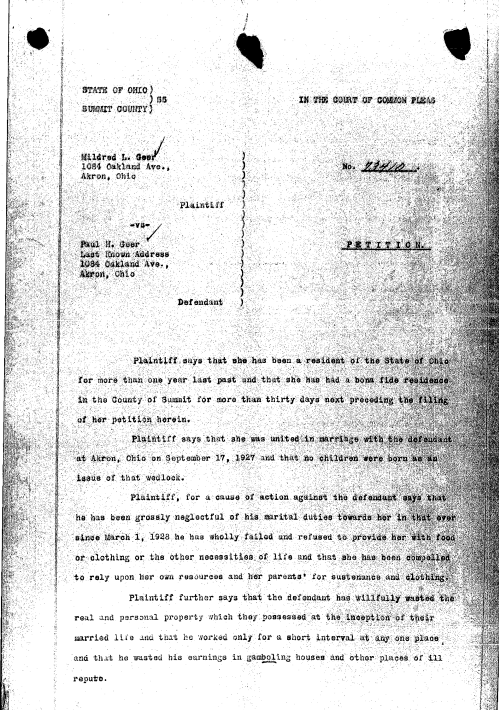
Mildred’s reasons for her divorce are as follows (the below is quoted directly from the records I received from the Summit County Probate Court):

Page 1 of the divorce filing by Mildred Laura Dunbar to Paul Geer, I obtained from Summit County Clerk of Courts in October 2016

He “has been grossly neglectful of his marital duties towards her in that ever since March 1, 1928, he has wholly failed and refused to provide her with food or clothing or the other necessities of life and that she has been compelled to rely upon her own resources and her parents for sustenance and clothing” and “that the defendant has willfully wasted the real and personal property which they possessed at the inception of their married life and that he worked for a short interval at any one place and that he wasted his earnings in gamboling houses and other places of ill repute”.

The divorce record stated no children, and I don’t believe there was one in January when she filed as my grandmother, Alberta Lou Fleming was born prematurely on 2 October 1929. The story goes that Mildred was sent home from the hospital with my grandma and a hot water bottle and if she (Alberta) survived by morning for her (Mildred) to feed her. Lucky for me she lived.

Anyhow, I digress, I do not know how much of a preemie my grandma was, but I’m guessing Paul and Mildred had one more amicable night together before the divorce was final. That my great-grandmother married Albert Nank on 30 September 1929 and listed him as the father of Alberta on her birth certificate must just show how much she wanted Paul out of her life.

Paul Meets Juanita

I have been unable to find Paul in the 1930 census. He is single as the divorce from Mildred was final on 5 September 1929. He does pop up in the 1934 Akron City Directory working at Goodyear and living at 209 West Center. In 1937 he is still working at Goodyear but moved to 166 West Center. Then he marries Juanita Dodd on 30 December 1939, in a joint ceremony with his father, Clyde Geer, who was marrying Juanita’s mom, Stella Long, at the First United Methodist Church. (As a side note, it has always pleased me that Paul took an entire decade to re-marry. If he truly was guilty of all the things my great-grandmother accused him of in her filing for divorce, I like to think he learned his lesson).

The record of Paul Harrison Geer’s marriage to Juanita Dodd was found on FamilySearch

By the time the 1940 census came about, Paul and Juanita had moved to Detroit, Wayne, Michigan where Paul was working as an assembler in an auto factory, but by 1943 they have returned to Akron, living at 207 Carroll Street, #4 (no place of business is identified). By 1946 he and Juanita have a daughter and he is once again working for Goodyear, living at 571 North Summit. By the early 1950’s they have settled in Akron, living at 230 West South Street, and Paul has begun a career as a truck driver for Dixie-Ohio.

This was saved from Newspapers.com, the article is from the 5 April 1955 edition of the Akron Beacon Journal

I don’t find a whole lot of other information about Paul and his family. On 24 November 1960, he won tickets to see a movie at the Strand Theater, I wonder what movie did he see?

This was published in the 24 November 1960 edition of the Akron Beacon Journal, which I found using Newspapers.com

Two years later in December 1962, Paul’s father Clyde died of an acute myocardial infarction at the age of 82. Clyde had been living with Paul and his family for at least 6 years (the things you can learn using City Directories).

This was found on Newspapers.com, it is the 16 December 1962 edition of the Akron Beacon Journal

Twelve years later his brother, George, died in 1974, and then his sister, Ruth, in 1975. Paul lived to age 78, passing away on 27 February 1984.

Here is a shortened version of Paul’s obituary that ran on 28 February 1984 in the Akron Beacon Journal, I’ve cropped it so it does not include the names of the living. This was found using Newspapers.com

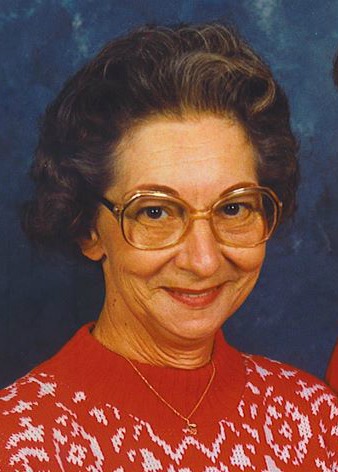
The photo in his obituary, and one other in that of his wife’s obituary, are the only 2 photos I have of Paul. You can read about my adventure in discovering through DNA how I figured out Paul was my great-grandfather here. After 3 years of composing a letter, I did reach out to Paul’s daughter to see if she could share with me what he was like as I’m quite curious. I mailed the letter out in early to mid-July and have not heard anything. To say I’m bummed is an understatement, but I understand. It took me 3 years to summon the courage to mail that letter to her simply because I was afraid of rocking her world. But to my knowledge, I don’t think Paul had any idea he had a child with Mildred. But it doesn’t lessen my curiosity at all.

But going back to that photo above, his cheekbones. My grandmother had those cheekbones. My cousin does as well, then again, she really looks like my grandma.

Here is a photo of my Grandmother, Alberta Lou Fleming. She had these taken some time in the 1990s. From my personal collection.

I’m still hopeful I’ll hear from Paul’s daughter, my half-grand-aunt. Not only did I ask what Paul was like, but Clyde, George, and Ruth as well. I want to know about all of them, I wish I could get answers about his mother, Gertrude, but that is pretty much a lost cause unless I come across another family historian who talked to people years ago.

I am gathering up names to do another genealogical visit to the Summit County Health Department to gather birth and death certificates, and Paul is on my list to discover what his cause of death was.

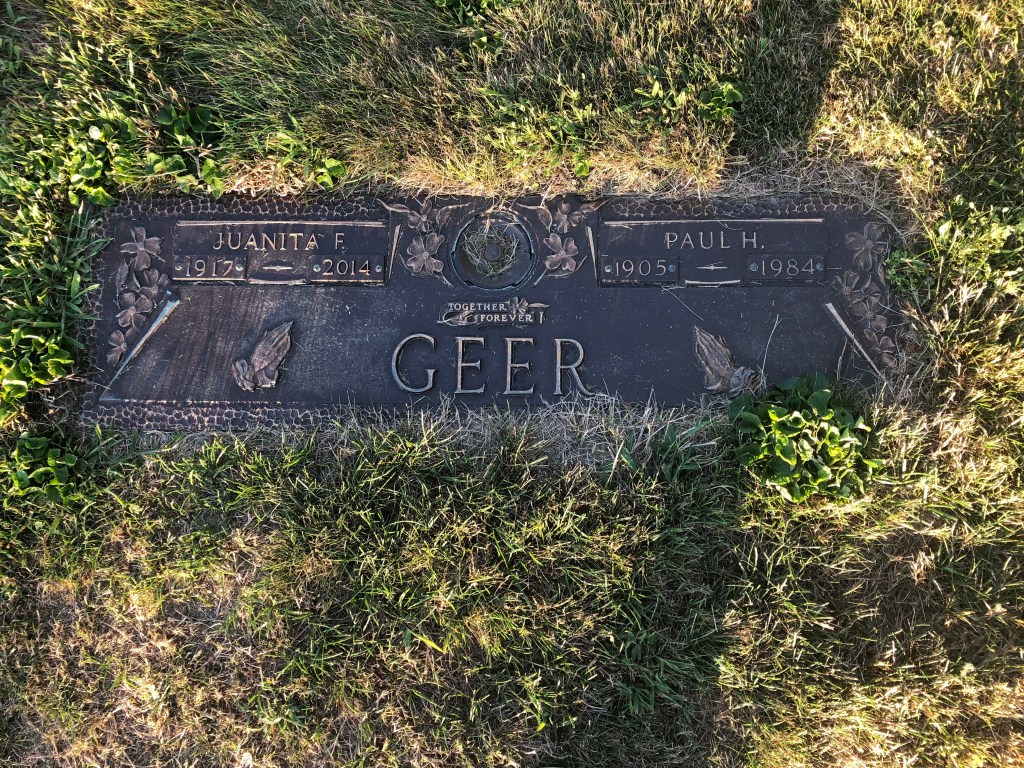
To finish this up properly my hubby and I went out to Greenlawn Memorial Park where Paul and his wife, Juanita are buried. It took us about 50 minutes to find his grave as the layout of section Y was a bit challenging, but for me worth it. You always get that feeling of closeness when you are near your departed relative, even if you never met them in person.

My own personal photo of the headstone of Paul & Juanita Geer from Greenlawn Memorial Park in Akron, Ohio, taken 12 August 2022

I’m glad I took the time to do this timeline about Paul Harrison Geer. From the comments on his wife Juanita’s obituary, they seemed like a very nice couple, which led to my coming around about him not being as bad as the divorce document states. In the end, isn’t being a good person what you want to learn about your ancestors?

Book

The Woman They Could Not Silence by Kate Moore

Though in the midst of reading a book about George Washington and Thomas Jefferson, I went to the online offerings of my local library to see if there was anything that could interest me. I discovered “The Woman They Could Not Silence” by Kate Moore and became sucked in immediately.

Elizabeth Packard

The book is the story of housewife, Elizabeth Packard. She was the wife of minister Theophilus Packard, who was a bit more of a free spirit compared to his more conservative religious views. Elizabeth, having been a teacher before marrying Theophilus, felt that women were equal to men. Trouble was this was 1860 and not too many others felt this way.

So Theophilus did what many men were doing in 1860, he began making a case that Elizabeth was insane. Soon he had a majority of the town stating the same, and on 18 June 1860 Elizabeth was carried from her home to the train station where her husband then accompanied her to Jacksonville, Illinois where the Illinois State Hospital was, leaving her six children behind (Theophilus III, aka Toffey, Isaac, Samuel, Libby, George, and Arthur).

What Elizabeth discovered once she was settled in the asylum were many women who had been admitted by their husbands who were perfectly sane. Dr. McFarland, the superintendent of the Jacksonville asylum initially thought her sane, but as Elizabeth began to despise her husband for locking her up, this is when McFarland began to view her has mad, how could she be angry at her husband? I’ve scratched my head many times as this was referenced repeatedly in the book, trying to figure out how obtuse a person could be to not see why she would hate her husband for locking her up.

Life in the asylum goes from bad to worse as she is moved to a harsher Ward. One of the ways that Elizabeth kept her sanity in the asylum was by writing. And it was also the way McFarland found to punish her, he’d take her paper away. She still found ways to write, often hiding her pages within her linings of her clothes, trunks, and even in the back of her mirror. She recorded the things she had seen and heard.

Life After the Asylum

Elizabeth is finally released by the trustees 18 June 1863, being considered “incurable”. Her husband didn’t allow her to return home, taking her to her cousin’s home to live. Theophilus told her she was not to return to her family. Initially she listens and stays with her cousin Angeline, but then after four months opts to defy her husband.

On 20 October 1863 Elizabeth returns home to Manteno, to be with her children. As I read this I remember becoming full of dread, the only way I can describe it is like when you’re reading a Nicholas Spark’s novel and you just sit there waiting for the bad things to happen. This is the same way I felt when I read Elizabeth was returning to her home. You see, before she left the asylum there were rumors that Theophilus was going to send her to a far worse hospital located in Massachusetts, so why would she risk it? Well, easy, a woman loves her babies.

And though it took a while, eventually Theophilus locked her in her room again, without heat, hoping to once again commit her. But Elizabeth outsmarted him with her “four meddlesome friends” as he called them, by obtaining a “writ of habeas corpus” where a person being held prisoner was to be brought before a judge and have a reason to be held hostage in her own home. Theophilus tried to once again convince the judge that Elizabeth was insane. But there was one huge difference this time, the judge made him prove it.

My Summary

Elizabeth Packard was an eloquent woman who made it her life’s mission to prevent women from being incarcerated in insane asylums for no reason. She made it so each woman would have a trial before being committed and truly made a difference. Though her name is not as common as Susan B. Anthony or Elizabeth Cady Stanton, she did create legislation that helped women all across the United States.

If you are looking for a book that will have you rooting for the underdog and wanting a positive ending, look no further. I’ve tried to highlight Elizabeth’s story but didn’t want to go into details and give it away. The book was nicely done using quotes from many of Elizabeth’s books that she wrote that she initially used “crowdfunding” to produce. Drawings within the book showed you what Elizabeth looked like, her husband and children, along with their house in Manteno.

In the future I plan on reading Kate Moore’s other popular book, “Radium Girls”.

12 Ancestors in 12 Months, Paternal Side

Month #6: Conflict

One of things I wish I could achieve in my genealogical journey would be to join a lineage society, specifically Daughters of the American Revolution (as I am a huge fan of the Revolutionary War). However, with this goal also lies one of my largest conflicts in my family history as I would like to join under my 5th-great-grandfather, Peter Morgart, simply because this is through my Grandma Blair’s (Anna Maria Morgart) family, as I had always had a special bond with her and my obsession with genealogy began as I was missing her back on 10 August 2016, and I signed up with FamilySearch and the rest is now history.

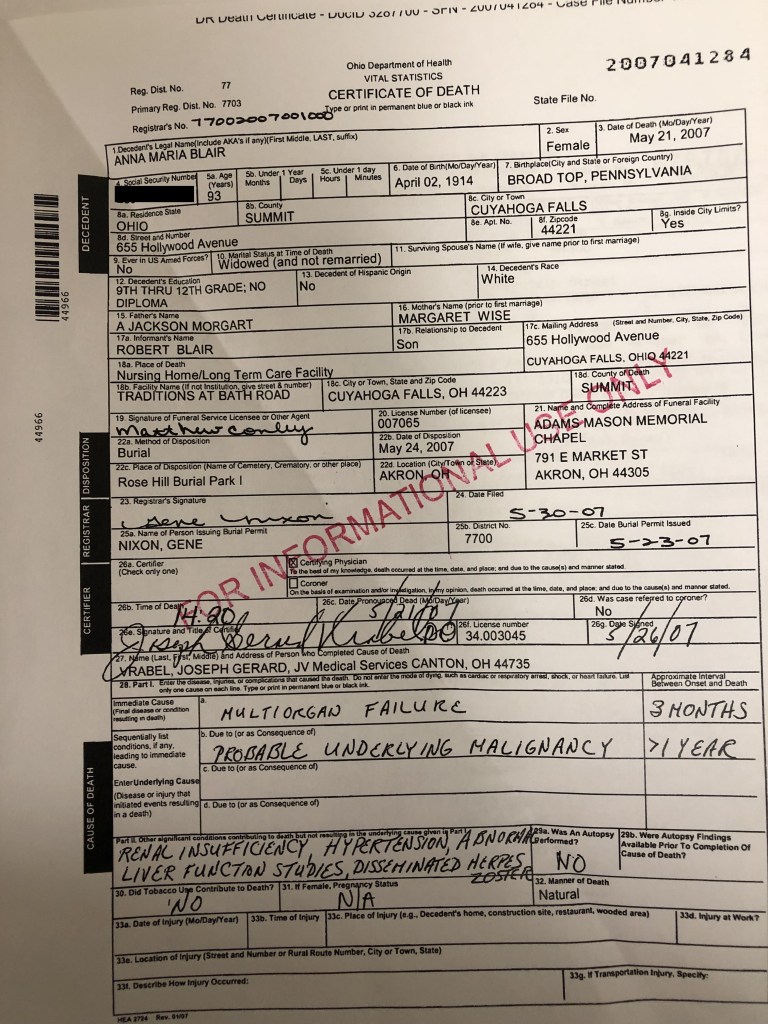
My conflict exists because both my Grandmother’s birth certificate and death certificate have the same incorrect name listed for her father. Instead of the correct name of Charles Jackson Morgart, A Jackson Morgart is listed instead.

Certificate of Birth for Anna Maria Morgart, obtained through the Pennsylvania State Archives
Death Certificate of Anna Maria (Morgart) Blair obtained at the Summit County Health Department

Now, in my dad’s defense, who was the informant on her death certificate, his paternal grandfather’s name was Andrew Jackson Blair, so I can relate to his boo-boo in his time of grief. But no one was more surprised than me when I ordered up my Grandmother’s birth certificate from the Pennsylvania Historic and Museum Commission back in January 2020 to find her dad’s name would once again be listed as A Jackson Morgart instead of Charles Jackson Morgart.

To cause me more grief is the fact that Charles Jackson Morgart committed suicide on 24 July 1917, and with my Grandmother being born on 2 April 1914, there is no census that has both listed on the same document as father and daughter. I’ve also never found an obituary or death notice in the newspaper to shed light on his death, so nothing that would state that he had a daughter named Anna Maria Morgart (or at least not yet).

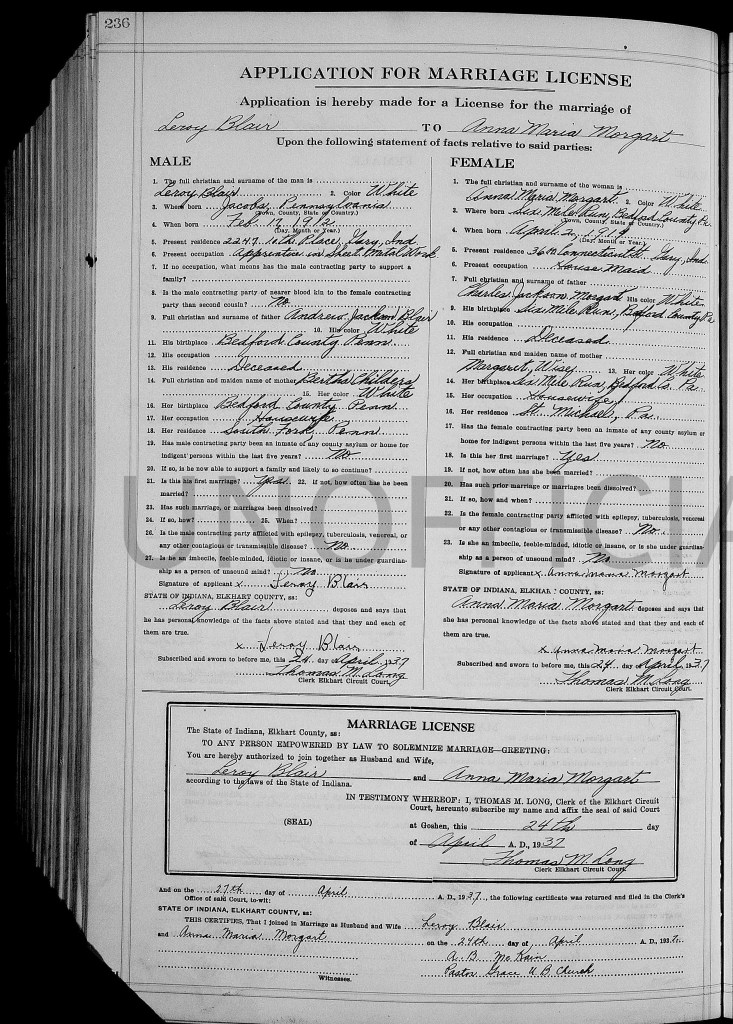
I do have her marriage license that states her father’s name is Charles Jackson Morgart, but would that document be enough?

The above marriage certificate was found on FamilySearch as part of Indiana Marriages, 1811-2007

I suppose if I needed more evidence I could hope that the birth certificate for his older son, Charles Edward Morgart, which does have the correct name listed would work, and that I could hope that I have a DNA match with one of his descendants which could give me the argument I need to prove I am his great-granddaughter, and connect me to the rest of the lineage that would lead to Peter Morgart.

Has anyone out there in cyberspace had this sort of genealogical problem? How did you get around it? Is the marriage license enough?

12 Ancestors in 12 Months, Genealogy

Month#5: Social

For the 12 Ancestors in 12 Months challenge for this month the word is “social”. I find myself talking about myself again but it’s because I am not a social type of person. I am an introvert to the nth degree, and this is a part of my personality that I really need to work on if I am going to be the person I truly want myself to be.

Why did this come about now? Because last night I learned that on 6 June 2022 one of my older relatives passed away. I feel horrible as my dad always thought to call her later in the day and with her being 88 he didn’t want to call at that moment in time and wake her up. When he couldn’t reach her I threw her name into Google and her obituary came up. And then I cried as I had met Hope on more than one occasion, and she was a lovely woman. My most recent meeting was when I went back to Pennsylvania in 2019 as she was excited to share with me the photo she had of her great-grandparents, my 2nd-great-grandparents. You see, Margaret Hope Dipko was my first cousin once removed on my dad’s side of the family.

As the memes on social media highlight, “a library has been lost”. Because of Covid I wasn’t able to get back to Pennsylvania and ask Hope questions I should have asked about my Wise side of the family. I thought she may have had answers about the Morgart side as I was semi-focused on them when I visited in 2019 but she was unaware. I wasn’t prepared for Wise questions and now I’ll never know (she attended the Wise Family Reunions with my grandmother years ago).

So, in honor of Hope, I am going to learn to get out of my comfort zone and begin talking to people. I’ll start out locally and begin interviewing those I know, (but do I really know them?) in order to practice on those I am not as familiar with. I’m going to make sure I interview my relatives and be more social and learn as much from those who are still here. Genealogy is a social hobby, how else am I going to fill in all those dashes, the important part of a person’s vital statistics.

Go be social. Talk to your relatives. All of them. You never know what kind of wonderful information is lurking in someone’s memory just waiting to entertain you with a fabulous story about their life. One of the best ways you can honor your relatives/ancestors is to keep their spirit alive by sharing the story of their life.

12 Ancestors in 12 Months, Maternal Side

Month 4: Check It Out

I have to laugh even now that I have completed half of the local cemeteries that I need to visit. I laugh because it was 3 years ago this week I packed up my husband and a few belongings and we headed 4 hours away to Pennsylvania to do a cemetery hop, some research at the Bedford County Historical Society, and went to the Courthouse to view probate records and deeds of the ancestors on my paternal side.

What is comical is that I haven’t accomplished any of those things for my ancestors who lived here in Akron, Ohio. So, this past Saturday I began by visiting 2 of 5 local cemeteries where my ancestors are buried. I flew solo this time as my husband was assisting with parking for the Bridgestone Seniors Golf Tournament at Firestone Country Club. I can admit I truly missed the second set of eyes. It began getting a little toasty so I stopped, knowing that I can finish up at a later time because that’s what happens when you are visiting cemeteries close to home. The urgency is not there because who knows when you will return (which has been the case for me and Pennsylvania during this time of Covid).

Chestnut Hill Memorial Park

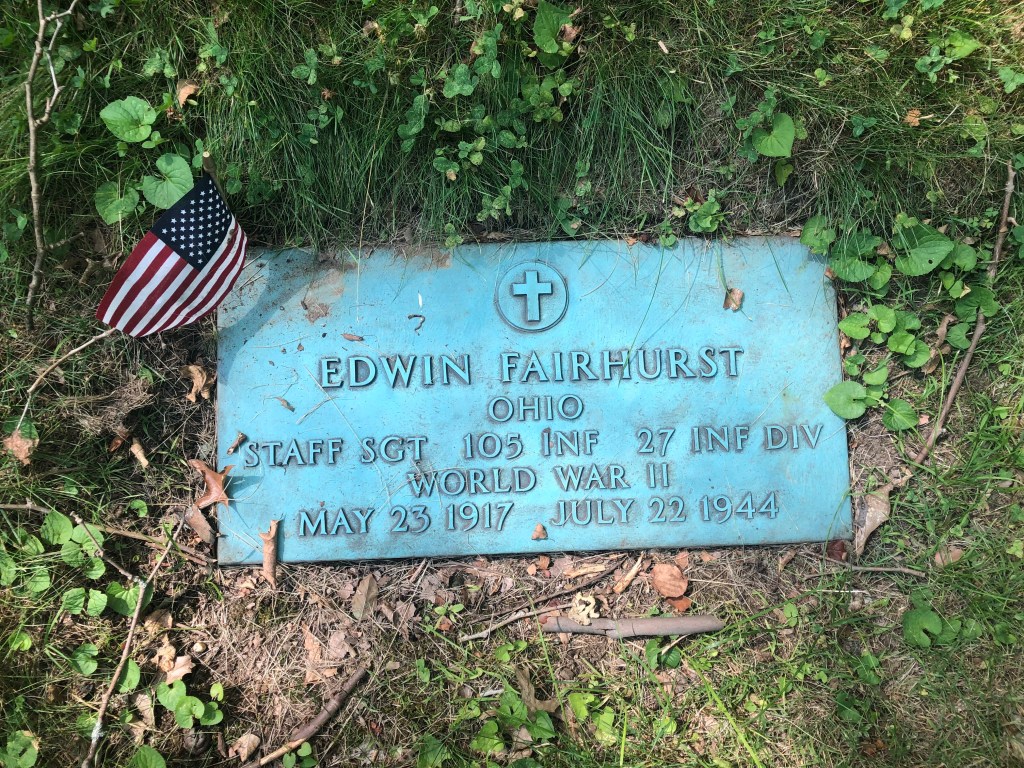
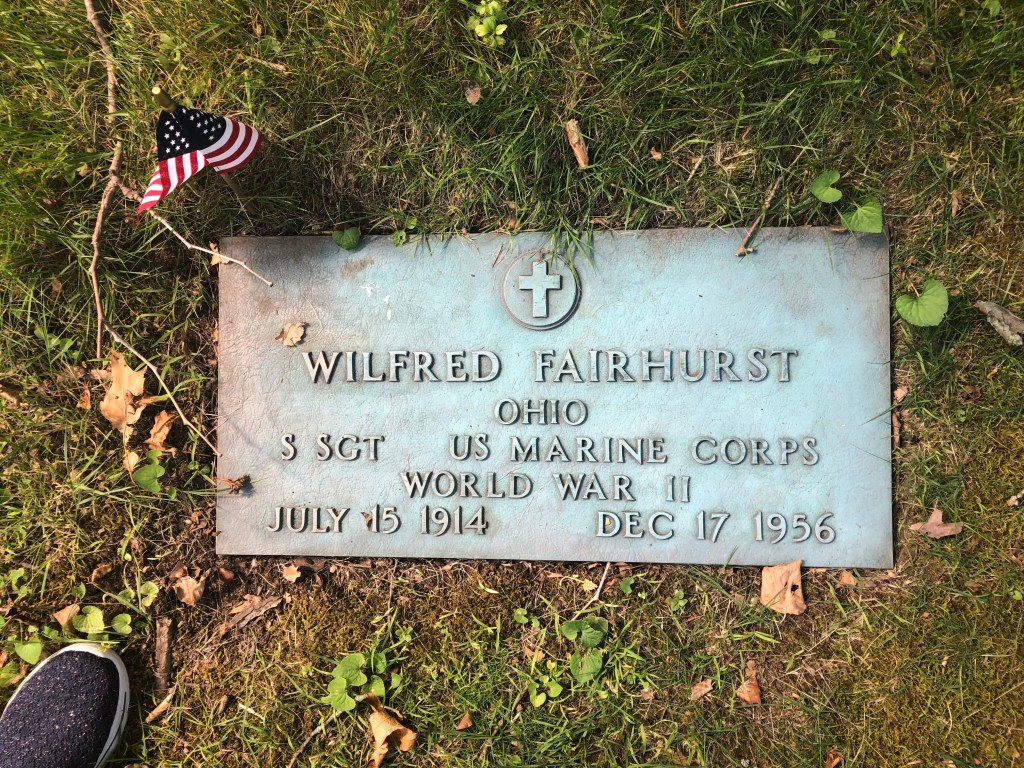
My first stop of the day was Chestnut Hill Memorial Park where my maternal granduncles were both buried. Edwin Fairhurst was killed in Saigon during World War II while his older brother, Wilfred, died in 1956. Wilfred also fought in World War II for the Marines and was in Saigon when his brother, who was in the Army, was killed.

Oakwood Cemetery

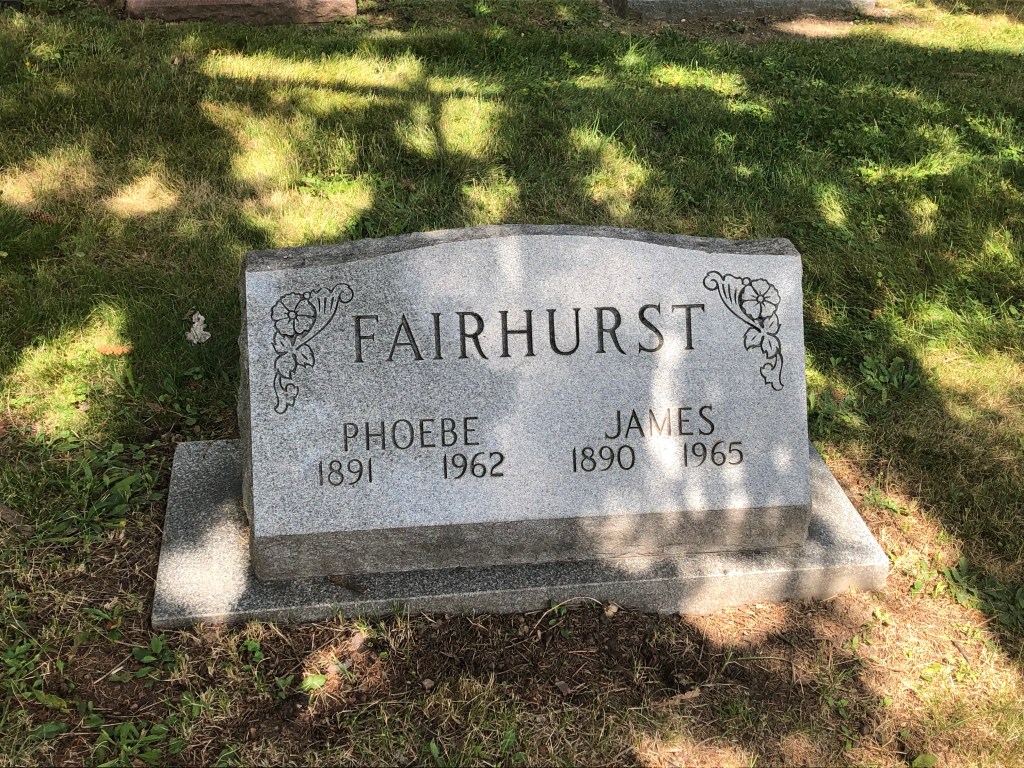
Oakwood Cemetery was literally the cemetery about 5 minutes (driving) from where I grew up. I passed it every day on my drive to Cuyahoga Falls High School as Oakwood Drive was the street both my dad and neighbor took to take me to school for all 4 years. The interesting part was that my great-grandparents, James Fairhurst and Phoebe Boone Fairhurst were buried not far from the fence that I drove next to every day. They were who I searched for first as I entered the larger than it seems cemetery in the middle of the suburban city of Cuyahoga Falls.

The Fairhurst’s

It was interesting. I wasn’t sure how to react to their gravestone. As I felt so sad for the death of their sons (Wilfred and Edwin were their children), it was more complicated for them. My grandfather, their youngest son, was never a very nice person. He was physically abusive to his wives and children. As I’ve picked up stories about James and Phoebe, all those stories aren’t very promising either. Maybe I’m mistaken to blame his cruelty on them, but sometimes things just start and never end. I believe this is why I’ve never been big on trying to find out more about this branch of my family. Granted, it takes me to England right away as both James and Phoebe came here in the early 20th century, but it’s hard to get excited for people who you hear of just not being nice.

The Dailey’s

The next stop in my cemetery adventure was looking for the headstone of Andrew Dailey and Maria Munson Dailey, who I am pretty sure are my 4th-great-grandparents on my maternal grandmother’s side of the family.

I haven’t really learned a whole lot about Andrew Dailey and Maria Munson. This is one of those things I plan on delving into as I settle back down into focusing on my research. I know Andrew was born in this area back in 1814 so he has been a settler here in this area for a very long time. Researching here in Ohio will be a change of pace, as I am so use to Pennsylvania.

The gravestone was very worn and if there were words are the other sides they were completely washed away. Andrew passed away in 1886, Maria in 1898.

Albert Nank

I opted to include Albert William Nank as I knew he was buried in Oakwood Cemetery. Albert is the man named on my maternal grandmother’s birth certificate as her father, but to my knowledge I have not discovered any DNA evidence from when I took my test 3 years ago to support that. That’s why I have the Dailey’s above, they are branched off of who I think is really her father’s family.

But I began looking for my 7th-grade-teacher’s final resting place and I remembered that Albert was not buried far from him. He was still my great-grandmother’s second husband so I guess he deserves to be memorialized as well, even if he wasn’t very nice either. I think he knew he wasn’t her dad but must have thought it wasn’t his place to say so.

I know I’m probably not suppose too, but I do wish I could take a weed whacker to his headstone so you can see it in its entirety again.

Mr. Muster

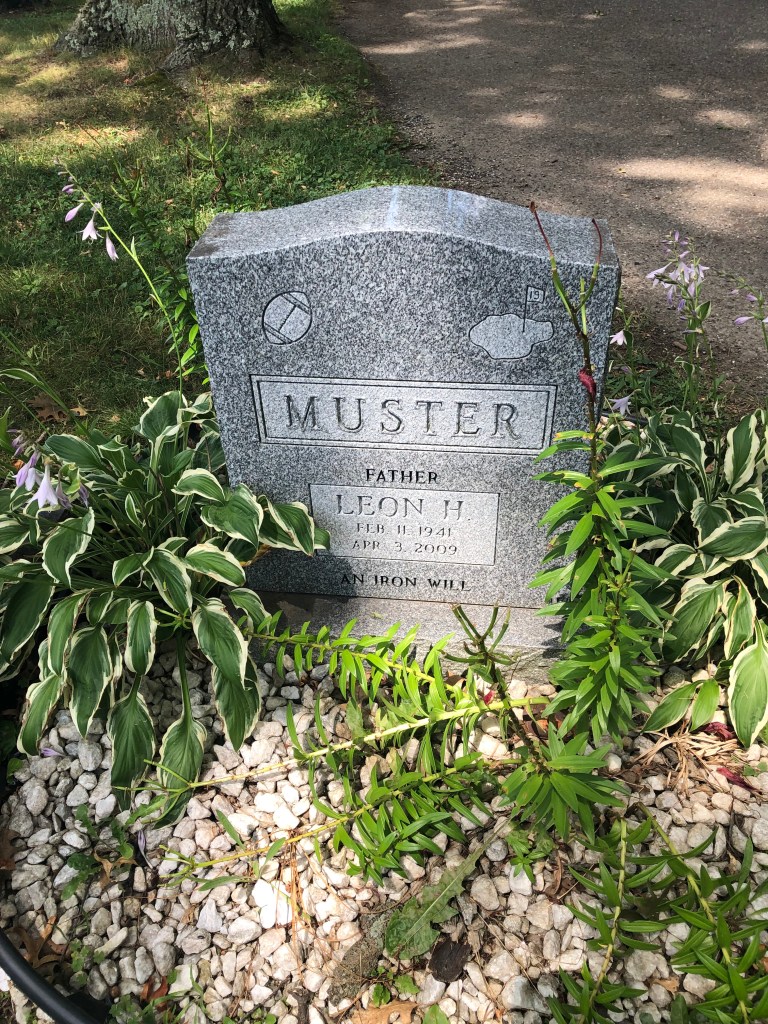
This last one is not a relative of mine, but rather my favorite teacher. I had Mr. Muster for a combination of geography and Ohio History in 7th grade at Roberts Middle School. He was a teacher that you either loved or hated, there was seldom an in-between. My sister did not have Mr. Muster but her good friend did. Heidi told horror stories about how mean Mr. Muster was. She was heavy-set and apparently he gave her a hard time about that. I found this odd as he himself was heavy-set. And he smoked a pipe. We had B lunch so our class went a half hour, we had lunch, and then we had another half hour, and I always remember the smell of his pipe when we returned to class.

I don’t remember much about the geography portions of class except the Africa test. It was a map test and you went up and pulled a slip of paper from a hat and you selected which test you would take. You then went up in front of the entire class and had to point out where things were. I lucked out and pulled the easiest one – so I had to point out the Nile River, Egypt, South Africa, and Zaire… all the really big and easy things to find. My friend Pam ended up selecting the most difficult test…. I don’t even remember what was on it but I was prepared and wish I could have helped her.

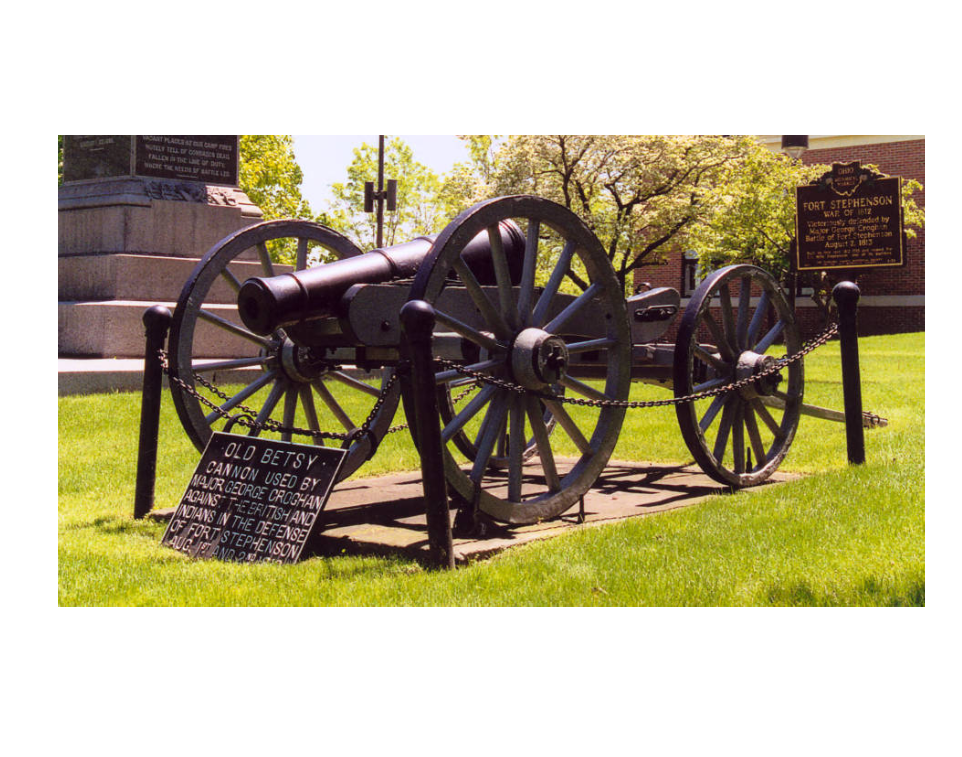
Ohio History was the fun part of class. I love history. And there was a cannon that was famous in Ohio named Old Betsy (gosh, I can’t remember why?) and Mr. Muster had a cannon that he claimed was a replica and he began shooting it in class with caps (like what was used in cap guns). I had a similar cannon at my grandma’s so I brought it in one day and fired back. He asked me if my cannon had a name, I said yes, Victory. So he then went on to inspect his own cannon, all we could find was “Made in Taiwan”.

Mr. Muster’s son was also in the same grade as my sister, so I hunted him down at graduation that night to discover how I did on my final exam. I’d missed 2. But that I found him was quite a feat as the Richfield Colosseum was huge (it no longer exists) and my sister had a very large class (but not as big as my mom’s).

I went back and visited Mr. Muster often as I went to high school. It’s amazing how teacher’s really have that impact on you. I had a few in high school and my favorite English teacher is someone I am friends with on Facebook (he taught my all-time favorite class – Enriched World Literature – it’s where I began my love of classical music).

Old Betsy

I just Googled “Old Betsy Cannon” and it was used at Fort Stephenson during the War of 1812. It was the only cannon the fort had so Major George Croghan decided to move it around the fort to make it appear that they had more fire power than they did. In the end 150 British and Native Americans were killed and the United States only lost 1 soldier. You can learn more here.

I found this photo of Old Betsy at Ohio Memory.
12 Ancestors in 12 Months, Genealogy, My Family Tree

Month 3: Females

The dynamic between mothers and daughters is one of the most intense relationships that I feel has ever been developed. I’m not sure why, exactly. I know for the past year especially I have had more issues with my daughter than I have at any other period of her life. Between skipping school, arguments about grades (apparently I’m offensive because I wanted C’s or higher? To be fair my son gives me the same amount of lip about it and as a person who got more A’s than C’s in high school, I feel I’m being generous), and the latest one seems to be about curfew (so angry at this she up and left a month ago and has yet to return, I’m quite confident she isn’t coming back, my hubby seems to hold out hope – she feels she is 18 and doesn’t need a time to be home, I feel she is living in my house and should still follow some rules, but let me add I’ve included if she just lets us know where she is she can stay out later, just let us know when you’re going to be home). But I digress.

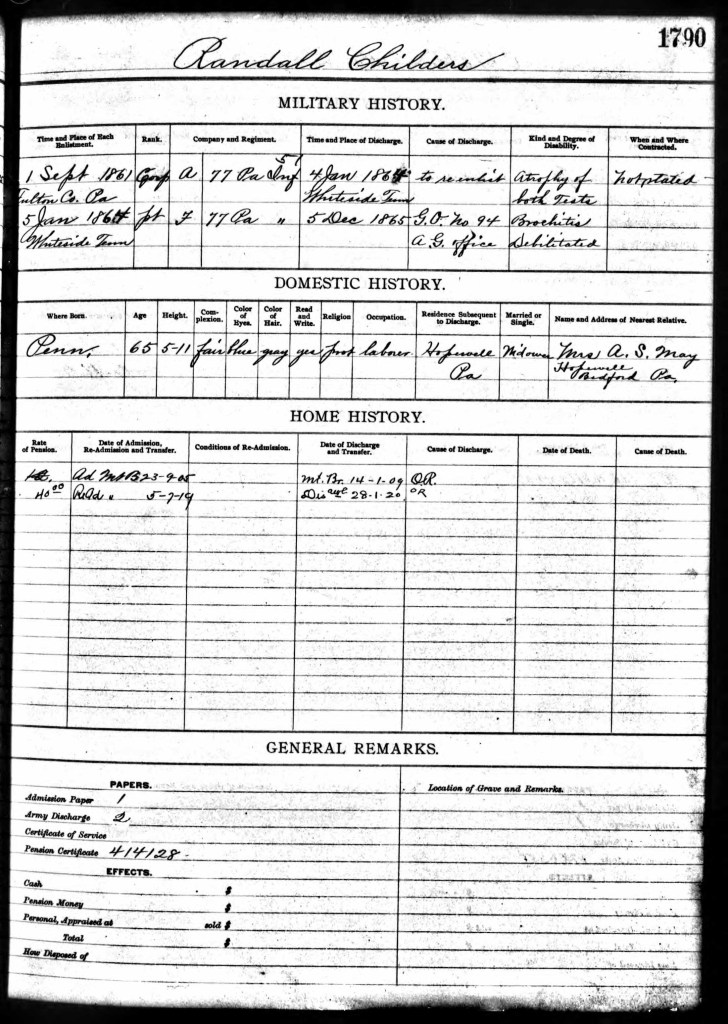
I remember a year or so ago when I was researching my second-great-grandfather, Randall Childers, that one of his daughters knew where he was at when he up and left Pennsylvania and moved to Tennessee. Well, maybe I am overstating, I’m not sure if Jennie Childers May knew where her father had relocated, but seeing her name as the “next of kin” on his paperwork was a surprise to me.

I remember when first finding the memorial for Sara Jane Fesler on Find A Grave where in the paragraph below it stated the “issues” that Randall and Sara had in their marriage. When I saw that Randall had died in Tennessee, I just assumed he’d left his family behind for a different life. I was never approving of his marrying a second time, and I always wondered what Sara thought. Was she happy he was gone? Sad? Mad? I could see myself going back and forth between the latter two emotions.

But for some reason things changed for me when I found a document on Ancestry from the US Homes for Disabled Soldiers that noted in 1905 that Randall was a widower and that his next of kin was Mrs. A. S. May, I was somewhat blown away. I suppose there is that chance she had no idea… but what if Jennie knew? I don’t think I’d be happy if my dad told the government my mom was dead when she wasn’t.

But what if Jennie didn’t get along with Sara? What if she was a daddy’s girl? (As I myself am). Did she know of her dad’s new life in Tennessee? Did she keep such information from her mother? Did Sara even want to know? These are questions I’ll never have the answer too.

My own situation has really got me thinking about my own ancestors and how well all the mothers and daughters got along. I believe my mom got along with my grandma pretty well, at least I don’t recall her getting into any big kerfuffle with her. Now my older sister and my mom use to get into it, I didn’t as much but I watched and learned. I saw how mouthing off to my mother didn’t get my sister anywhere, so I would make my mom mad by sitting there and just letting her get her anger out. I often thought my mom wouldn’t even be that mad at my sister, she was just looking for someone to argue with and she happened to be an easy target. Well, maybe that’s being a bit too blunt, my mom knew exactly what to do to push my sister’s buttons. And frankly, my sister did the same to my mom.

I feel that females have much stronger emotions compared to men. Granted part of that could just be our ability to overthink everything. And I believe that these feelings tend to get the best of us, but this is what makes us females so wonderful.

Did you have some feisty females in your family? Feel free to share in the comments below.

Genealogy

Stuck in a Rut?

Have you ever found yourself constantly trying to solve brick wall and really not getting anywhere with it? I have found myself in this situation before, normally involving Andrew Blair and Susanna Akers but this time around it’s on my mom’s side of the family with Oliver Charles Warner and trying to prove that Joel Warner and Thankful Chapin are his parents. Every new angle seems to lead to a dead end.

So I began with a simple task that did not even involve researching, it was running a report in my family tree program and finding out which relatives I needed the FamilySearch number for. And it was a good task for me to do as 12 pages of individuals and I’m halfway done. This is a task where you can feel proud if you can figure out on your own where a specific person actually lies on your tree. Sometimes I’m doing fist pumps in the air in a congratulatory way, other times I’m slapping my forehead questioning how I could have forgotten someone.

Inspiration via YouTube

I’ve also tried watching videos. Late last year I became a member of AmericanAncestors.org and along with a great website I’m slowly acclimating myself to, I find myself heading over to their YouTube page and watching videos. I opted to watch an interview they had with Brian Matthew Jordan, a history professor at Sam Houston University who is originally from Northeast Ohio. He wrote a book called “A Thousand May Fall: An Immigrant Regiment’s Civil War” about an Ohio regiment made up of German’s fighting in the Civil War. I’ll admit my mom was a nurse at his doctor’s office as a kid and she always thought it neat his love of history at such a young age, I believe as a teen he wrote a book on Franklin Pierce, simply because no one else had (that may be an overstatement, but he is one of the president’s hardly written about).

Anyhow, I digress, he mentioned in his talk about if you don’t have any information about your ancestor and what they went through during a war, in this case he was referencing the Civil War, he spoke of researching through newspapers and looking up stories in relation to the regiment that your ancestor was in, because many smaller towns received information about the war from the letters that the soldiers would send home to their loved ones. So, this is my latest endeavor, as I have not been able to obtain my pension file from the National Archives due to it being closed, I am going to search for the Company K 13th Regiment of New York Heavy Artillery that my 3rd Great Grandfather, Winfield Warner, fought in during the Civil War to obtain more information on what he faced.

The AmericanAncestors.org video from their American Inspiration series when Brian Matthew Jordan spoke about his book “A Thousand May Fall: An Immigrant Regiment’s Civil War”

Okay, so maybe my new topic to take my mind off of my brick walls is not so far away from my brick wall (Winfield Warner is the youngest son of Oliver Charles Warner), but I think it will be fascinating to delve into a period of history that I am not as familiar with (I was always more of a Revolutionary War girl myself).

You never know where inspiration can hit you. If you have an hour, watch the above video, it was really interesting. Dr. Jordan was a great speaker and really highlighted a lot of details as he has written a few books on the Civil War. And I hope to share what I find on the Company K 13th Regiment out of New York with you all soon.

Maternal Side, My Family Tree, Paternal Side

Who Did You Find in the 1950 Census?

Ever since the clock struck midnight on Friday, April 1 the genealogical world has gone crazy trying to find their ancestors in the newly released 1950 census. Were you prepared to know where you had to search for your loved ones? I was a last-minute person, looking up the enumeration district for my mom and giving my dad a call to find out what state he was living in when 1950 rolled around. You see this was the first census my parents are in so I will admit I was a little excited.

I contemplated staying up until midnight when it was released to the world, but I was so tired I knew I wouldn’t have been able to stay awake that long. So, I made sure I got up at my usual 6:11am (the time I normally get up to get ready when my kids are going to school, they happened to be on Spring Break last week, so I was able to sleep in an extra hour), got ready, ate early and made sure I had a good solid hour before having to head out the door to focus on the 1950 census.

My Mom

Of my parents, finding my mom was a little easier. I thought initially she and her parents were already living on North Main Street in Akron, Ohio but I was wrong. I am glad I took the time to look up their information in the City Directory to find them living in Cuyahoga Falls, which is where I myself was born and raised (and it’s literally a 2-minute drive in either direction from where I live presently). It made it even easier for me to find except I selected the wrong enumeration district. Where they lived on Second Street there were multiple choices. It was odd though, I never had paid attention that they lived there before and here I drove by where their house was every day when I took my kids to school, or when I was a member of the Natatorium a few years back. (It appears that it’s a vacant lot where the building once stood).

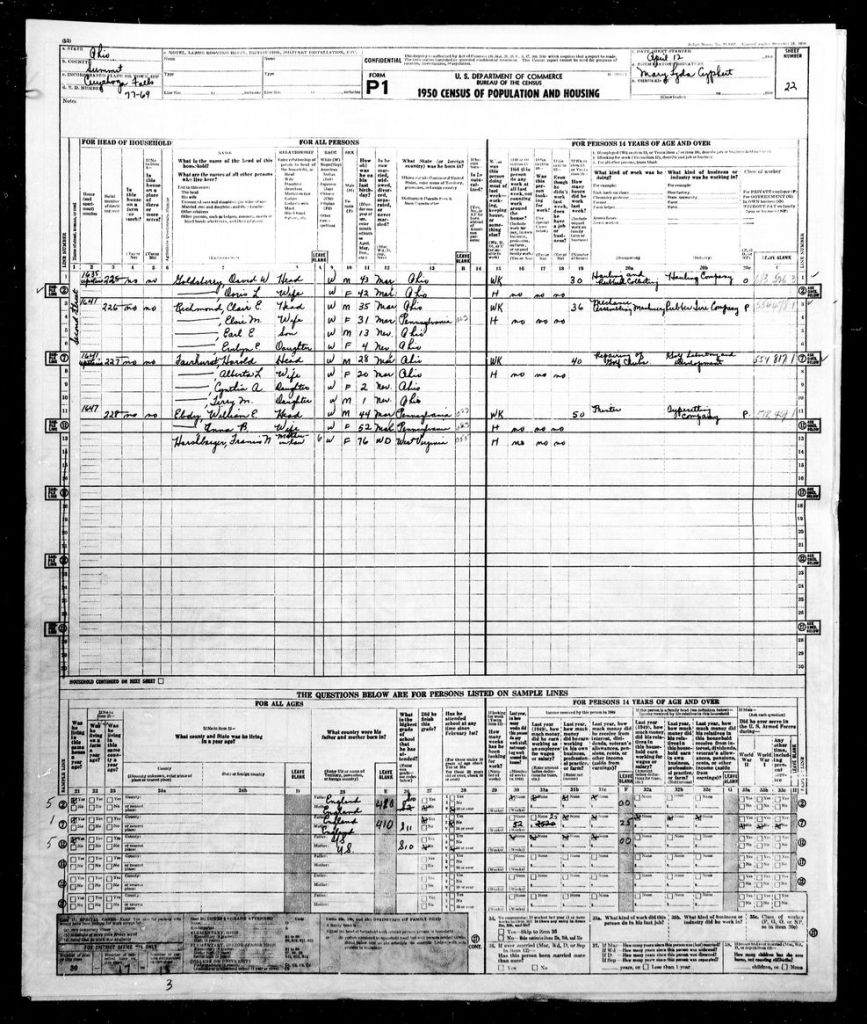
I found my Mom in the 1950 using the National Archives website in enumeration district 77-69 for Summit County, Ohio. They were of course on the very last page. Harold Fairhurst was the head of household.

On my mom’s side of the family, I found her parents, Harold Fairhurst, Alberta Lou Fairhurst, herself, Cynthia Anne Fairhurst, and her younger sister, Terry (Teri) Mildred Fairhurst.

My Dad

My dad was a little trickier. I had called him the night before to ask if he knew if they were in Ohio yet, or if they (he and his parents) were still living in Indiana. My dad would have been 7 in 1950 and apparently all of his schooling was here in Ohio, so that narrowed it down. However, when they first moved to Ohio, they didn’t live in Akron, they lived in the Village of Lakemore, which was near Akron. This is one of those places that I have heard of, but I am not sure if I have ever been there.

I threw “Lakemore” into the enumeration district page to see if anything came up, but it wasn’t helpful. Luckily Google exists. I searched Lakemore, Ohio and luckily it came up and I was able to discover the zip code for it.

I then went to the Ancestry.com and they had a tool you could throw in your zip code and such and it would provide the enumeration districts for the area. So, I put in 44250 and I was able to narrow my search to 77-114, 115, 116, or 117, which translates to about 100 total pages to scan.

I lucked out, they were halfway through 115, and not only did I find my dad and grandparents, but my grandfather’s brother was living right next door with two of their kids as well! So, the total family I found for my dad was his dad, Leroy Blair, his mom, Anna Maria Morgart, his uncle, Donald Blair, his aunt, Anna Smzrlich, and two of their children.

My grandfather, Leroy Blair, is about 4 people down and is the head of household. This can be found at the National Archives website.

Everybody Else

I’ll admit I have hundreds of people I am sure I need to look up and find in the 1950 census. My great-grandparents on all sides of my family would have all been alive and kicking still, but I’m more than happy to wait until I can search by name and save it that way. I figure if I come across someone else that I just need to find, I will, but I have time (and not fully understanding the layout of Pennsylvania towns, who knows how long it would take me to find them).

Did you enjoy the fun of finding your ancestors in the 1950 census? How many people did you find? Share in the comments below!